Unit of Comparative Medicine, Caribbean Primate Research Center, University of Puerto Rico - Medical Sciences Campus, San Juan, PR, USA; Department of Microbiology and Medical Zoology, University of Puerto Rico - Medical Sciences Campus, San Juan, PR, USA; Department of Internal Medicine, University of Puerto Rico - Medical Sciences Campus, San Juan, PR, USA.
Faculdade de Medicina de Sao Jose do Rio Preto, SP, Brazil.
Trends Microbiol. 2018 Mar;26(3):186-190. doi: 10.1016/j.tim.2017.10.004. Epub 2017 Nov 6.
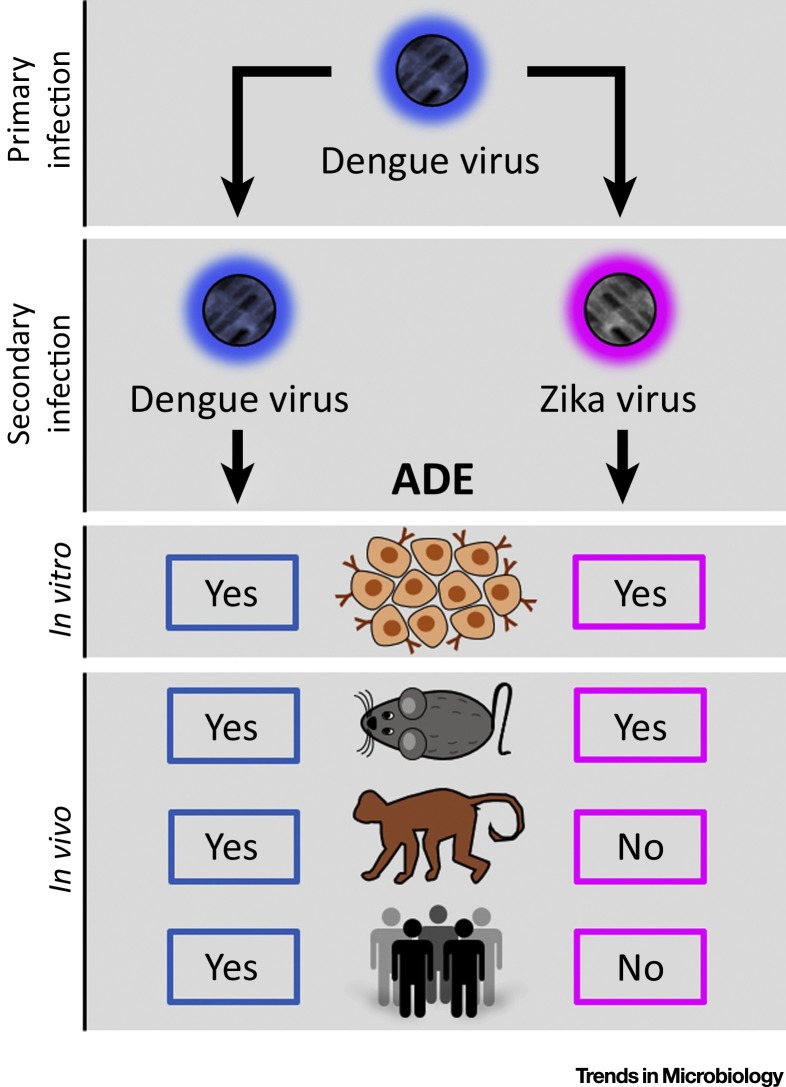
The rise of Zika virus (ZIKV) and its unusual clinical manifestations provided ground for speculative debate. The clinical severity of secondary dengue virus (DENV) infections is associated with antibody-dependent enhancement (ADE), and it was recently suggested that previous exposure to DENV may worsen ZIKV clinical outcomes. In this Opinion article we analyze the relationship among different flaviviruses and ADE. We discuss new evidence obtained in non-human primates and human cohorts demonstrating that there is no correlation to ADE when ZIKV infection occurs in the presence of pre-existing DENV immunity. We propose a redefinition of ADE in the context of complex immunological flavivirus interactions to provide a more objective perspective when translating in vitro or in vivo observations into the clinical setting.
寨卡病毒(ZIKV)的兴起及其不寻常的临床表现引发了推测性的争论。二次登革热病毒(DENV)感染的临床严重程度与抗体依赖性增强(ADE)有关,最近有人提出,先前接触 DENV 可能会使 ZIKV 的临床结果恶化。在这篇观点文章中,我们分析了不同黄病毒之间以及与 ADE 的关系。我们讨论了在非人类灵长类动物和人类队列中获得的新证据,这些证据表明,当存在预先存在的 DENV 免疫时,ZIKV 感染与 ADE 无关。我们提出在复杂的免疫性黄病毒相互作用的背景下重新定义 ADE,以便在将体外或体内观察结果转化为临床环境时提供更客观的视角。