Carlson Colin J, Dougherty Eric R, Getz Wayne
Department of Environmental Science, Policy, and Management, University of California, Berkeley, Berkeley, California, United States of America.
School of Mathematical Sciences, University of KwaZulu-Natal, Durban, South Africa.
PLoS Negl Trop Dis. 2016 Aug 26;10(8):e0004968. doi: 10.1371/journal.pntd.0004968. eCollection 2016 Aug.
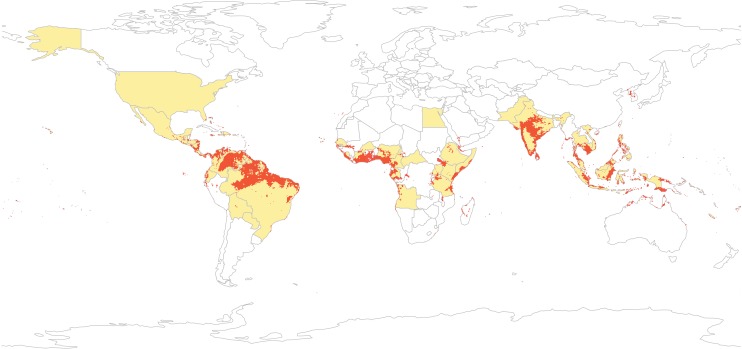
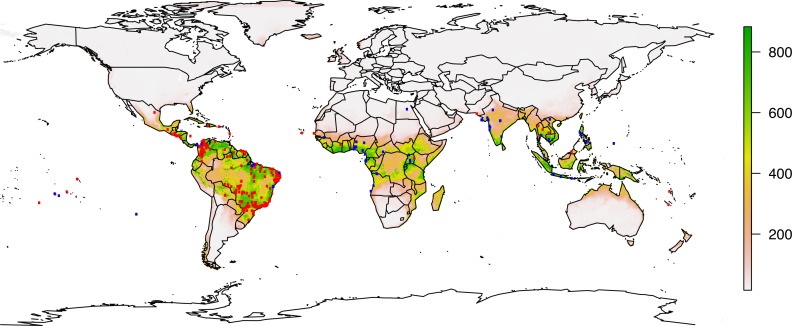
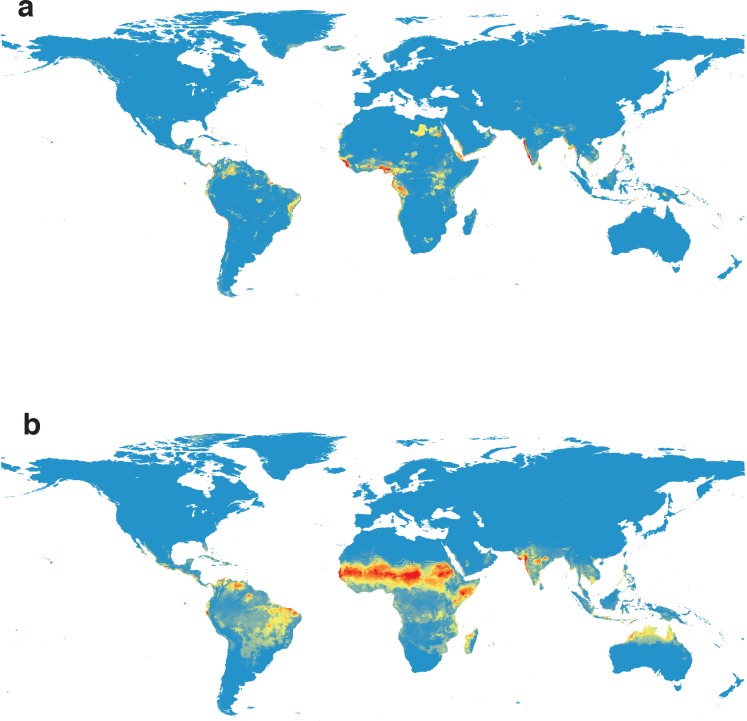
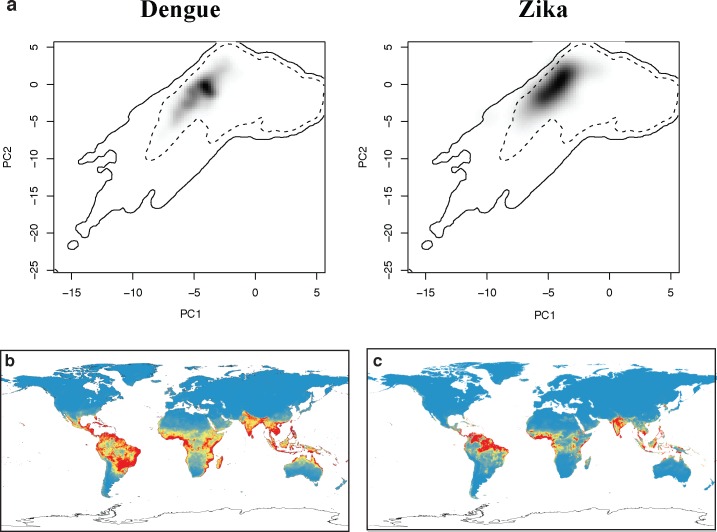
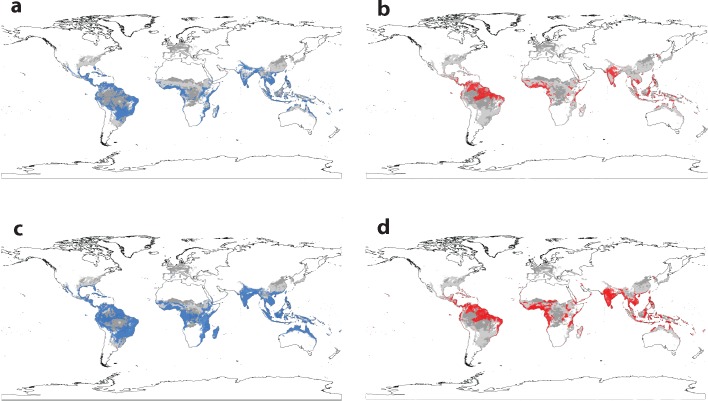
The current outbreak of Zika virus poses a severe threat to human health. While the range of the virus has been cataloged growing slowly over the last 50 years, the recent explosive expansion in the Americas indicates that the full potential distribution of Zika remains uncertain. Moreover, many studies rely on its similarity to dengue fever, a phylogenetically closely related disease of unknown ecological comparability. Here we compile a comprehensive spatially-explicit occurrence dataset from Zika viral surveillance and serological surveys based in its native range, and construct ecological niche models to test basic hypotheses about its spread and potential establishment. The hypothesis that the outbreak of cases in Mexico and North America are anomalous and outside the native ecological niche of the disease, and may be linked to either genetic shifts between strains, or El Nino or similar climatic events, remains plausible at this time. Comparison of the Zika niche against the known distribution of dengue fever suggests that Zika is more constrained by the seasonality of precipitation and diurnal temperature fluctuations, likely confining autochthonous non-sexual transmission to the tropics without significant evolutionary change. Projecting the range of the diseases in conjunction with three major vector species (Aedes africanus, Ae. aegypti, and Ae. albopictus) that transmit the pathogens, under climate change, suggests that Zika has potential for northward expansion; but, based on current knowledge, our models indicate Zika is unlikely to fill the full range its vectors occupy, and public fear of a vector-borne Zika epidemic in the mainland United States is potentially informed by biased or limited scientific knowledge. With recent sexual transmission of the virus globally, we caution that our results only apply to the vector-borne transmission route of the pathogen, and while the threat of a mosquito-carried Zika pandemic may be overstated in the media, other transmission modes of the virus may emerge and facilitate naturalization worldwide.
当前寨卡病毒的爆发对人类健康构成了严重威胁。虽然在过去50年里该病毒的传播范围一直在缓慢扩大,但近期在美洲地区的急剧扩张表明,寨卡病毒的潜在分布范围仍不明确。此外,许多研究依赖于它与登革热的相似性,登革热是一种在系统发育上密切相关但生态可比性未知的疾病。在此,我们根据寨卡病毒在其原生范围内的监测和血清学调查,汇编了一个全面的空间明确的发生数据集,并构建生态位模型来检验关于其传播和潜在定殖的基本假设。目前,关于墨西哥和北美地区病例的爆发是异常的,且超出了该疾病原生生态位的假设,可能与毒株间的基因转移、厄尔尼诺或类似气候事件有关,这一假设仍有一定合理性。将寨卡病毒的生态位与登革热的已知分布进行比较表明,寨卡病毒受降水季节性和昼夜温度波动的限制更大,这可能将本地非性传播限制在热带地区,而不会发生重大进化变化。结合传播病原体的三种主要病媒物种(非洲伊蚊、埃及伊蚊和白纹伊蚊),在气候变化情况下预测疾病的传播范围,表明寨卡病毒有向北扩张的潜力;但是,根据目前的知识,我们的模型表明寨卡病毒不太可能占据其病媒所占据的全部范围,美国大陆民众对病媒传播寨卡病毒流行的恐惧可能是基于有偏差或有限的科学知识。鉴于最近该病毒在全球的性传播情况,我们提醒,我们的结果仅适用于病原体的病媒传播途径,虽然媒体可能夸大了蚊媒传播寨卡大流行的威胁,但该病毒的其他传播方式可能出现并促进其在全球范围内的自然化。