Liu Jian-Jun, Ghosh Sujoy, Kovalik Jean-Paul, Ching Jianhong, Choi Hyung Won, Tavintharan Subramaniam, Ong Choon Nam, Sum Chee Fang, Summers Scott A, Tai E Shyong, Lim Su Chi
Clinical Research Unit, Khoo Teck Puat Hospital, Singapore.
Duke-NUS Medical School, Singapore.
Kidney Int Rep. 2016 Dec 16;2(3):470-480. doi: 10.1016/j.ekir.2016.12.003. eCollection 2017 May.
Pathophysiology of diabetic kidney disease (DKD) is incompletely understood. We aim to elucidate metabolic abnormalities associated with DKD in type 2 diabetes mellitus (T2DM) by targeted plasma metabolomics.
A total of 126 T2DM participants with early DKD (urinary albumin-to-creatinine ratio [ACR] 30-299 mg/g and eGFR ≥ 60 ml/min/1.73 m), 154 overt DKD (ACR ≥ 300 mg/g or eGFR < 60 ml/min/1.73 m), and 129 non-DKD T2DM controls (ACR < 30 mg/g and eGFR ≥ 60 ml/min/1.73 m) were included in discovery study. Findings were subsequently validated in 149 T2DM with macroalbuminuria (ACR ≥ 300 mg/g) and 149 matched non-DKD T2DM controls. Plasma amino acid, acylcarnitine, Krebs cycle organic acid, and sphingolipids/ceramide levels were quantified by liquid chromatography-mass spectrometry and gas chromatography-mass spectrometry.
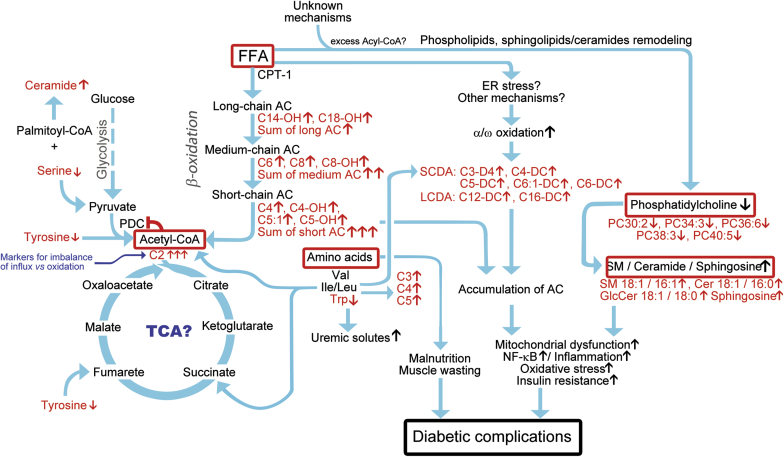
Of 123 metabolites included in the data analysis, 24 differed significantly between DKD and controls in the same direction in both discovery and validation subpopulations. A number of short acylcarnitines including their dicarboxylic derivatives (C2-C6) were elevated in DKD, suggesting abnormalities in fatty acids and amino acids metabolic pathways. Five phosphatidylcholines were lower whereas 4 metabolites in the sphingomyelin-ceramide subfamily were higher in DKD. Principal component regression revealed that long-chain ceramides were independently associated with ACR but not eGFR. Conversely, essential amino acids catabolism and short dicarboxylacylcarnitine accumulation were associated with eGFR but not ACR.
DKD is associated with altered fuel substrate use and remodeling of sphingolipid metabolism in T2DM with DKD. Associations of albuminuria and impaired filtration function with distinct metabolomic signatures suggest different pathophysiology underlying these 2 manifestations of DKD.
糖尿病肾病(DKD)的病理生理学尚未完全明确。我们旨在通过靶向血浆代谢组学阐明2型糖尿病(T2DM)中与DKD相关的代谢异常。
共有126例早期DKD的T2DM参与者(尿白蛋白与肌酐比值[ACR]为30 - 299 mg/g且估算肾小球滤过率[eGFR]≥60 ml/min/1.73 m²)、154例显性DKD患者(ACR≥300 mg/g或eGFR < 60 ml/min/1.73 m²)以及129例非DKD的T2DM对照者(ACR < 30 mg/g且eGFR≥60 ml/min/1.73 m²)纳入发现性研究。随后在149例伴有大量白蛋白尿(ACR≥300 mg/g)的T2DM患者和149例匹配的非DKD的T2DM对照者中对研究结果进行验证。通过液相色谱 - 质谱联用和气相色谱 - 质谱联用对血浆氨基酸、酰基肉碱、三羧酸循环有机酸以及鞘脂/神经酰胺水平进行定量分析。
在数据分析纳入的123种代谢物中,有24种在发现性子群体和验证性子群体中,DKD组与对照组之间均在相同方向上存在显著差异。包括其二羧酸衍生物(C2 - C6)在内的多种短链酰基肉碱在DKD组中升高,提示脂肪酸和氨基酸代谢途径存在异常。5种磷脂酰胆碱水平较低,而鞘磷脂 - 神经酰胺亚家族中的4种代谢物在DKD组中较高。主成分回归分析显示,长链神经酰胺与ACR独立相关,但与eGFR无关。相反,必需氨基酸分解代谢和短链二羧酸酰基肉碱蓄积与eGFR相关,但与ACR无关。
DKD与T2DM合并DKD时燃料底物利用改变和鞘脂代谢重塑有关。蛋白尿和滤过功能受损与不同代谢组学特征的关联提示DKD这两种表现形式背后存在不同的病理生理学机制。