Fuller Trevon L, Calvet Guilherme, Genaro Estevam Camila, Rafael Angelo Jussara, Abiodun Gbenga J, Halai Umme-Aiman, De Santis Bianca, Carvalho Sequeira Patricia, Machado Araujo Eliane, Alves Sampaio Simone, Lima de Mendonça Marco Cesar, Fabri Allison, Ribeiro Rita Maria, Harrigan Ryan, Smith Thomas B, Raja Gabaglia Claudia, Brasil Patrícia, Bispo de Filippis Ana Maria, Nielsen-Saines Karin
Institute of the Environment and Sustainability, University of California Los Angeles, Los Angeles, California, United States of America.
Instituto Nacional de Infectologia Evandro Chagas, Fundação Oswaldo Cruz, Rio de Janeiro, Brazil.
PLoS One. 2017 Nov 16;12(11):e0188002. doi: 10.1371/journal.pone.0188002. eCollection 2017.
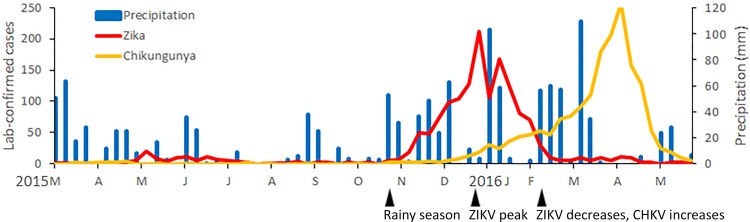
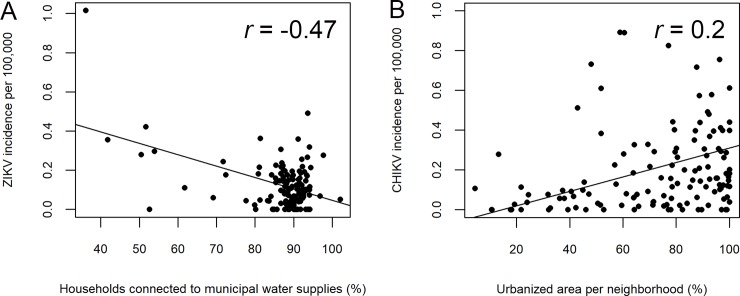
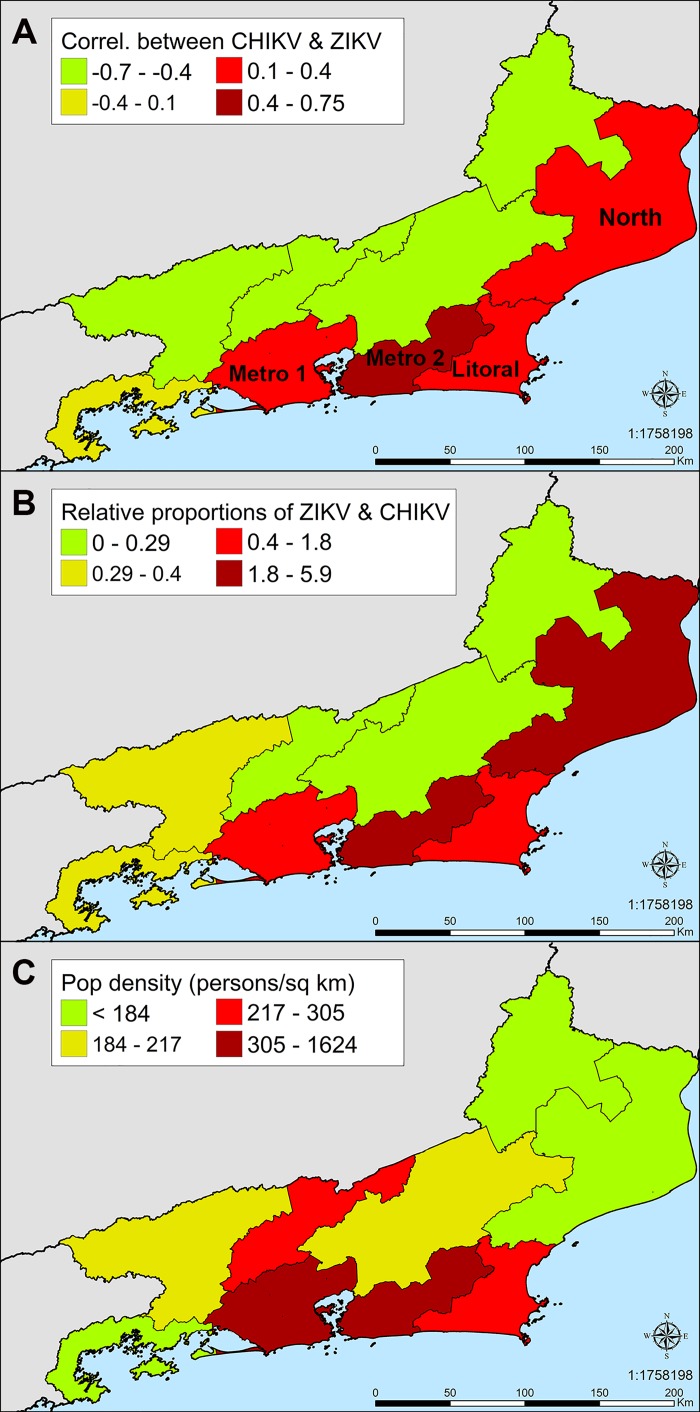
The burden of arboviruses in the Americas is high and may result in long-term sequelae with infants disabled by Zika virus infection (ZIKV) and arthritis caused by infection with Chikungunya virus (CHIKV). We aimed to identify environmental drivers of arbovirus epidemics to predict where the next epidemics will occur and prioritize municipalities for vector control and eventual vaccination. We screened sera and urine samples (n = 10,459) from residents of 48 municipalities in the state of Rio de Janeiro for CHIKV, dengue virus (DENV), and ZIKV by molecular PCR diagnostics. Further, we assessed the spatial pattern of arbovirus incidence at the municipal and neighborhood scales and the timing of epidemics and major rainfall events. Lab-confirmed cases included 1,717 infections with ZIKV (43.8%) and 2,170 with CHIKV (55.4%) and only 29 (<1%) with DENV. ZIKV incidence was greater in neighborhoods with little access to municipal water infrastructure (r = -0.47, p = 1.2x10⁻⁸). CHIKV incidence was weakly correlated with urbanization (r = 0.2, p = 0.02). Rains began in October 2015 and were followed one month later by the largest wave of ZIKV epidemic. ZIKV cases markedly declined in February 2016, which coincided with the start of a CHIKV outbreak. Rainfall predicted ZIKV and CHIKV with a lead time of 3 weeks each time. The association between rainfall and epidemics reflects vector ecology as the larval stages of Aedes aegypti require pools of water to develop. The temporal dynamics of ZIKV and CHIKV may be explained by the shorter incubation period of the viruses in the mosquito vector; 2 days for CHIKV versus 10 days for ZIKV.
美洲地区虫媒病毒的负担很重,可能会导致长期后遗症,如因感染寨卡病毒(ZIKV)而致残的婴儿以及因感染基孔肯雅病毒(CHIKV)而引发的关节炎。我们旨在确定虫媒病毒流行的环境驱动因素,以预测下一次疫情将在何处发生,并为病媒控制和最终的疫苗接种确定优先的城市地区。我们通过分子PCR诊断技术,对里约热内卢州48个城市居民的血清和尿液样本(n = 10459)进行了基孔肯雅病毒、登革热病毒(DENV)和寨卡病毒的筛查。此外,我们评估了城市和社区尺度上虫媒病毒发病率的空间格局以及疫情和主要降雨事件的时间。实验室确诊病例包括1717例寨卡病毒感染(43.8%)、2170例基孔肯雅病毒感染(55.4%)以及仅29例(<1%)登革热病毒感染。在获得城市供水基础设施机会较少的社区,寨卡病毒发病率更高(r = -0.47,p = 1.2×10⁻⁸)。基孔肯雅病毒发病率与城市化呈弱相关(r = 0.2,p = 0.02)。降雨始于2015年10月,一个月后迎来了最大规模的寨卡病毒疫情浪潮。寨卡病毒病例在2016年2月显著下降,这与基孔肯雅病毒疫情的开始相吻合。降雨每次都提前3周预测了寨卡病毒和基孔肯雅病毒的疫情。降雨与疫情之间的关联反映了病媒生态学,因为埃及伊蚊的幼虫阶段需要积水才能发育。寨卡病毒和基孔肯雅病毒的时间动态可能是由于病毒在蚊媒中的潜伏期较短;基孔肯雅病毒为2天,而寨卡病毒为10天。