Lim Su Yin, Lee Jenny H, Welsh Sarah J, Ahn Seong Beom, Breen Edmond, Khan Alamgir, Carlino Matteo S, Menzies Alexander M, Kefford Richard F, Scolyer Richard A, Long Georgina V, Rizos Helen
Faculty of Medicine and Health Sciences, Macquarie University, Sydney, Australia.
Melanoma Institute Australia, Sydney, Australia.
Biomark Res. 2017 Nov 10;5:32. doi: 10.1186/s40364-017-0112-9. eCollection 2017.
Selective kinase and immune checkpoint inhibitors, and their combinations, have significantly improved the survival of patients with advanced metastatic melanoma. Not all patients will respond to treatment however, and some patients will present with significant toxicities. Hence, the identification of biomarkers is critical for the selection and management of patients receiving treatment. Biomarker discovery often involves proteomic techniques that simultaneously profile multiple proteins but few studies have compared these platforms.
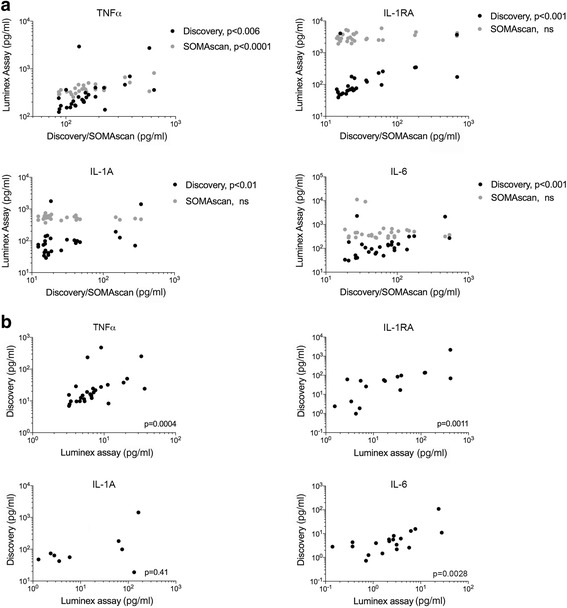
In this study, we used the multiplex bead-based Eve Technologies Discovery assay and the aptamer-based SomaLogic SOMAscan assay to identify circulating proteins predictive of response to immunotherapy in melanoma patients treated with combination immune checkpoint inhibitors. Expression of four plasma proteins were further validated using the bead-based Millipore Milliplex assay.
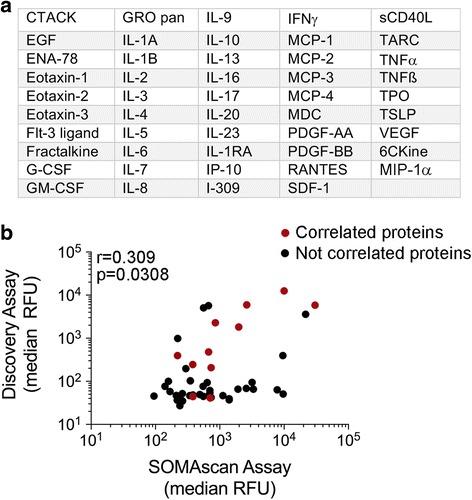
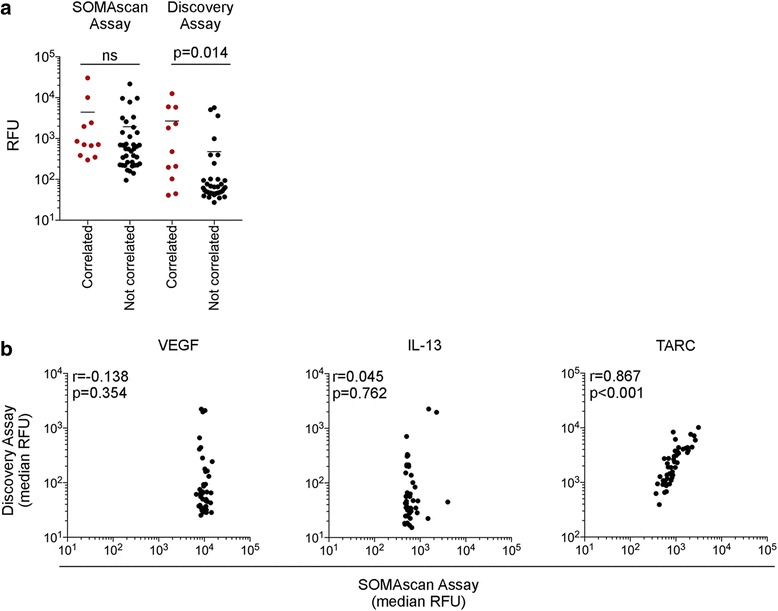
Both the Discovery and the SOMAscan assays detected circulating plasma proteins in immunotherapy-treated melanoma patients. However, these widely used assays showed limited correlation in relative protein quantification, due to differences in specificity and the dynamic range of protein detection. Protein data derived from the Discovery and Milliplex bead-based assays were highly correlated.
Our study highlights significant limitations imposed by inconsistent sensitivity and specificity due to differences in the detection antibodies or aptamers of these widespread biomarker discovery approaches. Our findings emphasize the need to improve these technologies for the accurate identification of biomarkers.
选择性激酶和免疫检查点抑制剂及其联合使用显著提高了晚期转移性黑色素瘤患者的生存率。然而,并非所有患者都会对治疗产生反应,一些患者会出现严重的毒性反应。因此,生物标志物的识别对于接受治疗患者的选择和管理至关重要。生物标志物的发现通常涉及同时对多种蛋白质进行分析的蛋白质组学技术,但很少有研究对这些平台进行比较。
在本研究中,我们使用基于多重微珠的伊芙技术发现分析方法和基于适配体的索马逻辑公司SOMAscan分析方法,来识别接受联合免疫检查点抑制剂治疗的黑色素瘤患者中对免疫治疗有反应的循环蛋白。使用基于微珠的密理博公司Milliplex分析方法进一步验证了四种血浆蛋白的表达。
发现分析方法和SOMAscan分析方法均检测到了接受免疫治疗的黑色素瘤患者的循环血浆蛋白。然而,由于特异性和蛋白质检测动态范围的差异,这些广泛使用的分析方法在相对蛋白质定量方面显示出有限的相关性。来自发现分析方法和基于微珠的Milliplex分析方法得到的蛋白质数据高度相关。
我们的研究突出了这些广泛使用的生物标志物发现方法因检测抗体或适配体的差异而导致的敏感性和特异性不一致所带来的重大局限性。我们的研究结果强调需要改进这些技术以准确识别生物标志物。