Emerg Infect Dis. 2017 Dec;23(13):S15-24. doi: 10.3201/eid2313.170898.
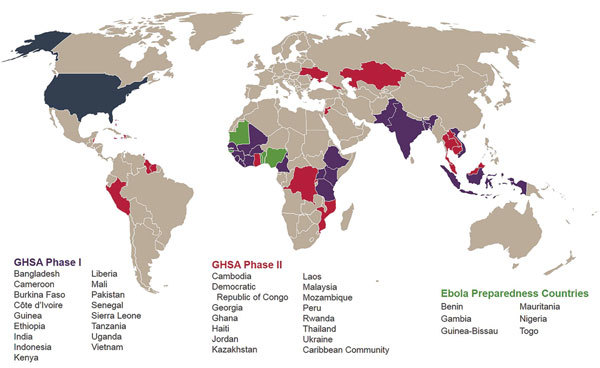
The Global Health Security Agenda (GHSA), a partnership of nations, international organizations, and civil society, was launched in 2014 with a mission to build countries' capacities to respond to infectious disease threats and to foster global compliance with the International Health Regulations (IHR 2005). The US Centers for Disease Control and Prevention (CDC) assists partner nations to improve IHR 2005 capacities and achieve GHSA targets. To assess progress through these CDC-supported efforts, we analyzed country activity reports dating from April 2015 through March 2017. Our analysis shows that CDC helped 17 Phase I countries achieve 675 major GHSA accomplishments, particularly in the cross-cutting areas of public health surveillance, laboratory systems, workforce development, and emergency response management. CDC's engagement has been critical to these accomplishments, but sustained support is needed until countries attain IHR 2005 capacities, thereby fostering national and regional health protection and ensuring a world safer and more secure from global health threats.
全球卫生安全议程(GHSA)是一个由国家、国际组织和民间社会组成的伙伴关系,于 2014 年启动,其使命是建立各国应对传染病威胁的能力,并促进全球遵守《国际卫生条例(2005 年)》。美国疾病控制与预防中心(CDC)协助伙伴国家提高《国际卫生条例(2005 年)》能力并实现 GHSA 目标。为了通过这些 CDC 支持的努力评估进展情况,我们分析了 2015 年 4 月至 2017 年 3 月的国家活动报告。我们的分析表明,CDC 帮助 17 个第一阶段国家实现了 675 项重大 GHSA 成就,特别是在公共卫生监测、实验室系统、劳动力发展和应急管理等跨领域。CDC 的参与对这些成就至关重要,但需要持续支持,直到国家实现《国际卫生条例(2005 年)》能力,从而促进国家和地区的健康保护,并确保世界更安全,免受全球卫生威胁。