Department of Neuroradiology, Klinikum rechts der Isar, Technische Universität München, Ismaningerstrasse 22, 81675 Munich, Germany; TUM-Neuroimaging Center (TUM-NIC), Klinikum Rechts der Isar, Technische Universität München TUM, Ismaninger Strasse 22, 81675 Munich, Germany; Windach Institute and Hospital of Neurobehavioural Research and Therapy (WINTR), Windach, Schützenstraße 100, 86949 Windach, Germany.
Department of Neuroradiology, Klinikum rechts der Isar, Technische Universität München, Ismaningerstrasse 22, 81675 Munich, Germany; TUM-Neuroimaging Center (TUM-NIC), Klinikum Rechts der Isar, Technische Universität München TUM, Ismaninger Strasse 22, 81675 Munich, Germany; Windach Institute and Hospital of Neurobehavioural Research and Therapy (WINTR), Windach, Schützenstraße 100, 86949 Windach, Germany.
Neuroimage Clin. 2017 Nov 8;17:474-480. doi: 10.1016/j.nicl.2017.11.006. eCollection 2018.
The hippocampus has recently been identified to play a key role in the pathophysiology of adult obsessive-compulsive disorder (OCD). Surprisingly, there is only limited evidence regarding the potential relationships with symptom dimensions. Due to the heterogeneity of symptoms in OCD, we aimed at further examining, whether hippocampal volume differences might be related to symptom profiles instead of single symptom dimensions.
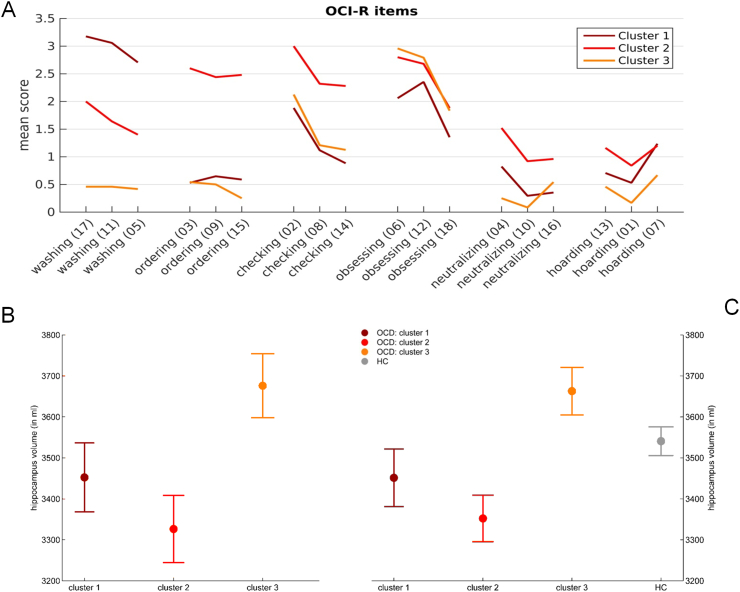
In order to find out more about the potential association between clinical symptom profiles and alterations in hippocampal volume we categorized a large sample of OCD patients ( = 66) into distinct symptom profile groups using K-means clustering. In addition, hippocampal volumes of the different symptom profile groups were compared with hippocampal volumes in a sample of 66 healthy controls.
We found significant differences in hippocampal volume between the different symptom profile groups which remained significant after correcting for age, sex, total intracranial volume, OCI-total score, depression, medication, disease duration and scanner. The patient group characterized by overall lower symptom scores and without high symptom severity in any specific domain showed the highest hippocampal volume. Finally, the comparison with healthy controls demonstrated significantly lower hippocampal volumes in those patients whose symptom profile was characterized by a high severity of ordering and checking symptoms.
Present results provide further confirmation for alterations in hippocampus structure in OCD and suggest that symptom profiles which take into account the multi-symptomatic character of the disorder should be given greater attention in this context.
海马体最近被确定在成人强迫症(OCD)的病理生理学中发挥关键作用。令人惊讶的是,关于其与症状维度之间的潜在关系的证据有限。由于 OCD 症状的异质性,我们旨在进一步研究海马体积的差异是否可能与症状特征而不是单一症状维度相关。
为了更深入地了解临床症状特征与海马体积改变之间的潜在关联,我们使用 K-均值聚类法将大量 OCD 患者(n=66)分为不同的症状特征组。此外,还将不同症状特征组的海马体积与 66 名健康对照组的海马体积进行了比较。
我们发现不同症状特征组之间的海马体积存在显著差异,在对年龄、性别、总颅内体积、OCI 总分、抑郁、药物、疾病持续时间和扫描仪进行校正后,这些差异仍然显著。以整体较低的症状评分且在任何特定领域都没有高严重程度为特征的患者组显示出最高的海马体积。最后,与健康对照组的比较显示,那些症状特征以高排序和检查症状严重程度为特征的患者的海马体积显著较低。
目前的结果进一步证实了 OCD 中海马体结构的改变,并表明在这种情况下,应更加关注考虑到疾病多症状特征的症状特征。