Yao Fei, Yang Shan, Wang Zhirui, Wang Xue, Ye Ji, Wang Xugao, DeBruyn Jennifer M, Feng Xue, Jiang Yong, Li Hui
CAS Key Laboratory of Forest Ecology and Management, Institute of Applied Ecology, Chinese Academy of Sciences, Shenyang, China.
University of Chinese Academy of Sciences, Beijing, China.
Front Microbiol. 2017 Oct 27;8:2071. doi: 10.3389/fmicb.2017.02071. eCollection 2017.
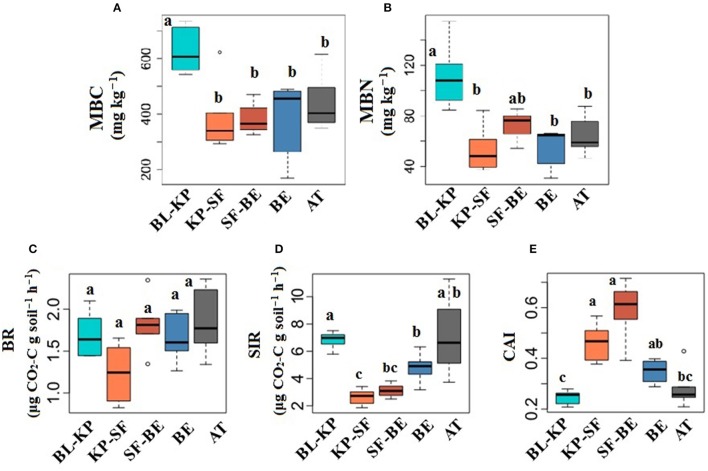
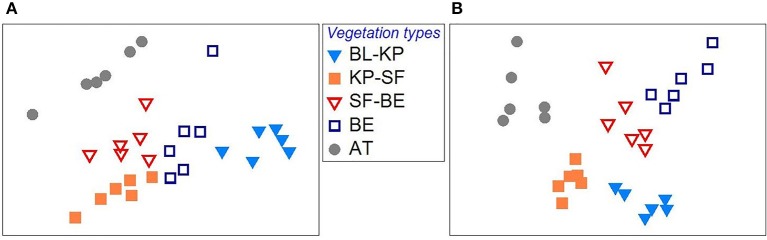
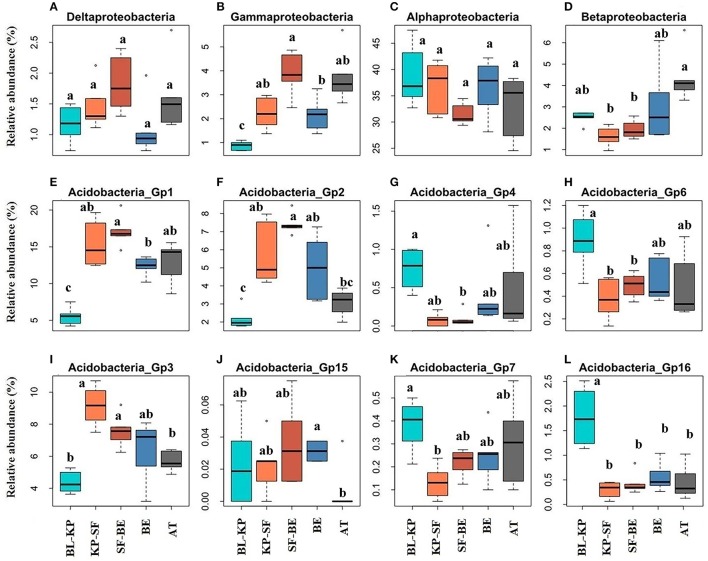
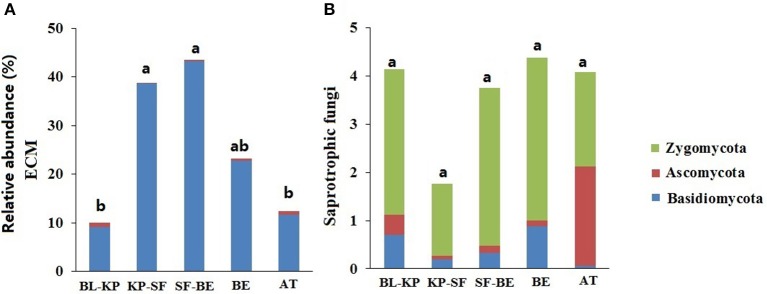
The elevational pattern of soil microbial diversity along mountain slopes has received considerable interest over the last decade. An increasing amount of taxonomic data on soil microbial community composition along elevation gradients have been collected, however the trophic patterns and environmental drivers of elevational changes remain largely unclear. Here, we examined the distribution patterns of major soil bacterial and fungal taxa along the northern slope of Changbai Mountain, Northeast China, at five typical vegetation types located between 740 and 2,691 m above sea level. Elevational patterns of the relative abundance of specific microbial taxa could be partially explained by the oligotrophic-copiotrophic theory. Specifically, two dark-coniferous forests, located at mid-elevation sites, were considered to be oligotrophic habitats, with relatively higher soil C/N ratio and [Formula: see text]-N concentrations. As expected, oligotrophic microbial taxa, belonging to the bacterial phyla Acidobacteria and Gemmatimonadetes, and fungal phylum Basidiomycota, were predominant in the two dark-coniferous forests, exhibiting a mid-elevation maximum pattern. In contrast, the broad leaf-Korean pine mixed forest located at the foot of the mountain, -dominated forest located below the tree line, and alpine tundra at the highest elevation were considered more copiotrophic habitats, characterized by higher substrate-induced-respiration rates and [Formula: see text]-N concentrations. Microbial taxa considered to be so called copiotrophic members, such as bacterial phyla Proteobacteria and Actinobacteria, and fungal phylum Ascomycota, were relatively abundant in these locations, resulting in a mid-elevation minimum pattern. At finer taxonomic levels, the two most abundant proteobacterial classes, alpha- and beta-Proteobacteria, along with Acidobacteria Gp1, 2, 3, 15, and the Basidiomycotal class of Tremellomycetes were classified with the copiotrophic group. Gamma- and delta-Proteobacteria, Acidobacteria Gp4, 6, 7, 16, and Basidiomycotal class of Agaricomycetes were classified as oligotrophic taxa. This work uses the oligotrophic-copiotrophic theory to explain the elevational distribution pattern of the relative abundance of specific microbial taxa, confirming some of the existing trophic classifications of microbial taxa and expanding on the theory to include a broader range of taxonomic levels.
在过去十年中,土壤微生物多样性沿山坡的海拔格局备受关注。沿着海拔梯度,关于土壤微生物群落组成的分类学数据收集得越来越多,然而,海拔变化的营养模式和环境驱动因素仍基本不清楚。在此,我们研究了中国东北长白山北坡海拔740至2691米之间五个典型植被类型中主要土壤细菌和真菌类群的分布格局。特定微生物类群相对丰度的海拔格局可以部分地用贫营养-富营养理论来解释。具体而言,位于中海拔地区的两个暗针叶林被认为是贫营养生境,具有相对较高的土壤碳氮比和铵态氮浓度。正如预期的那样,属于细菌门酸杆菌门和芽单胞菌门以及真菌门担子菌门的贫营养微生物类群在这两个暗针叶林中占主导地位,呈现出中海拔最大值模式。相比之下,位于山脚下的阔叶红松混交林、位于树线以下的岳桦林以及最高海拔处的高山冻原被认为是更富营养的生境,其特征是较高的底物诱导呼吸速率和铵态氮浓度。被认为是所谓富营养成员的微生物类群,如细菌门变形菌门和放线菌门以及真菌门子囊菌门,在这些地点相对丰富,导致中海拔最小值模式。在更精细的分类水平上,两个最丰富的变形菌纲类群,α-和β-变形菌纲,以及酸杆菌属Gp1、2、3、15和银耳菌纲的担子菌纲被归类为富营养类群。γ-和δ-变形菌纲、酸杆菌属Gp4、6、7、16以及伞菌纲的担子菌纲被归类为贫营养类群。这项工作利用贫营养-富营养理论来解释特定微生物类群相对丰度的海拔分布格局,证实了一些现有的微生物类群营养分类,并将该理论扩展到包括更广泛的分类水平。