Department of Clinical Gerontology, Broca Hospital, Public Assistance - Paris Hospitals (AP-HP).
Research Team 4468, Paris Descartes University, Paris, France.
Clin Interv Aging. 2017 Nov 21;12:1967-1975. doi: 10.2147/CIA.S145769. eCollection 2017.
Mild cognitive impairment (MCI) is associated with a higher risk of dementia and is becoming a topic of interest for pharmacological and nonpharmacological interventions. With advances in technology, computer-based cognitive exercises are increasingly integrated into traditional cognitive interventions, such as cognitive training. Another type of cognitive intervention involving technology use is cognitive engagement, consisting of involving participants in highly motivational and mentally challenging activities, such as learning to use a form of new digital technology. This study examined the feasibility and acceptability of a computerized cognitive stimulation (CCS) program and a computerized cognitive engagement (CCE) program, and then compared their effects in older adults with MCI.
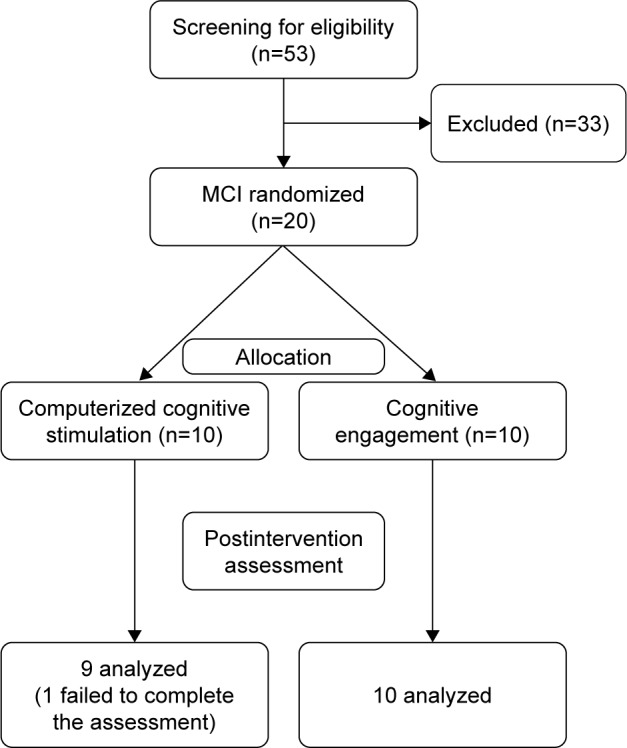
In this randomized study, data from 19 MCI patients were analyzed (n=9 in CCS and n=10 in CCE). The patients attended a group weekly session for a duration of 3 months. Assessments of cognitive and psychosocial variables were conducted at baseline (M0) and at the end of the programs (M3).
All of the participants attended the 12 sessions and showed a high level of motivation. Attrition rate was very low (one dropout at M3 assessment). At M3, the CCS participants displayed a significant improvement in part B of the Trail Making Test (TMT-B; =0.03) and self-esteem (=0.005), while the CCE participants showed a significant improvement in part A of the Trail Making Test (TMT-A; =0.007) and a higher level of technology acceptance (=0.006). The two groups did not differ significantly (>0.05) in cognitive and psychosocial changes after the intervention. However, medium effect sizes (Cohen's d=0.56; 95% CI =-0.43:1.55) were found on the free recall, favoring the CCS group, as well as on TMT-A (d=0.51; 95% CI =-0.48:1.49) and technology acceptance (d=-0.65; 95% CI =-1.64:0.34), favoring the CCE group.
Both interventions were highly feasible and acceptable and allowed improvement in different aspects of cognitive and psychosocial functioning in MCI subjects.
轻度认知障碍(MCI)与痴呆的风险增加相关,并且正在成为药物和非药物干预的关注话题。随着技术的进步,基于计算机的认知练习越来越多地融入传统的认知干预,如认知训练。另一种涉及技术使用的认知干预是认知参与,包括让参与者参与高度激励和具有挑战性的活动,例如学习使用某种新的数字技术。本研究旨在检验计算机认知刺激(CCS)和计算机认知参与(CCE)方案的可行性和可接受性,并比较它们在 MCI 老年人中的效果。
在这项随机研究中,对 19 名 MCI 患者的数据进行了分析(CCS 组 n=9,CCE 组 n=10)。患者每周参加一次小组会议,持续 3 个月。在基线(M0)和方案结束时(M3)进行认知和心理社会变量的评估。
所有患者均参加了 12 次会议,表现出很高的积极性。失访率非常低(仅在 M3 评估时有 1 人退出)。在 M3 时,CCS 组在连线测试 B(TMT-B;=0.03)和自尊(=0.005)部分显示出显著改善,而 CCE 组在连线测试 A(TMT-A;=0.007)和更高的技术接受程度(=0.006)方面显示出显著改善。干预后,两组在认知和心理社会变化方面无显著差异(>0.05)。然而,在自由回忆(CCS 组有利,Cohen's d=0.56;95%CI=-0.43:1.55)、TMT-A(d=0.51;95%CI=-0.48:1.49)和技术接受度(d=-0.65;95%CI=-1.64:0.34)方面发现了中等效应量,对 CCE 组有利。
两种干预措施均具有高度可行性和可接受性,并能改善 MCI 患者认知和心理社会功能的不同方面。