Mahtab Mamun Al, Chaudhury Muntasir, Uddin Mohammad H, Noor-E Alam Sheikh M, Rahim Mohammad A, Alam Mohammad A, Moben Ahmed L, Khondaker Faiz A, Choudhury Mohammad Fi, Sarkar Mohammad Ja, Poddar Provat K, Foez Syed A, Akbar Sheikh Mf
Department of Hepatology, Bangabandhu Sheikh Mujib Medical University,, Dhaka, Bangladesh.
Department of Economics, East West University, Dhaka, People's Republic of Bangladesh.
Euroasian J Hepatogastroenterol. 2016 Jul-Dec;6(2):163-166. doi: 10.5005/jp-journals-10018-1190. Epub 2016 Dec 1.
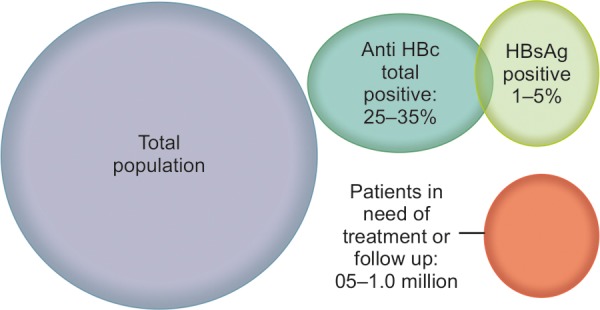
Hepatitis B virus (HBV) infection is endemic in Bangladesh. Studies have indicated that HBV is the major cause of chronic hepatitis B (CHB), liver cirrhosis (LC), and hepatocellular carcinoma (HCC) in this country. Recently, HBV-related acute on chronic liver failure (HBV-ACLF) has emerged as a serious and emergent medical problem in Bangladesh. To develop a strategy to address HBV-related problems and their influence on health care delivery system, proper understandings about extent of problems and nature of economic burden should be explored. Conservative estimates indicate that about 50 million or more of Bangladeshi have been infected by HBV at some point of their life. Out of the total Bangladeshi population, about 2 to 5% is chronically infected with HBV (about 3-8 million) (1-6%) and considerable number of these patients will eventually develop LC, HCC, or ACLF (about 1 million). Although proper statistics is lacking, it is estimated that HBV-related liver diseases account for a majority of hospital admissions and around 20,000 deaths every year in Bangladesh. In addition, complex clinical features of HBV-related liver diseases have been documented in Bangladesh that show similarity and differences from HBV infection in other Asian countries. Although vaccination against HBV and containment of horizontal transmission are in progress in Bangladesh for reduction of new HBV infection, there is a lack of national strategy for treatment of millions of chronic HBV-infected subjects. This paper will provide an insight regarding the economic impact of HBV in Bangladesh that may act as a primary impetus for developing national HBV eradication program, a goal set by World Health Organization (WHO).
Al Mahtab M, Chaudhury M, Uddin MH, Noor-E-Alam SM, Rahim MA, Alam MA, Moben AL, Khondaker FA, Choudhury MFI, Sarkar MJA, Poddar PK, Foez SA, Akbar SMF. Cost Assessment of Hepatitis B Virus-related Hepatitis in Bangladesh. Euroasian J Hepato-Gastroenterol 2016;6(2):163-166.
乙型肝炎病毒(HBV)感染在孟加拉国呈地方性流行。研究表明,HBV是该国慢性乙型肝炎(CHB)、肝硬化(LC)和肝细胞癌(HCC)的主要病因。最近,HBV相关的慢加急性肝衰竭(HBV-ACLF)在孟加拉国已成为一个严重且紧急的医学问题。为制定应对HBV相关问题及其对医疗保健系统影响的策略,应探索对问题程度和经济负担性质的恰当理解。保守估计表明,约5000万或更多孟加拉人在其生命中的某个时刻感染过HBV。在孟加拉国总人口中,约2%至5%的人慢性感染HBV(约300 - 800万)(1% - 6%),这些患者中有相当数量最终会发展为LC、HCC或ACLF(约100万)。尽管缺乏确切统计数据,但据估计,在孟加拉国,HBV相关肝病占医院入院人数的大部分,每年约有20000人死亡。此外,孟加拉国已记录了HBV相关肝病的复杂临床特征,这些特征与其他亚洲国家的HBV感染既有相似之处,也有不同之处。尽管孟加拉国正在进行HBV疫苗接种和控制水平传播以减少新的HBV感染,但缺乏针对数百万慢性HBV感染患者的国家治疗策略。本文将深入探讨HBV在孟加拉国的经济影响,这可能成为制定世界卫生组织(WHO)设定的全国消除HBV计划的主要推动力。
Al Mahtab M, Chaudhury M, Uddin MH, Noor-E-Alam SM, Rahim MA, Alam MA, Moben AL, Khondaker FA, Choudhury MFI, Sarkar MJA, Poddar PK, Foez SA, Akbar SMF. 孟加拉国乙型肝炎病毒相关肝炎的成本评估。《欧亚肝脏胃肠病学杂志》2016;6(2):163 - 166。