Departamento de Bioquímica y Biología Molecular, Universidad de Córdoba, Edificio Severo Ochoa, 1ª planta, Campus de Rabanales, 14071, Córdoba, Spain.
Departamento de Botánica, Ecología y Fisiología Vegetal, Universidad de Córdoba, Edificio Celestino Mutis, Campus de Rabanales, 14071, Córdoba, Spain.
Appl Microbiol Biotechnol. 2018 Feb;102(3):1067-1074. doi: 10.1007/s00253-017-8678-6. Epub 2017 Dec 5.
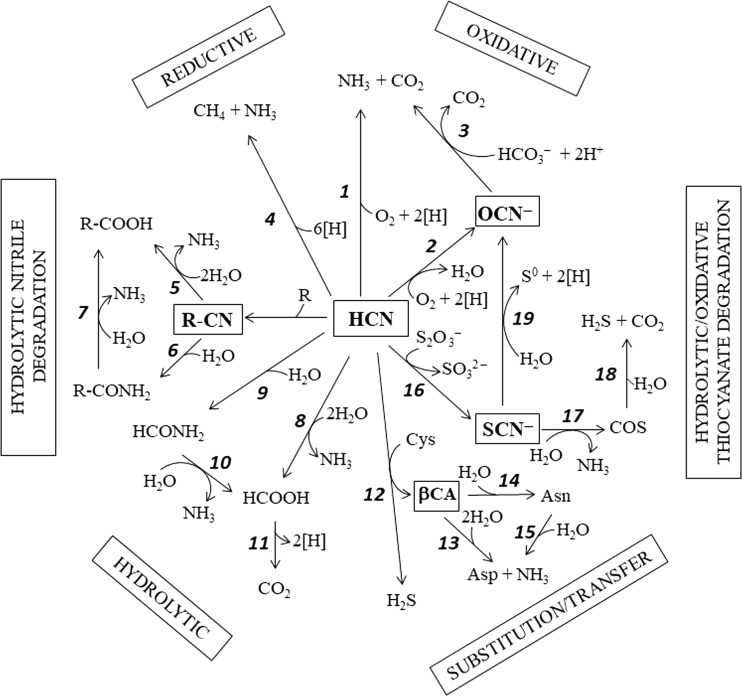
Cyanide is one of the most toxic chemicals for living organisms described so far. Its toxicity is mainly based on the high affinity that cyanide presents toward metals, provoking inhibition of essential metalloenzymes. Cyanide and its cyano-derivatives are produced in a large scale by many industrial activities related to recovering of precious metals in mining and jewelry, coke production, steel hardening, synthesis of organic chemicals, and food processing industries. As consequence, cyanide-containing wastes are accumulated in the environment becoming a risk to human health and ecosystems. Cyanide and related compounds, like nitriles and thiocyanate, are degraded aerobically by numerous bacteria, and therefore, biodegradation has been offered as a clean and cheap strategy to deal with these industrial wastes. Anaerobic biological treatments are often preferred options for wastewater biodegradation. However, at present very little is known about anaerobic degradation of these hazardous compounds. This review is focused on microbial degradation of cyanide and related compounds under anaerobiosis, exploring their potential application in bioremediation of industrial cyanide-containing wastes.
氰化物是迄今为止描述的对生物体最具毒性的化学物质之一。其毒性主要基于氰化物与金属的高亲和力,导致必需金属酶的抑制。氰化物及其氰基衍生物由许多与采矿和珠宝业回收贵金属、焦炭生产、钢硬化、有机化学品合成和食品加工行业相关的工业活动大量产生。因此,含氰废物在环境中积累,对人类健康和生态系统构成威胁。氰化物和相关化合物,如腈和硫氰酸盐,可被许多细菌好氧降解,因此,生物降解作为一种清洁且廉价的策略已被用于处理这些工业废物。厌氧生物处理通常是废水生物降解的首选方法。然而,目前对这些危险化合物的厌氧降解知之甚少。本综述重点介绍了在厌氧条件下氰化物和相关化合物的微生物降解,探索了它们在工业含氰废物生物修复中的潜在应用。