Department of Psychiatry, School of Medicine, Anschutz Medical Campus, University of Colorado, Aurora, Colorado, USA.
Division of Endocrinology, Metabolism and Diabetes, Department of Medicine, School of Medicine, Anschutz Medical Campus, University of Colorado, Aurora, Colorado, USA.
Obesity (Silver Spring). 2018 Feb;26(2):362-367. doi: 10.1002/oby.22082. Epub 2017 Dec 13.
The current study aimed to identify how sex influences neurobiological responses to food cues, particularly those related to hedonic eating, and how this relates to obesity propensity, using functional magnetic resonance imaging (fMRI).
Adult men and women who were either obesity resistant (OR) or obesity prone (OP) underwent fMRI while viewing visual food cues (hedonic foods, neutral foods, and nonfood objects) in both fasted and fed states.
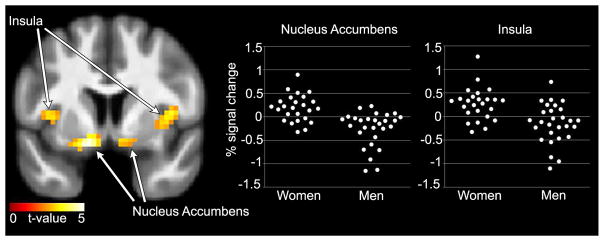
When fasted, a significant sex effect on the response to hedonic vs. neutral foods was observed, with greater responses in women than men in the nucleus accumbens (P = 0.0002) and insula (P = 0.010). Sex-based differences were not observed in the fed state. No significant group effects (OP vs. OR) or group-by-sex interactions were observed in fasted or fed states.
Greater fasted responses to hedonic food cues in reward-related brain regions were observed in women compared with men, suggesting that women may be more sensitive to the reward value of hedonic foods than men when fasted. This may indicate sex-dependent neurophysiology underlying eating behaviors.
本研究旨在使用功能磁共振成像(fMRI)技术,确定性别如何影响对食物线索的神经生物学反应,特别是与享乐性进食相关的反应,以及这与肥胖倾向的关系。
肥胖抵抗(OR)和肥胖易感(OP)的成年男性和女性在禁食和进食状态下观看视觉食物线索(享乐性食物、中性食物和非食物物体)时进行 fMRI 扫描。
在禁食状态下,观察到对享乐性食物与中性食物的反应存在显著的性别效应,女性的伏隔核(P=0.0002)和岛叶(P=0.010)的反应大于男性。在进食状态下没有观察到基于性别的差异。在禁食或进食状态下,均未观察到组间效应(OP 与 OR)或组间-性别交互作用。
与男性相比,女性在禁食状态下对奖赏相关脑区的享乐性食物线索的反应更大,这表明女性在禁食时可能比男性对享乐性食物的奖赏价值更为敏感。这可能表明存在与进食行为相关的性别依赖性神经生理学基础。