Trudel Guy, Uhthoff Hans K, Laneuville Odette
The Ottawa Hospital Rehabilitation Centre, Ottawa, Ontario, Canada
University of Ottawa, Faculty of Medicine, Department of Medicine, Ottawa, Ontario, Canada.
Physiol Rep. 2017 Dec;5(24). doi: 10.14814/phy2.13469.
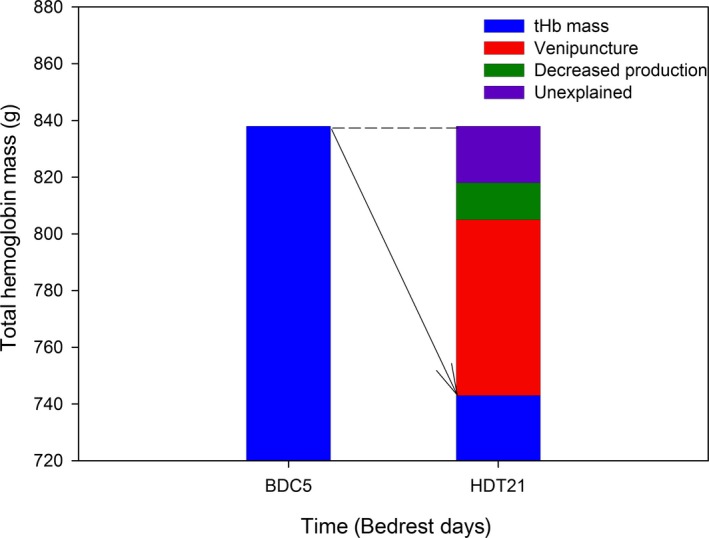
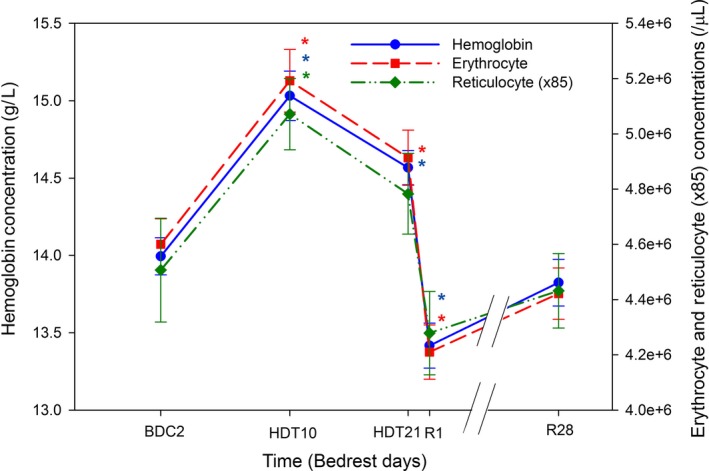
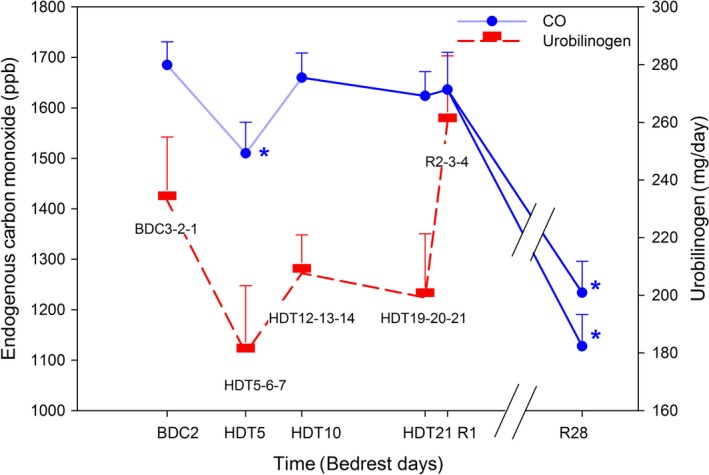
Hemoconcentration is observed in bed rest studies, descent from altitude, and exposure to microgravity. Hemoconcentration triggers erythrocyte losses to subsequently normalize erythrocyte concentration. The mechanisms of erythrocyte loss may involve enhanced hemolysis, but has never been measured directly in bed rest studies. Steady-state hemolysis was evaluated by measuring two heme degradation products, endogenous carbon monoxide concentration [CO] and urobilinogen in feces, in 10 healthy men, before, during, and after two campaigns of 21 days of 6° head-down-tilt (HDT) bed rest. The subjects were hemoconcentrated at 10 and 21 days of bed rest: mean concentrations of hemoglobin (15.0 ± 0.2 g/L and 14.6 ± 0.1 g/L, respectively) and erythrocytes (5.18 ± 0.06E6/L and 5.02 ± 0.06E6/L, respectively) were increased compared to baseline (all s < 0.05). In contrast, mean hemoglobin mass (743 ± 19 g) and number of erythrocytes (2.56 ± 0.07E13) were decreased at 21 days of bed rest (both s < 0.05). Indicators of hemolysis mean [CO] (1660 ± 49 ppb and 1624 ± 48 ppb, respectively) and fecal urobilinogen concentration (180 ± 23 mg/day and 199 ± 22 mg/day, respectively) were unchanged at 10 and 21 days of bed rest compared to baseline (both s > 0.05). A significant decrease in [CO] (-505 ppb) was measured at day 28 after bed rest. HDT bed rest caused hemoconcentration in parallel with lower hemoglobin mass. Circulating indicators of hemolysis remained unchanged throughout bed rest supporting that enhanced hemolysis did not contribute significantly to erythrocyte loss during the hemoconcentration of bed rest. At day 28 after bed rest, decreased hemolysis accompanied the recovery of erythrocytes, a novel finding.
在卧床休息研究、从高海拔下降以及暴露于微重力环境中均观察到血液浓缩现象。血液浓缩会引发红细胞损失,从而使红细胞浓度随后恢复正常。红细胞损失的机制可能涉及溶血增强,但在卧床休息研究中从未直接测量过。通过测量两种血红素降解产物,即内源性一氧化碳浓度[CO]和粪便中的尿胆原,对10名健康男性在两次为期21天的6°头低位倾斜(HDT)卧床休息前后及期间的稳态溶血情况进行了评估。受试者在卧床休息10天和21天时出现血液浓缩:与基线相比,血红蛋白平均浓度(分别为15.0±0.2 g/L和14.6±0.1 g/L)和红细胞平均浓度(分别为5.18±0.06×10⁶/L和5.02±0.06×10⁶/L)均升高(所有P<0.05)。相比之下,卧床休息21天时血红蛋白平均质量(743±19 g)和红细胞数量(2.56±0.07×10¹³)下降(两者P<0.05)。溶血指标平均[CO](分别为1660±49 ppb和1624±48 ppb)和粪便尿胆原浓度(分别为180±23 mg/天和199±22 mg/天)在卧床休息10天和21天时与基线相比无变化(两者P>0.05)。卧床休息后第28天测得[CO]显著下降(-505 ppb)。HDT卧床休息导致血液浓缩,同时血红蛋白质量降低。在整个卧床休息期间,循环溶血指标保持不变,这表明在卧床休息导致血液浓缩期间,溶血增强对红细胞损失没有显著贡献。在卧床休息后第28天,溶血减少伴随着红细胞的恢复,这是一个新发现。