Division of Obstetrics and Gynecology, School of Medicine, Pontificia Universidad Católica de Chile, Santiago, Chile.
J Cell Mol Med. 2018 Mar;22(3):1805-1815. doi: 10.1111/jcmm.13463. Epub 2017 Dec 20.
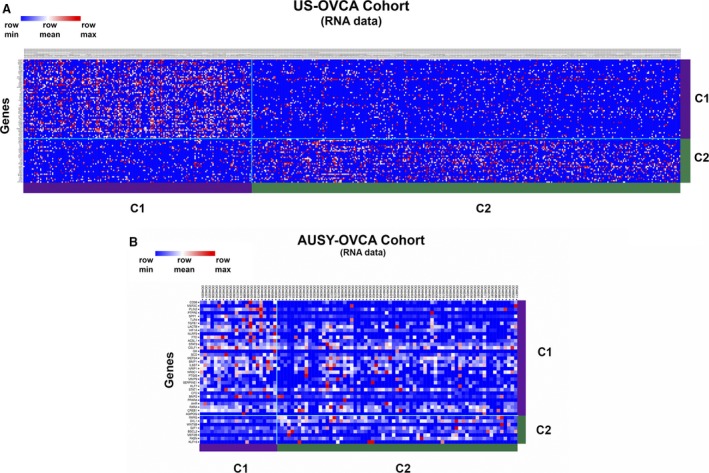
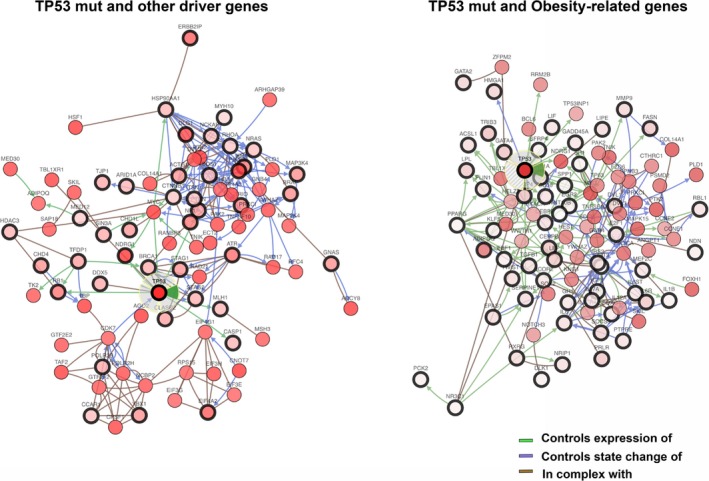
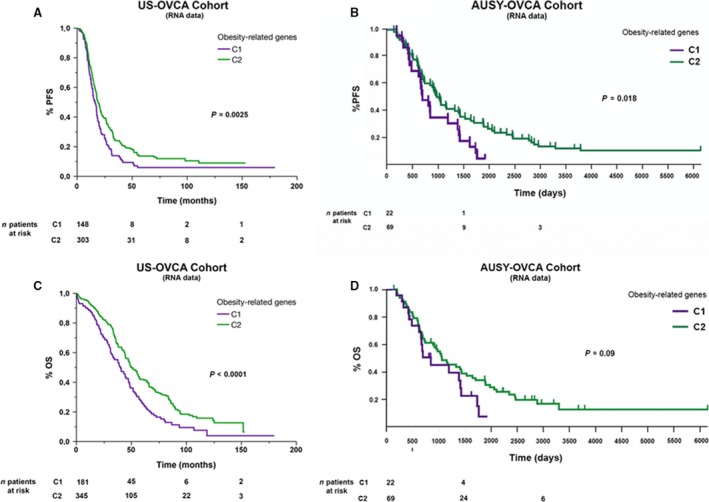
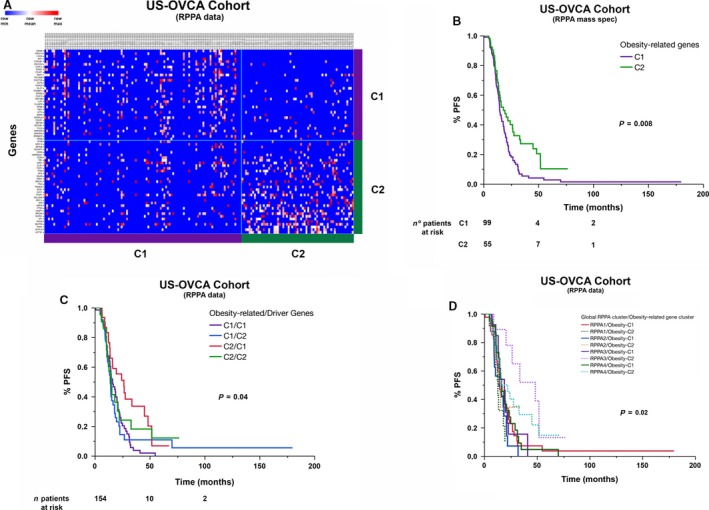
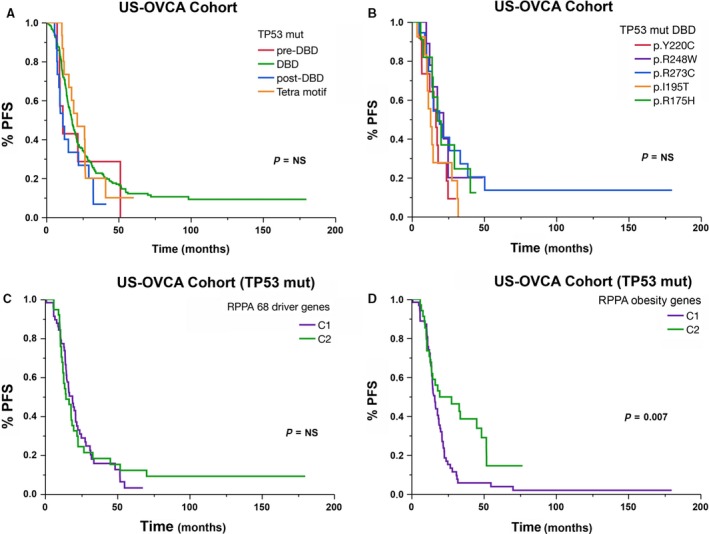
To investigate whether specific obesity/metabolism-related gene expression patterns affect the survival of patients with ovarian cancer. Clinical and genomic data of 590 samples from the high-grade ovarian serous carcinoma (HGOSC) study of The Cancer Genome Atlas (TCGA) and 91 samples from the Australian Ovarian Cancer Study were downloaded from the International Cancer Genome Consortium (ICGC) portal. Clustering of mRNA microarray and reverse-phase protein array (RPPA) data was performed with 83 consensus driver genes and 144 obesity and lipid metabolism-related genes. Association between different clusters and survival was analyzed with the Kaplan-Meier method and a Cox regression. Mutually exclusive, co-occurrence and network analyses were also carried out. Using RNA and RPPA data, it was possible to identify two subsets of HGOSCs with similar clinical characteristics and cancer driver mutation profiles (e.g. TP53), but with different outcome. These differences depend more on up-regulation of specific obesity and lipid metabolism-related genes than on the number of gene mutations or copy number alterations. It was also found that CD36 and TGF-ß are highly up-regulated at the protein levels in the cluster with the poorer outcome. In contrast, BSCL2 is highly up-regulated in the cluster with better progression-free and overall survival. Different obesity/metabolism-related gene expression patterns constitute a risk factor for prognosis independent of the therapy results in the Cox regression. Prognoses were conditioned by the differential expression of obesity and lipid metabolism-related genes in HGOSCs with similar cancer driver mutation profiles, independent of the initial therapeutic response.
为了探究特定的肥胖/代谢相关基因表达模式是否会影响卵巢癌患者的生存。我们从癌症基因组图谱(TCGA)的高级别卵巢浆液性癌(HGOSC)研究中下载了 590 个样本的临床和基因组数据,以及从国际癌症基因组联合会(ICGC)门户下载了 91 个澳大利亚卵巢癌研究样本。使用 83 个共识驱动基因和 144 个肥胖和脂质代谢相关基因对 mRNA 微阵列和反相蛋白阵列(RPPA)数据进行聚类。采用 Kaplan-Meier 方法和 Cox 回归分析不同聚类与生存的关系。还进行了互斥、共存和网络分析。使用 RNA 和 RPPA 数据,我们可以识别出具有相似临床特征和癌症驱动突变特征(如 TP53)的 HGOSC 的两个子集,但结局不同。这些差异更多地取决于特定肥胖和脂质代谢相关基因的上调,而不是基因突变或拷贝数改变的数量。还发现 CD36 和 TGF-β在预后较差的聚类中蛋白水平高度上调。相比之下,BSCL2 在无进展和总生存期更好的聚类中高度上调。不同的肥胖/代谢相关基因表达模式构成了 Cox 回归中独立于治疗结果的预后危险因素。在具有相似癌症驱动突变特征的 HGOSC 中,肥胖和脂质代谢相关基因的差异表达会影响预后,而与初始治疗反应无关。