Department of Chemistry & Biochemistry, University of Notre Dame, Notre Dame, IN, USA.
Harper Cancer Research Institute, University of Notre Dame, A200E Harper Hall, 1234 N. Notre Dame Ave, South Bend, IN, 46617, USA.
J Exp Clin Cancer Res. 2023 Jul 12;42(1):165. doi: 10.1186/s13046-023-02740-y.
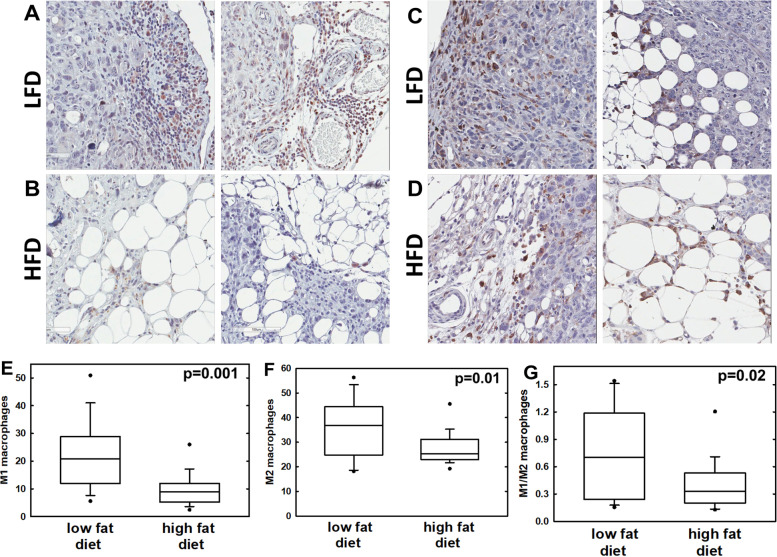
The majority of women with epithelial ovarian cancer (OvCa) are diagnosed with metastatic disease, resulting in a poor 5-year survival of 31%. Obesity is a recognized non-infectious pandemic that increases OvCa incidence, enhances metastatic success and reduces survival. We have previously demonstrated a link between obesity and OvCa metastatic success in a diet-induced obesity mouse model wherein a significantly enhanced tumor burden was associated with a decreased M1/M2 tumor-associated macrophage ratio (Liu Y et al. Can, Res. 2015; 75:5046-57).
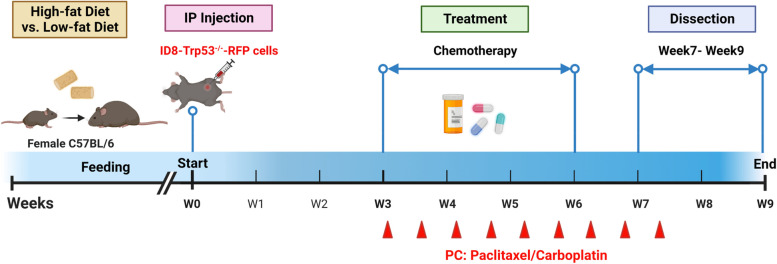
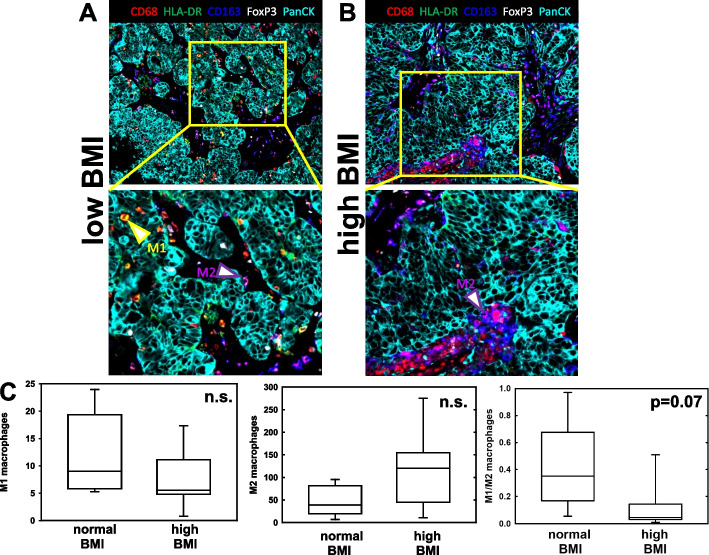
The objective of this study was to use pre-clinical murine models of diet-induced obesity to evaluate the effect of a high fat diet (HFD) on response to standard of care chemotherapy and to assess obesity-associated changes in the tumor microenvironment. Archived tumor tissues from ovarian cancer patients of defined body mass index (BMI) were also evaluated using multiplexed immunofluorescence analysis of immune markers.
We observed a significantly diminished response to standard of care paclitaxel/carboplatin chemotherapy in HFD mice relative to low fat diet (LFD) controls. A corresponding decrease in the M1/M2 macrophage ratio and enhanced tumor fibrosis were observed both in murine DIO studies and in human tumors from women with BMI > 30.
Our data suggest that the reported negative impact of obesity on OvCa patient survival may be due in part to the effect of the altered M1/M2 tumor-associated macrophage ratio and enhanced fibrosis on chemosensitivity. These data demonstrate a contribution of host obesity to ovarian tumor progression and therapeutic response and support future combination strategies targeting macrophage polarization and/or fibrosis in the obese host.
大多数上皮性卵巢癌(OvCa)患者被诊断为转移性疾病,导致 5 年生存率仅为 31%。肥胖是一种公认的非传染性大流行病,它会增加 OvCa 的发病率,增强转移性成功,并降低生存率。我们之前在饮食诱导肥胖的小鼠模型中证明了肥胖与 OvCa 转移成功之间的联系,其中肿瘤负荷的显著增加与 M1/M2 肿瘤相关巨噬细胞比例的降低有关(Liu Y 等人,Cancer Res. 2015; 75:5046-57)。
本研究的目的是使用饮食诱导肥胖的临床前小鼠模型来评估高脂肪饮食(HFD)对标准护理化疗反应的影响,并评估肥胖相关的肿瘤微环境变化。还使用免疫标志物的多重免疫荧光分析评估了来自体质量指数(BMI)定义明确的卵巢癌患者的存档肿瘤组织。
与低脂饮食(LFD)对照组相比,我们观察到 HFD 小鼠对标准护理紫杉醇/卡铂化疗的反应明显减弱。在小鼠 DIO 研究和 BMI>30 的女性肿瘤中均观察到 M1/M2 巨噬细胞比例降低和肿瘤纤维化增强。
我们的数据表明,肥胖对 OvCa 患者生存的负面影响可能部分归因于改变的 M1/M2 肿瘤相关巨噬细胞比例和增强的纤维化对化疗敏感性的影响。这些数据表明宿主肥胖会促进卵巢肿瘤的进展和治疗反应,并支持未来针对肥胖宿主中巨噬细胞极化和/或纤维化的联合治疗策略。