Borges J-F-P, Lanaro N-D, Bernardo V-G, Albano R-M, Dias F, de Faria P-A-S, Pinto L-F-R, Lourenço S-Q-C
Av. das Acacias, 150, bl.01, ap. 104 Barra da Tijuca, RJ, Brazil 22776000,
Med Oral Patol Oral Cir Bucal. 2018 Jan 1;23(1):e7-e12. doi: 10.4317/medoral.21960.
Lower lip squamous cell carcinoma (LLSCC) is a common malignancy of the head and neck, being mainly a consequence of a chronic exposure to ultraviolet (UV) light solar radiation. Here, we evaluated the clinicopathological profile of patients with photosensitive disorders (xeroderma pigmentosum, lupus erythematosus and albinism) that developed LLSCC.
Data from patients who had a diagnosed LLSCC with a prior xeroderma pigmentosum, lupus erythematosus or albinism diagnosis that were treated at INCA from 1999 to 2012 were collected from patients medical records (n=16). The control group was composed of 68 patients with LLSCC without a medical history of photosensitivity. The clinicopathological data of this study population were collected and the association between these variables was analyzed by Fisher's exact test. Survival curves were constructed using the Kaplan-Meier method and compared by log-rank test. All statistical analyses were performed using SPSS statistics package.
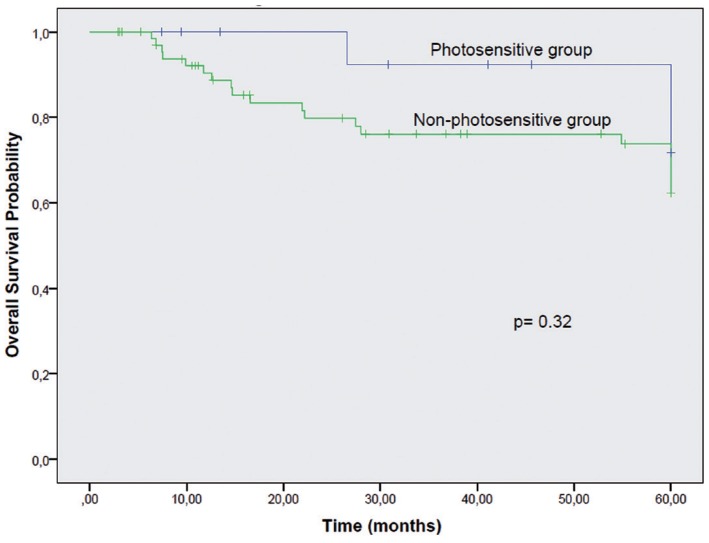
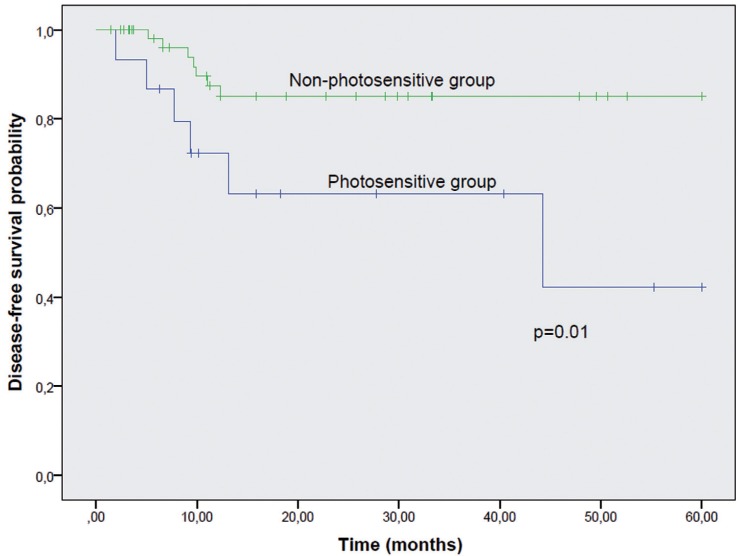
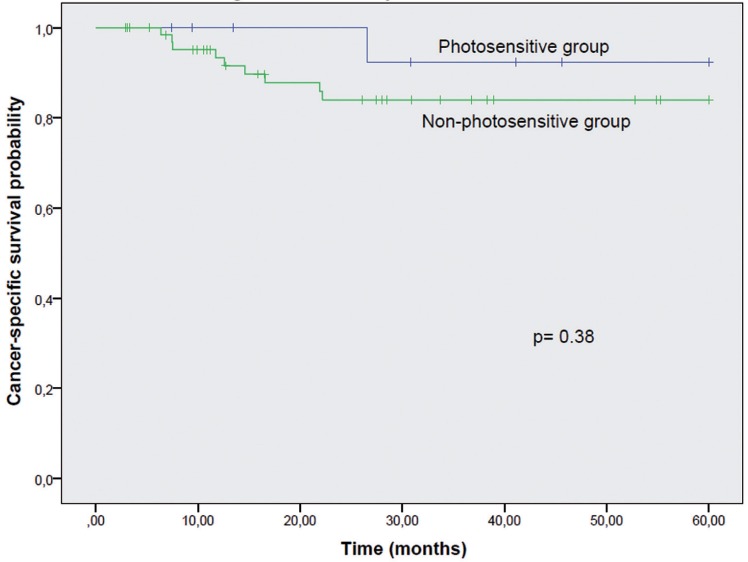
The mean age of patients in the photosensitive and non-photosensitive groups was 42 years and 67 years, respectively (p<0.0001). A previous history of malignant diseases was more common in the photosensitive group (p=0.001). In both groups, most tumors showed a pathological stage I/II disease. Overall and cancer-specific survival were not statistically different. However, disease-free interval showed a significant difference (p=0.01) between the photosensitive and non-photosensitive patients.
Photosensitive patients presented LLSCC at earlier age but it usually was not the primary tumor in these patients. Furthermore, a more aggressive pathological behavior was not seen when compared with tumors from non-photosensitive patients. The disease-free interval was lower in photosensitive patients, as expected.
下唇鳞状细胞癌(LLSCC)是头颈部常见的恶性肿瘤,主要是长期暴露于太阳紫外线(UV)辐射的结果。在此,我们评估了发生LLSCC的光敏性疾病(着色性干皮病、红斑狼疮和白化病)患者的临床病理特征。
从1999年至2012年在INCA接受治疗的已诊断为LLSCC且先前有过着色性干皮病、红斑狼疮或白化病诊断的患者病历中收集数据(n = 16)。对照组由68例无光敏病史的LLSCC患者组成。收集该研究人群的临床病理数据,并通过Fisher精确检验分析这些变量之间的关联。使用Kaplan-Meier方法构建生存曲线,并通过对数秩检验进行比较。所有统计分析均使用SPSS统计软件包进行。
光敏组和非光敏组患者的平均年龄分别为42岁和67岁(p<0.0001)。光敏组先前有恶性疾病史更为常见(p = 0.001)。在两组中,大多数肿瘤显示为病理I/II期疾病。总生存率和癌症特异性生存率在统计学上无差异。然而,光敏患者和非光敏患者之间的无病间期存在显著差异(p = 0.01)。
光敏患者患LLSCC的年龄较早,但通常不是这些患者的原发性肿瘤。此外,与非光敏患者的肿瘤相比,未观察到更具侵袭性的病理行为。如预期的那样,光敏患者的无病间期较短。