School of Public Health, Addis Ababa University, PO Box 9086, Addis Ababa, Ethiopia.
School of Medicine, Addis Ababa University, PO Box 9086, Addis Ababa, Ethiopia.
Hum Resour Health. 2017 Dec 28;15(1):86. doi: 10.1186/s12960-017-0257-5.
A rapid transition from severe physician workforce shortage to massive production to ensure the physician workforce demand puts the Ethiopian health care system in a variety of challenges. Therefore, this study discovered how the health system response for physician workforce shortage using the so-called flooding strategy was viewed by different stakeholders.
The study adopted the grounded theory research approach to explore the causes, contexts, and consequences (at the present, in the short and long term) of massive medical student admission to the medical schools on patient care, medical education workforce, and medical students. Forty-three purposively selected individuals were involved in a semi-structured interview from different settings: academics, government health care system, and non-governmental organizations (NGOs). Data coding, classification, and categorization were assisted using ATLAs.ti qualitative data analysis scientific software.
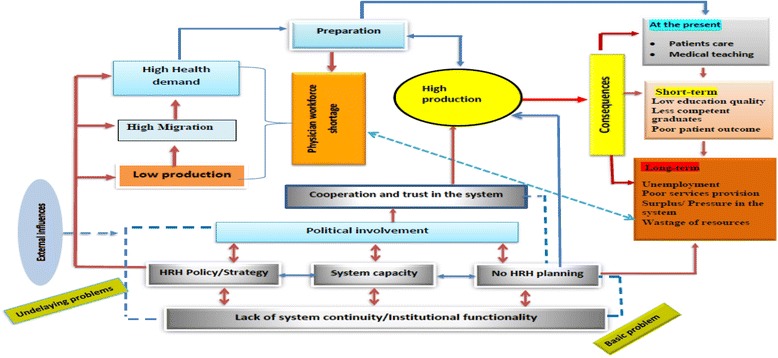
In relation to the health system response, eight main categories were emerged: (1) reasons for rapid medical education expansion; (2) preparation for medical education expansion; (3) the consequences of rapid medical education expansion; (4) massive production/flooding as human resources for health (HRH) development strategy; (5) cooperation on HRH development; (6) HRH strategies and planning; (7) capacity of system for HRH development; and (8) institutional continuity for HRH development. The demand for physician workforce and gaining political acceptance were cited as main reasons which motivated the government to scale up the medical education rapidly. However, the rapid expansion was beyond the capacity of medical schools' human resources, patient flow, and size of teaching hospitals. As a result, there were potential adverse consequences in clinical service delivery, and teaching learning process at the present: "the number should consider the available resources such as number of classrooms, patient flows, medical teachers, library…". In the future, it was anticipated to end in surplus in physician workforce, unemployment, inefficiency, and pressure on the system: "…flooding may seem a good strategy superficially but it is a dangerous strategy. It may put the country into crisis, even if good physicians are being produced; they may not get a place where to go…".
Massive physician workforce production which is not closely aligned with the training capacity of the medical schools and the absorption of graduates in to the health system will end up in unanticipated adverse consequences.
从严重的医生劳动力短缺到大规模生产的快速转变,以确保医生劳动力需求,这给埃塞俄比亚的医疗保健系统带来了各种挑战。因此,本研究发现了卫生系统如何利用所谓的洪水战略来应对医生劳动力短缺,以及不同利益相关者对此的看法。
本研究采用扎根理论研究方法,探讨了大规模招收医学生进入医学院对患者护理、医学教育劳动力和医学生的影响的原因、背景和后果(目前、短期和长期)。从不同背景下的 43 名有针对性选择的个人参与了半结构化访谈:学术界、政府医疗保健系统和非政府组织(非政府组织)。使用 ATLAs.ti 定性数据分析科学软件协助数据编码、分类和分类。
与卫生系统应对措施有关的,出现了八个主要类别:(1)快速扩大医学教育的原因;(2)扩大医学教育的准备;(3)快速扩大医学教育的后果;(4)大规模生产/洪水作为卫生人力(HRH)发展战略;(5)人力资源开发合作;(6)人力资源战略和规划;(7)人力资源发展系统能力;(8)人力资源发展的机构连续性。对医生劳动力的需求和获得政治认可被认为是促使政府迅速扩大医学教育的主要原因。然而,快速扩张超出了医学院人力资源、患者流量和教学医院规模的承受能力。因此,目前在临床服务提供和教学学习过程中存在潜在的不利后果:“数量应考虑到可用资源,如教室数量、患者流量、医学教师、图书馆等”。未来,预计医生劳动力过剩、失业、效率低下和系统压力将成为问题:“……表面上看来,洪水策略似乎是一个好策略,但它是一个危险的策略。即使培养出了优秀的医生,也可能使国家陷入危机,因为他们可能无处可去……”。
大规模的医生劳动力生产,如果与医学院的培训能力和毕业生在卫生系统中的吸收情况不紧密结合,最终将导致意想不到的不利后果。