Li Enqi, Zhao Zhe, Ma Baotong, Zhang Jinli
Department of Orthopaedic Trauma, Tianjin Hospital, Tianjin 300211, P.R. China.
Department of Surgery of Traditional Chinese Medicine, Tianjin Hospital, Tianjin 300211, P.R. China.
Exp Ther Med. 2017 Dec;14(6):5321-5328. doi: 10.3892/etm.2017.5248. Epub 2017 Oct 2.
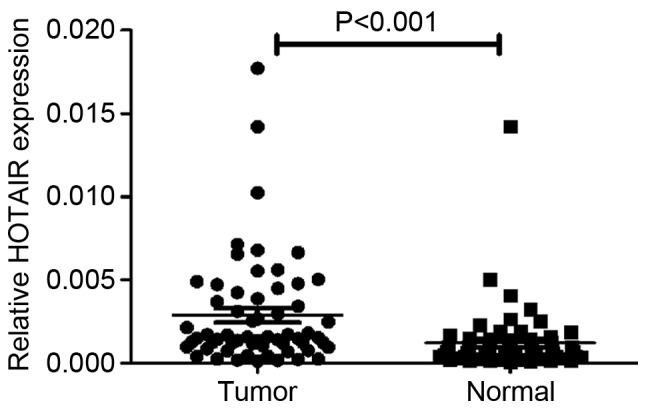
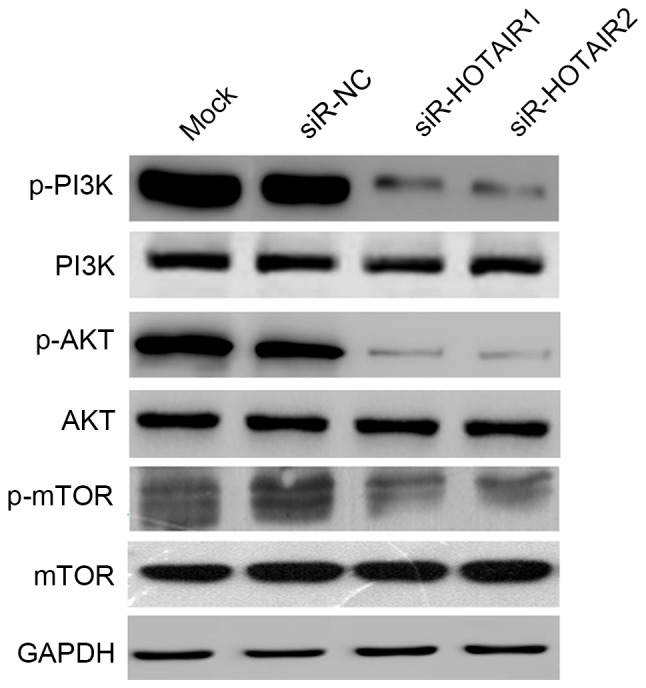
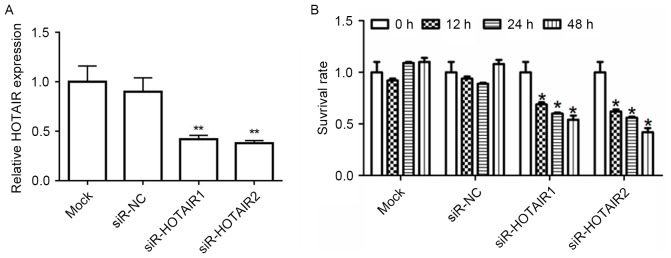
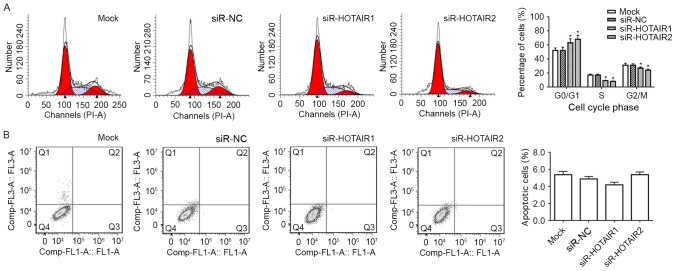
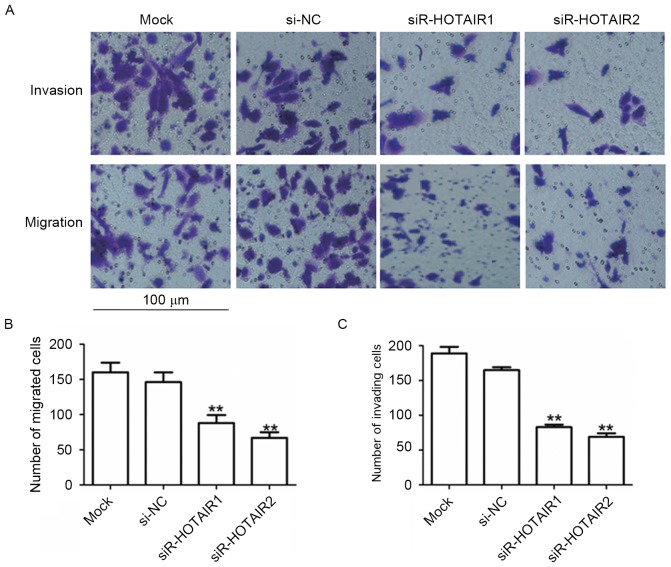
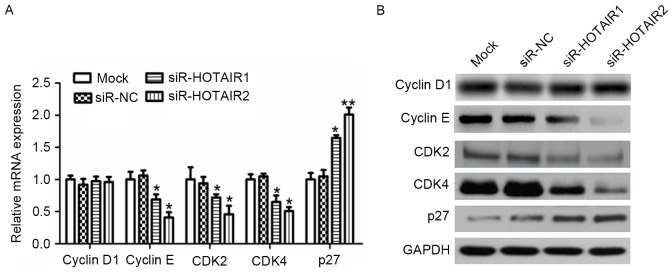
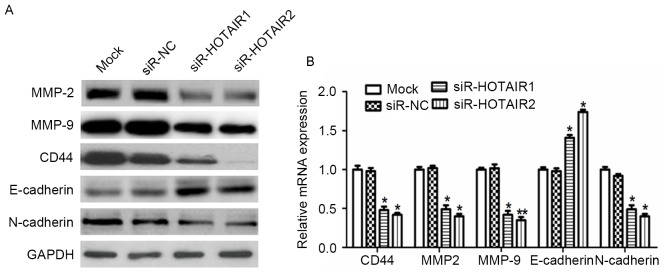
It has been proven that long non-coding (lnc)RNAs serve an important role in the tumorigenesis and development of several types of human malignancy. Previous studies have demonstrated that the lncRNA Hox transcript antisense intergenic RNA (HOTAIR) is involved in the development various types of cancer, including osteosarcoma (OS). However, the underlying mechanisms by which it has an affect are still largely unknown. In the present study, it was observed that the expression of HOTAIR was significantly upregulated in OS tissues compared to matched adjacent normal tissues, using reverse transcription-quantitative polymerase chain reaction analysis. HOTAIR was silenced using specific small interfering RNA (siRNA/siR), siR-HOTAIR, in order to investigate its role in regulating OS cell proliferation, apoptosis, migration and invasion. siR-HOTAIR inhibited the proliferation of MG-63 cells due to the induction of G1 phase arrest. In addition, the results of assays demonstrated that the suppression of HOTAIR in MG-63 OS cells significantly reduced migration and invasion. The silencing of HOTAIR also significantly decreased the expression of matrix metalloproteinase (MMP) 2 and MMP9, but increased E-cadherin expression through regulating the RAC α serine/threonine protein kinase-mammalian target of rapamycin signaling pathway. The results indicated that siR-HOTAIR may be a potential OS therapy.
已证实长链非编码(lnc)RNA在多种人类恶性肿瘤的发生和发展中发挥重要作用。先前的研究表明,lncRNA Hox转录本反义基因间RNA(HOTAIR)参与包括骨肉瘤(OS)在内的多种癌症的发展。然而,其发挥作用的潜在机制仍 largely未知。在本研究中,通过逆转录-定量聚合酶链反应分析观察到,与匹配的相邻正常组织相比,HOTAIR在OS组织中的表达显著上调。使用特异性小干扰RNA(siRNA/siR),即siR-HOTAIR,使HOTAIR沉默,以研究其在调节OS细胞增殖、凋亡、迁移和侵袭中的作用。siR-HOTAIR由于诱导G1期阻滞而抑制MG-63细胞的增殖。此外,实验结果表明,在MG-63 OS细胞中抑制HOTAIR可显著降低迁移和侵袭。HOTAIR的沉默还显著降低了基质金属蛋白酶(MMP)2和MMP9的表达,但通过调节RACα丝氨酸/苏氨酸蛋白激酶-雷帕霉素哺乳动物靶标信号通路增加了E-钙黏蛋白的表达。结果表明,siR-HOTAIR可能是一种潜在的OS治疗方法。