Guo Runzhi, Zheng Yunfei, Liu Hao, Li Xiaobei, Jia Lingfei, Li Weiran
Department of Orthodontics, Peking University School and Hospital of Stomatology, Beijing, China.
Department of Oral and Maxillofacial Surgery, Peking University School and Hospital of Stomatology, Beijing, China.
PeerJ. 2018 Jan 2;6:e4207. doi: 10.7717/peerj.4207. eCollection 2018.
Clear aligners are well known for facilitating oral hygiene maintenance and decreasing susceptibility to periodontal diseases as compared to conventional fixed appliances. However, few research studies focus on the subgingival microbial community during clear aligner treatment (CAT). Hence, this study investigates changes of the subgingival microbial community and its association with clinical characteristics during the first three months of CAT.
Ten female patients with clear aligners were enrolled in this study. Subgingival plaque samples were obtained at three time points: before orthodontic treatment (T0), one month after orthodontic treatment (T1) and three months after orthodontic treatment (T2). DNA was then extracted from plaque samples and analyzed by 16S rRNA gene sequencing. Periodontal examinations, including plaque index (PI) and gingival bleeding index (GBI) measurements were also recorded.
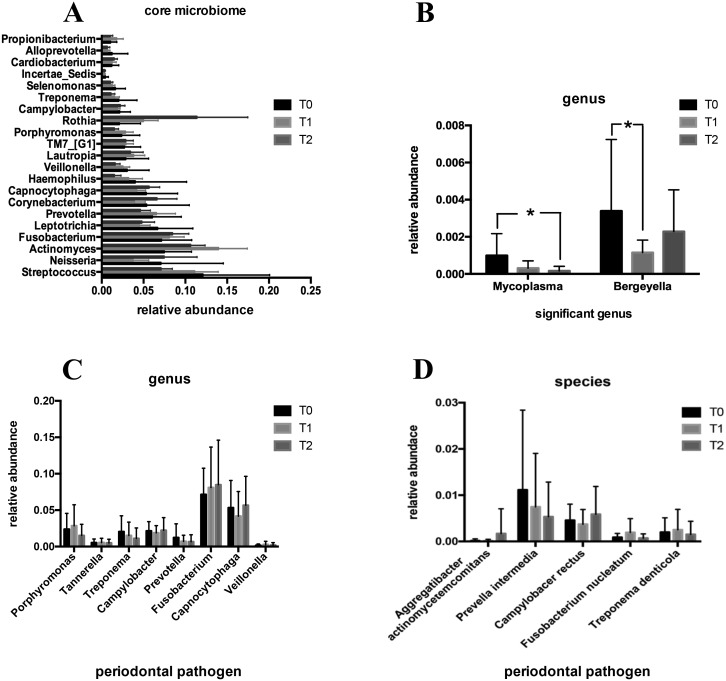
The plaque indices (PIs) and gingival bleeding indices (GBIs) were slightly increased at T1 and T2, but no statistically significant difference was found. The alpha diversity indices, including the ACE, Chao1, Shannon indices, all showed a declining trend without significance, and a rising trend in the Simpson diversity index was observed. The weighted UniFrac distance was significantly higher at T1 and T2 compared with T0. Principal Coordinates Analysis (PCoA) demonstrated that the communities at T0 tended to cluster apart from the communities at T1 and T2. The relative abundance of the phylum and genus was significantly increased at T0 compared with T2. There was no significant difference in the relative abundance of periodontal pathogens at the genus and species levels or core microorganisms at the genus level.
A slightly decreasing microbial diversity with a significant change of microbial structure was found during the first three-month clear aligner treatment (CAT). However, subjects receiving clear aligner treatment were free from periodontal diseases with relatively stable levels of periodontal microorganisms and core microorganisms. Thus, our preliminary findings indicated that clear aligners induced nonpathogenic changes of the subgingival microbiome in the first three-month treatment.
与传统固定矫治器相比,透明矫治器因便于保持口腔卫生和降低患牙周疾病的易感性而广为人知。然而,很少有研究关注透明矫治器治疗(CAT)期间的龈下微生物群落。因此,本研究调查了CAT前三个月龈下微生物群落的变化及其与临床特征的关联。
本研究纳入了10名佩戴透明矫治器的女性患者。在三个时间点采集龈下菌斑样本:正畸治疗前(T0)、正畸治疗后1个月(T1)和正畸治疗后3个月(T2)。然后从菌斑样本中提取DNA,并通过16S rRNA基因测序进行分析。还记录了牙周检查,包括菌斑指数(PI)和牙龈出血指数(GBI)测量。
T1和T2时菌斑指数(PI)和牙龈出血指数(GBI)略有升高,但未发现统计学上的显著差异。包括ACE、Chao1、香农指数在内的α多样性指数均呈下降趋势,但无显著性,辛普森多样性指数呈上升趋势。与T0相比,T1和T2时加权UniFrac距离显著更高。主坐标分析(PCoA)表明,T0时的群落倾向于与T1和T2时的群落聚类分开。与T2相比,T0时门和属的相对丰度显著增加。在属和种水平上的牙周病原体相对丰度或属水平上的核心微生物没有显著差异。
在透明矫治器治疗(CAT)的前三个月中,发现微生物多样性略有下降,微生物结构发生显著变化。然而,接受透明矫治器治疗的受试者没有患牙周疾病,牙周微生物和核心微生物水平相对稳定。因此,我们的初步研究结果表明,透明矫治器在治疗的前三个月诱导了龈下微生物群的非致病性变化。