Toy Randall, Roy Krishnendu
Wallace H. Coulter Dept. of Biomedical Engineering Georgia Institute of Technology, and Emory University Atlanta GA 30332.
Bioeng Transl Med. 2016 Jun 20;1(1):47-62. doi: 10.1002/btm2.10005. eCollection 2016 Mar.
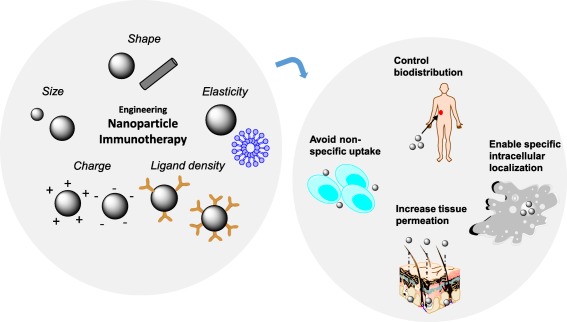
Advances in immunotherapy have led to the development of a variety of promising therapeutics, including small molecules, proteins and peptides, monoclonal antibodies, and cellular therapies. Despite this wealth of new therapeutics, the efficacy of immunotherapy has been limited by challenges in targeted delivery and controlled release, that is, spatial and temporal control on delivery. Particulate carriers, especially nanoparticles have been widely studied in drug delivery and vaccine research and are being increasingly investigated as vehicles to deliver immunotherapies. Nanoparticle-mediated drug delivery could provide several benefits, including control of biodistribution and transport kinetics, the potential for site-specific targeting, immunogenicity, tracking capability using medical imaging, and multitherapeutic loading. There are also a unique set of challenges, which include nonspecific uptake by phagocytic cells, off-target biodistribution, permeation through tissue (transport limitation), nonspecific immune-activation, and poor control over intracellular localization. This review highlights the importance of understanding the relationship between a nanoparticle's size, shape, charge, ligand density and elasticity to its vascular transport, biodistribution, cellular internalization, and immunogenicity. For the design of an effective immunotherapy, we highlight the importance of selecting a nanoparticle's physical characteristics (e.g., size, shape, elasticity) and its surface functionalization (e.g., chemical or polymer modifications, targeting or tissue-penetrating peptides) with consideration of its reactivity to the targeted microenvironment (e.g., targeted cell types, use of stimuli-sensitive biomaterials, immunogenicity). Applications of this rational nanoparticle design process in vaccine development and cancer immunotherapy are discussed.
免疫疗法的进展已促成了多种有前景的治疗方法的发展,包括小分子、蛋白质和肽、单克隆抗体以及细胞疗法。尽管有如此丰富的新治疗方法,但免疫疗法的疗效一直受到靶向递送和控释方面挑战的限制,即递送的空间和时间控制。颗粒载体,尤其是纳米颗粒,已在药物递送和疫苗研究中得到广泛研究,并且作为递送免疫疗法的载体正受到越来越多的研究。纳米颗粒介导的药物递送可带来多种益处,包括控制生物分布和运输动力学、实现位点特异性靶向的潜力、免疫原性、使用医学成像进行追踪的能力以及多疗法负载。也存在一系列独特的挑战,包括吞噬细胞的非特异性摄取、脱靶生物分布、组织渗透(运输限制)、非特异性免疫激活以及对细胞内定位的控制不佳。本综述强调了理解纳米颗粒的大小、形状、电荷、配体密度和弹性与其血管运输、生物分布、细胞内化和免疫原性之间关系的重要性。对于有效免疫疗法的设计,我们强调在考虑其对靶向微环境的反应性(例如,靶向细胞类型、刺激敏感生物材料的使用、免疫原性)的情况下,选择纳米颗粒的物理特性(例如,大小、形状、弹性)及其表面功能化(例如,化学或聚合物修饰、靶向或组织穿透肽)的重要性。讨论了这种合理的纳米颗粒设计过程在疫苗开发和癌症免疫疗法中的应用。