Bailly-Grandvaux M, Santos J J, Bellei C, Forestier-Colleoni P, Fujioka S, Giuffrida L, Honrubia J J, Batani D, Bouillaud R, Chevrot M, Cross J E, Crowston R, Dorard S, Dubois J-L, Ehret M, Gregori G, Hulin S, Kojima S, Loyez E, Marquès J-R, Morace A, Nicolaï Ph, Roth M, Sakata S, Schaumann G, Serres F, Servel J, Tikhonchuk V T, Woolsey N, Zhang Z
Univ. Bordeaux, CNRS, CEA, CELIA (Centre Lasers Intenses et Applications), UMR 5107, F-33405, Talence, France.
Institute of Laser Engineering, Osaka University, 2-6 Yamada-oka, Suita, Osaka, 565-0871, Japan.
Nat Commun. 2018 Jan 9;9(1):102. doi: 10.1038/s41467-017-02641-7.
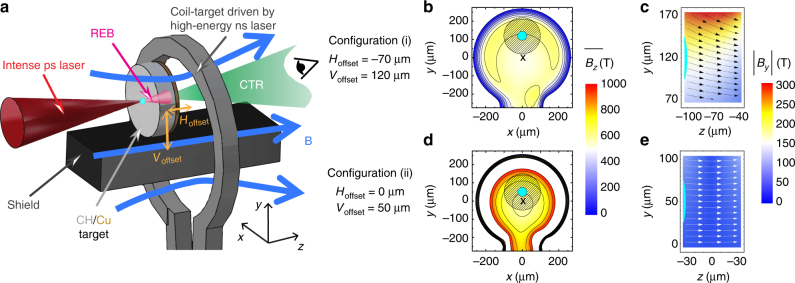
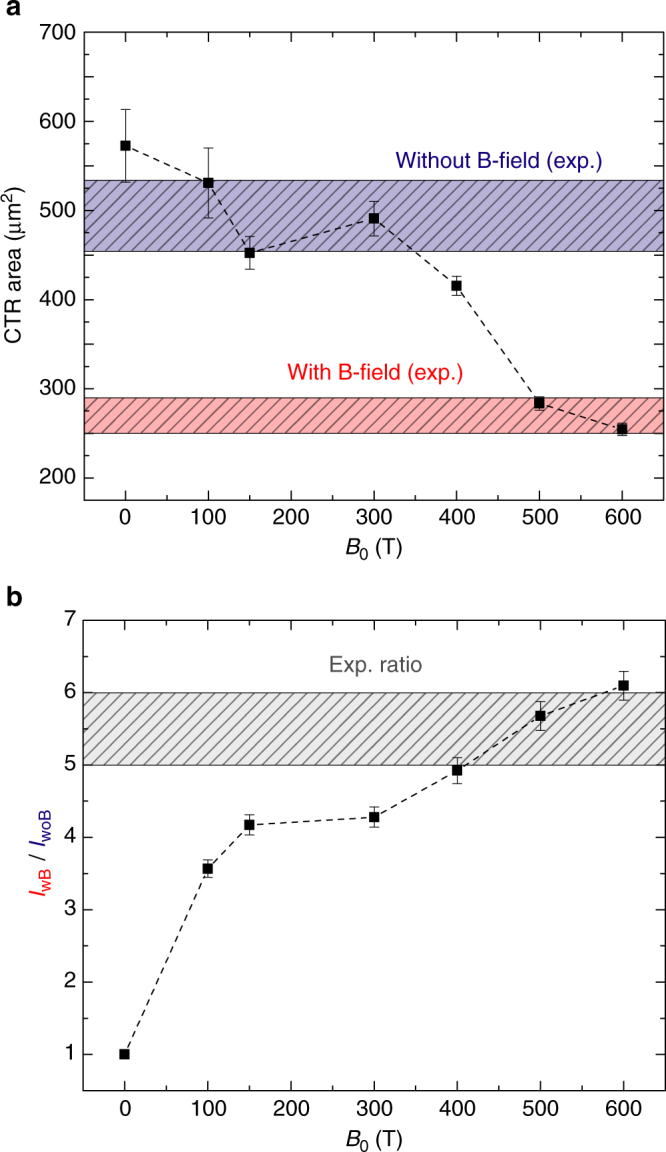
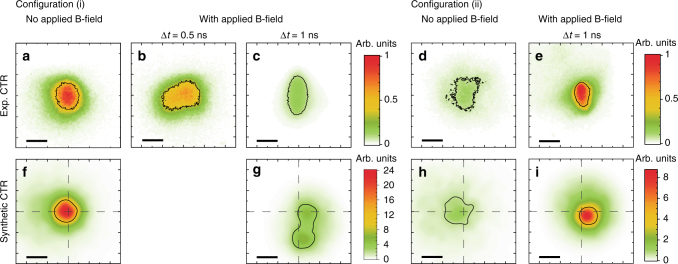
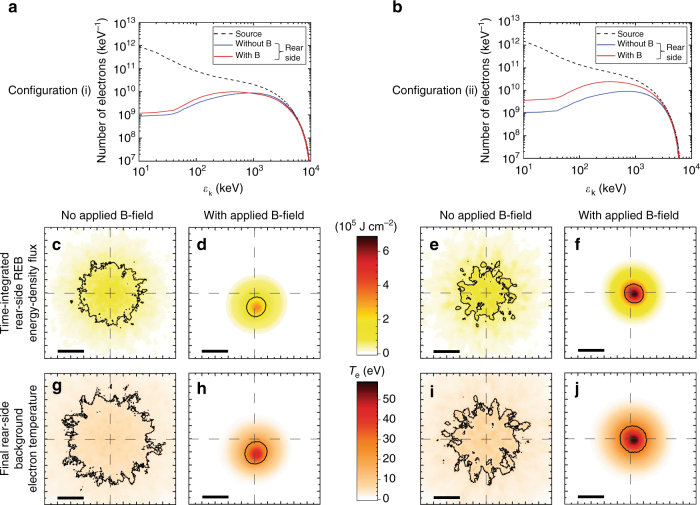
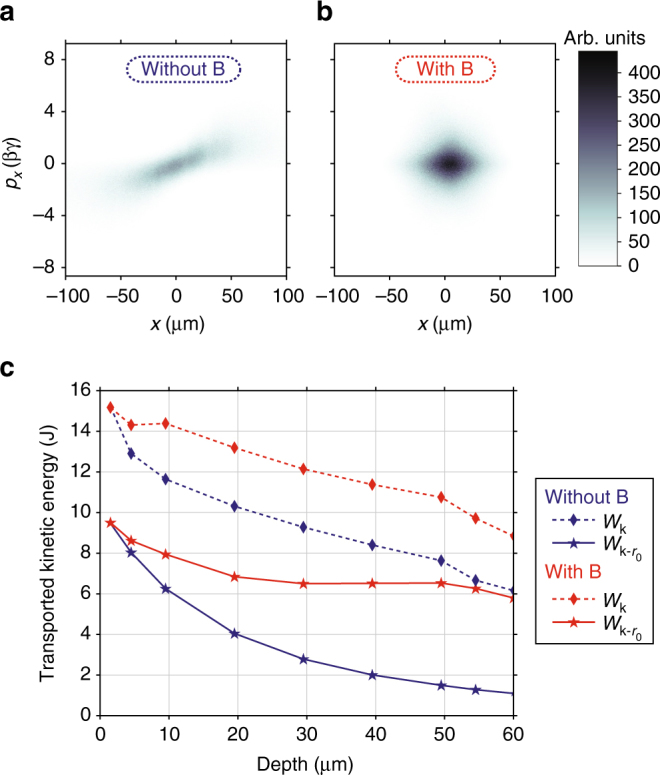
Intense lasers interacting with dense targets accelerate relativistic electron beams, which transport part of the laser energy into the target depth. However, the overall laser-to-target energy coupling efficiency is impaired by the large divergence of the electron beam, intrinsic to the laser-plasma interaction. Here we demonstrate that an efficient guiding of MeV electrons with about 30 MA current in solid matter is obtained by imposing a laser-driven longitudinal magnetostatic field of 600 T. In the magnetized conditions the transported energy density and the peak background electron temperature at the 60-μm-thick target's rear surface rise by about a factor of five, as unfolded from benchmarked simulations. Such an improvement of energy-density flux through dense matter paves the ground for advances in laser-driven intense sources of energetic particles and radiation, driving matter to extreme temperatures, reaching states relevant for planetary or stellar science as yet inaccessible at the laboratory scale and achieving high-gain laser-driven thermonuclear fusion.
强激光与致密靶相互作用会加速相对论电子束,这些电子束将部分激光能量传输到靶的深度。然而,激光与靶之间的整体能量耦合效率会因激光 - 等离子体相互作用中电子束固有的大发散角而降低。在此,我们证明通过施加600 T的激光驱动纵向静磁场,可以在固体物质中实现对约30 MA电流的兆电子伏特电子的有效引导。在磁化条件下,从基准模拟结果可知,在60μm厚靶的后表面处,传输的能量密度和峰值背景电子温度提高了约五倍。这种通过致密物质的能量密度通量的提升,为激光驱动的高能粒子和辐射强源的发展奠定了基础,能够将物质驱动到极端温度,达到在实验室规模下尚未能实现的与行星或恒星科学相关的状态,并实现高增益激光驱动热核聚变。