Chiu Hsien-Fu, Chen Hung-Chun, Lu Kuo-Cheng, Shu Kuo-Hsiung
Division of Nephrology, Department of Internal Medicine, Taichung Veterans General Hospital, Taichung, Taiwan.
Division of Nephrology, Department of Internal Medicine, Kaohsiung Medical University Hospital, Kaohsiung Medical University, Kaohsiung, Taiwan.
BMC Nephrol. 2018 Jan 10;19(1):6. doi: 10.1186/s12882-017-0810-4.
Despite the development of biomarkers and noninvasive imaging tools, biopsy remains the only method for correctly diagnosing patients with unexplained hematuria, proteinuria and renal failure. Renal biopsy has been performed for several decades in Taiwan; however, a national data registry is still lacking until 2013.
The Renal Biopsy Registry Committee was established within the Taiwan Society of Nephrology in January 2013. A biopsy registry format, including basic demographic data, baseline clinical features, laboratory data, and clinical and pathological diagnosis was developed. Approval from the local institutional review board was obtained in each participating medical center.
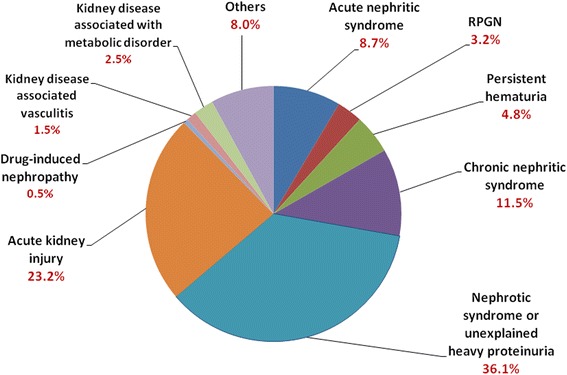
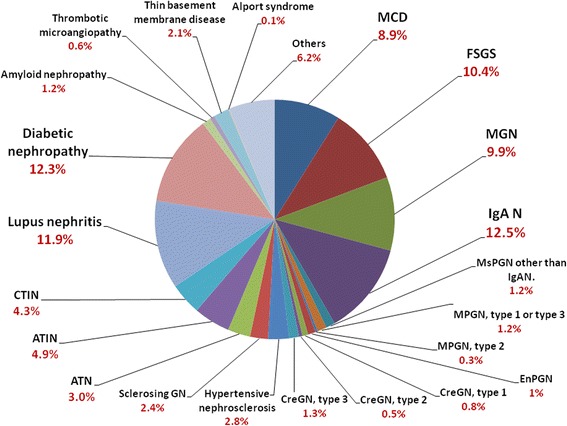
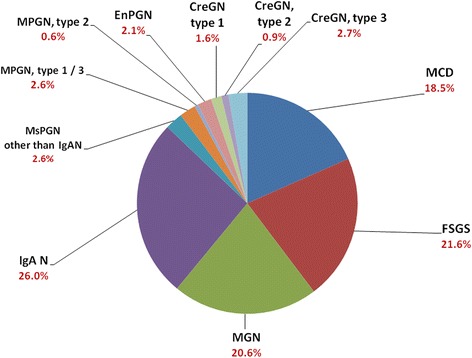
From January 2014 to September 2016, 1445 renal biopsies were identified from 17 medical centers. 53.8% cases were reported in men. After excluding renal transplantation, renal biopsies were commonly performed in patients with primary glomerulonephritis (48.1%), secondary glomerulonephritis (36.2%), followed by tubulointerstitial diseases (12.3%) and vascular nephropathy (3.4%). Among primary glomerulonephritis, IgA nephropathy (26.0%), focal segmental glomerulosclerosis (21.6%), and membranous nephropathy (20.6%) were most frequently diagnosed. Diabetic nephropathy (22.4%) and lupus nephritis (21.8%) were the most common among secondary glomerulonephritis. Patients with minimal change disease and membranous nephropathy had heavier proteinuria than those with focal segmental glomerulosclerosis and IgA nephropathy (P < 0.001). Patients with minimal change disease had higher serum IgM and IgE levels. The most common cause of nephrotic syndrome in primary glomerular disease was membranous nephropathy (28.8%), followed by minimal change disease (28.2%). IgA nephropathy was the leading cause of chronic nephritic syndrome, acute nephritic syndrome, and persistent hematuria. The incidence of primary glomerulonephritis was approximately 2.19 in 100,000/year.
This is the first report of the National Renal Biopsy Registry in Taiwan. IgA nephropathy is the most common primary glomerulonephritis, while membranous nephropathy is the most common cause of nephrotic syndrome. Primary glomerulonephritis distribution in Taiwan is slightly different from that in other Asian countries.
尽管生物标志物和非侵入性成像工具不断发展,但活检仍然是正确诊断不明原因血尿、蛋白尿和肾衰竭患者的唯一方法。肾活检在台湾已开展数十年;然而,直到2013年仍缺乏全国性的数据登记系统。
2013年1月,台湾肾脏病学会成立了肾活检登记委员会。制定了一种活检登记格式,包括基本人口统计学数据、基线临床特征、实验室数据以及临床和病理诊断。每个参与的医疗中心均获得了当地机构审查委员会的批准。
2014年1月至2016年9月,从17个医疗中心共识别出1445例肾活检病例。53.8%的病例为男性。排除肾移植病例后,肾活检常见于原发性肾小球肾炎患者(48.1%)、继发性肾小球肾炎患者(36.2%),其次是肾小管间质疾病患者(12.3%)和血管性肾病患者(3.4%)。在原发性肾小球肾炎中,最常诊断出的是IgA肾病(26.0%)、局灶节段性肾小球硬化症(21.6%)和膜性肾病(20.6%)。糖尿病肾病(22.4%)和狼疮性肾炎(21.8%)是继发性肾小球肾炎中最常见的类型。微小病变病和膜性肾病患者的蛋白尿比局灶节段性肾小球硬化症和IgA肾病患者更严重(P<0.001)。微小病变病患者的血清IgM和IgE水平较高。原发性肾小球疾病中肾病综合征最常见的病因是膜性肾病(28.8%),其次是微小病变病(28.2%)。IgA肾病是慢性肾炎综合征、急性肾炎综合征和持续性血尿的主要病因。原发性肾小球肾炎的发病率约为每年10万分之2.19。
这是台湾全国性肾活检登记系统的首份报告。IgA肾病是最常见的原发性肾小球肾炎,而膜性肾病是肾病综合征最常见的病因。台湾原发性肾小球肾炎的分布与其他亚洲国家略有不同。