Piao Dongri, Wang Heng, Di Dongdong, Tian Guozhong, Luo Jiantong, Gao Wenjie, Zhao Hongyan, Xu Weimin, Fan Weixing, Jiang Hai
State Key Laboratory for Infectious Disease Prevention and Control, Collaborative Innovation Center for Diagnosis and Treatment of Infectious Diseases, National Institute for Communicable Disease Control and Prevention, Chinese Center for Disease Control and Prevention, Beijing, China.
Hangzhou Center for Disease Control and Prevention (HZCDC), Hangzhou, China.
Front Vet Sci. 2017 Dec 18;4:223. doi: 10.3389/fvets.2017.00223. eCollection 2017.
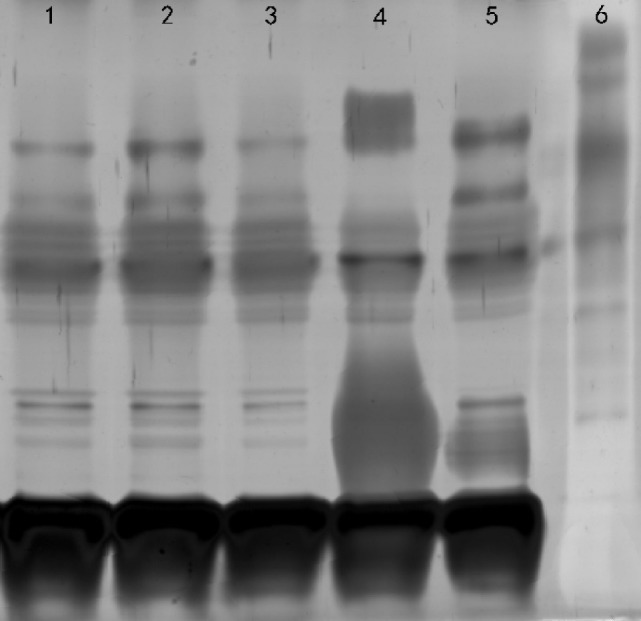
is a pathogenic bacterium that causes brucellosis in dogs, and its zoonotic potential has been increasing in recent years. is a rare source of human brucellosis in China, where has been the major pathogen associated with human brucellosis outbreaks. In late 2011, a case of a infection was detected in a human patient in Zhejiang Province, China. To compare the genotypes between strains of isolated from the patient and from dogs, a multiple-locus variable-number tandem-repeat analysis (MLVA-16) was performed. In addition, the lipopolysaccharide-synthesis-related genes were analyzed with the reference strain RM6/66.
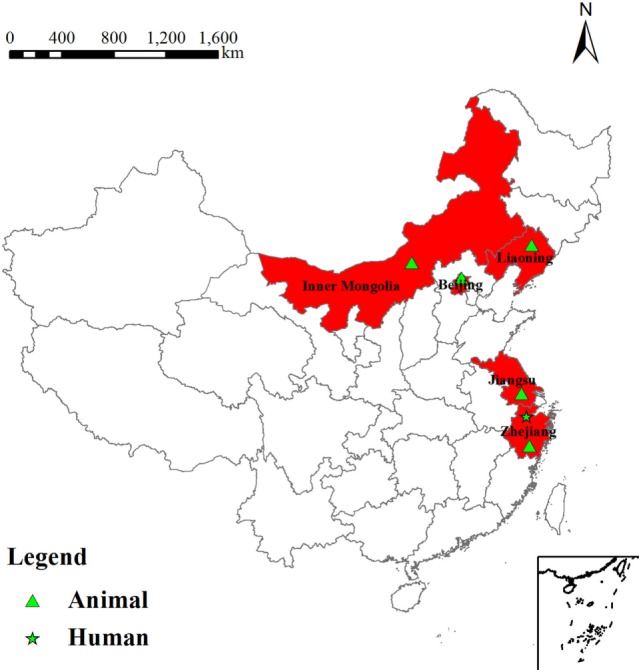
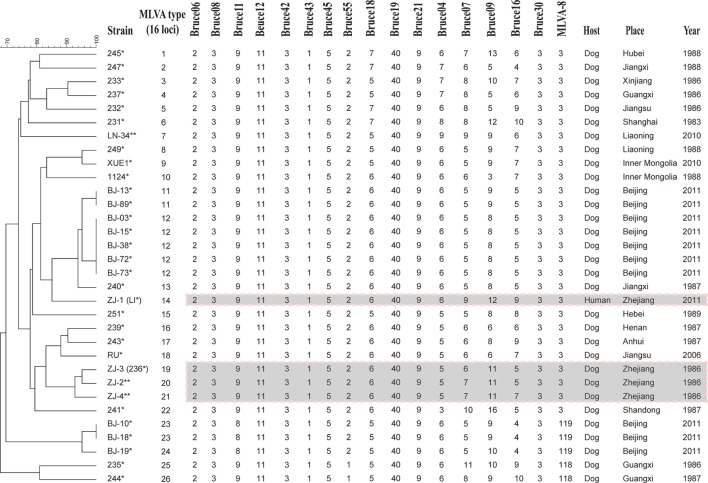
32 strains were divided into 26 genotypes using MLVA-16 [Hunter-Gaston Diversity Index (HGDI) = 0.976]. The HGDI indexes for various loci ranged between 0.000 and 0.865. All four Hangzhou isolates were indistinguishable using panel 1 (genotype 3) and panel 2A (genotype 28). However, these strains were distinctly different from other isolates from Beijing, Jiangsu, Liaoning, and Inner Mongolia at Bruce 09. The emergence of a human infection was limited to an area. Comparative analysis indicated from canines and humans have no differences in lipopolysaccharide-synthesis locus.
The comprehensive approaches have been used to analyze human and canine isolates, including molecular epidemiological and LPS genetic characteristics. Further detailed analysis of the whole genomic sequencing will contribute to understanding of the pathogenicity of in humans.
是一种可导致犬类布鲁氏菌病的致病细菌,近年来其人畜共患病潜力不断增加。在中国,是人类布鲁氏菌病的罕见传染源,一直是与人类布鲁氏菌病暴发相关的主要病原体。2011年末,在中国浙江省的一名人类患者中检测到一例感染病例。为比较从该患者和犬类中分离出的菌株的基因型,进行了多位点可变数目串联重复分析(MLVA - 16)。此外,还使用参考菌株RM6/66分析了脂多糖合成相关基因。
使用MLVA - 16将32株菌株分为26种基因型[亨特 - 加斯顿多样性指数(HGDI)= 0.976]。各个位点的HGDI指数在0.000至0.865之间。使用面板1(基因型3)和面板2A(基因型28)时,所有四株杭州分离株无法区分。然而,在Bruce 09位点,这些菌株与来自北京、江苏、辽宁和内蒙古的其他分离株明显不同。人类感染的出现局限于一个地区。比较分析表明,来自犬类和人类的在脂多糖合成位点上没有差异。
已采用综合方法分析人类和犬类分离株,包括分子流行病学和脂多糖遗传特征。对全基因组测序进行进一步详细分析将有助于了解在人类中的致病性。