Willner Sven N, Levermann Anders, Zhao Fang, Frieler Katja
Potsdam Institute for Climate Impact Research, Potsdam, Germany.
Institute of Physics, Potsdam University, Potsdam, Germany.
Sci Adv. 2018 Jan 10;4(1):eaao1914. doi: 10.1126/sciadv.aao1914. eCollection 2018 Jan.
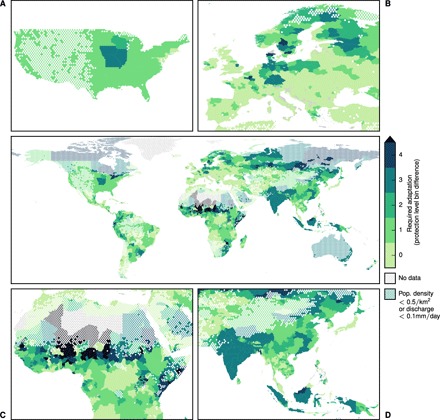
Earth's surface temperature will continue to rise for another 20 to 30 years even with the strongest carbon emission reduction currently considered. The associated changes in rainfall patterns can result in an increased flood risk worldwide. We compute the required increase in flood protection to keep high-end fluvial flood risk at present levels. The analysis is carried out worldwide for subnational administrative units. Most of the United States, Central Europe, and Northeast and West Africa, as well as large parts of India and Indonesia, require the strongest adaptation effort. More than half of the United States needs to at least double their protection within the next two decades. Thus, the need for adaptation to increased river flood is a global problem affecting industrialized regions as much as developing countries.
即使采取目前认为最强有力的碳排放减少措施,地球表面温度仍将在未来20至30年内持续上升。降雨模式的相关变化可能导致全球洪水风险增加。我们计算了将高端河流洪水风险维持在当前水平所需增加的防洪措施。该分析在全球范围内针对次国家行政单位进行。美国大部分地区、中欧、非洲东北部和西部以及印度和印度尼西亚的大部分地区需要做出最强有力的适应努力。美国一半以上的地区需要在未来二十年内至少将其防洪能力提高一倍。因此,适应河流洪水增加的需求是一个全球性问题,对工业化地区和发展中国家的影响同样大。