Department of Public Health and Policy, University of Liverpool, Liverpool, UK.
Division of Health Research, Faculty of Health and Medicine, Lancaster University, Lancaster, UK.
J Epidemiol Community Health. 2018 Mar;72(3):252-258. doi: 10.1136/jech-2017-209882. Epub 2018 Jan 12.
There are large inequalities in levels of physical activity in the UK, and this is an important determinant of health inequalities. Little is known about the effectiveness of community-wide interventions to increase physical activity and whether effects differ by socioeconomic group.
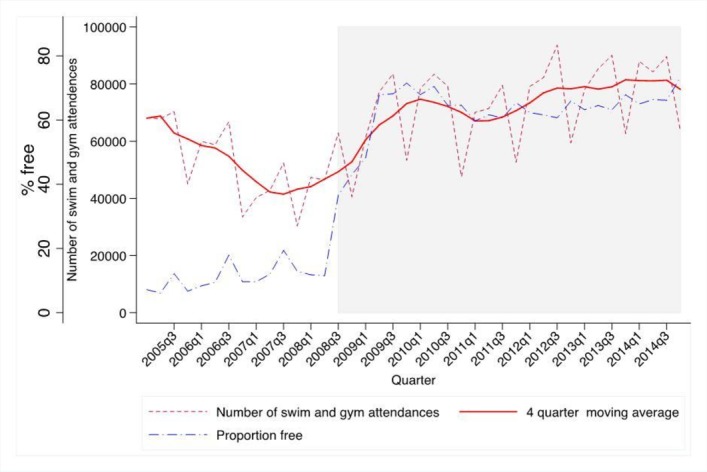
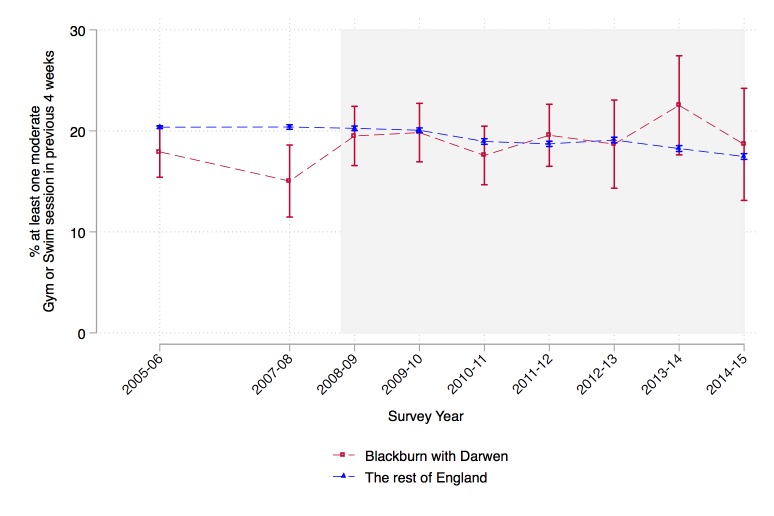
We conducted interrupted time series and difference-in-differences analyses using local administrative data and a large national survey to investigate the impact of an intervention providing universal free access to leisure facilities alongside outreach and marketing activities in a deprived local authority area in the northwest of England. Outcomes included attendances at swimming and gym sessions, self-reported participation in gym and swim activity and any physical activity.
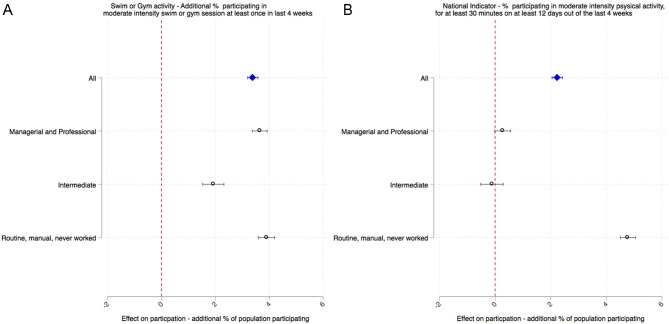
The intervention was associated with a 64% increase in attendances at swimming and gym sessions (relative risk 1.64, 95% CI 1.43 to 1.89, P<0.001), an additional 3.9% of the population participating in at least 30 min of moderate-intensity gym or swim sessions during the previous four weeks (95% CI 3.6 to 4.1) and an additional 1.9% of the population participating in any sport or active recreation of at least moderate intensity for at least 30 min on at least 12 days out of the last four weeks (95% CI 1.7 to 2.1). The effect on gym and swim activity and overall levels of participation in physical activity was significantly greater for the more disadvantaged socioeconomic group.
The study suggests that removing user charges from leisure facilities in combination with outreach and marketing activities can increase overall population levels of physical activity while reducing inequalities.
英国民众的身体活动水平存在较大差异,而这是健康不平等的一个重要决定因素。对于以社区为基础的干预措施增加身体活动的有效性,以及这些效果是否因社会经济群体而异,人们知之甚少。
我们使用地方行政数据和一项大型全国性调查,进行了中断时间序列和差分差异分析,以调查在英格兰西北部一个贫困地方当局地区提供免费使用休闲设施以及外展和营销活动的干预措施对游泳和健身课程出勤率、自我报告的健身房和游泳活动参与情况以及任何身体活动的影响。
该干预措施与游泳和健身课程出勤率增加 64%(相对风险 1.64,95%CI 1.43 至 1.89,P<0.001)、至少有 30 分钟中高强度健身房或游泳活动的人群比例增加 3.9%(95%CI 3.6 至 4.1)以及至少有 12 天每周至少进行 30 分钟中高强度体育或积极娱乐活动的人群比例增加 1.9%(95%CI 1.7 至 2.1)有关。对于社会经济地位较低的群体,该干预措施对健身房和游泳活动以及整体身体活动参与水平的影响更为显著。
研究表明,在休闲设施中取消用户收费,并结合外展和营销活动,可在提高全民身体活动水平的同时减少不平等现象。