Department of Genomics and Biology of Fruit Crops, Research and Innovation Centre, Fondazione Edmund Mach, Via E. Mach 1, 38010, San Michele all'Adige (TN), Italy.
Department of Agronomy, Food, Natural Resources, Animals and Environment (DAFNAE), University of Padova, Agripolis, V.le dell'Università, 16, 35020, Legnaro (PD), Italy.
Sci Rep. 2018 Jan 15;8(1):757. doi: 10.1038/s41598-018-19158-8.
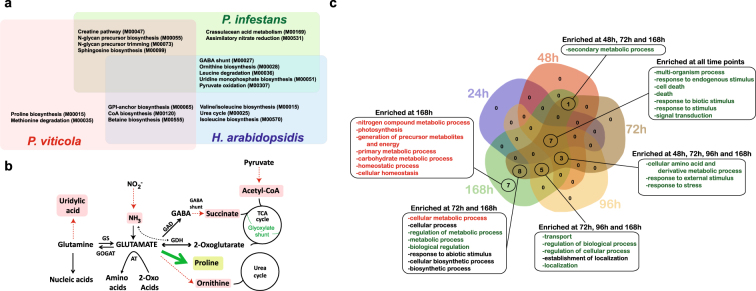
Fungicides are applied intensively to prevent downy mildew infections of grapevines (Vitis vinifera) with high impact on the environment. In order to develop alternative strategies we sequenced the genome of the oomycete pathogen Plasmopara viticola causing this disease. We show that it derives from a Phytophthora-like ancestor that switched to obligate biotrophy by losing genes involved in nitrogen metabolism and γ-Aminobutyric acid catabolism. By combining multiple omics approaches we characterized the pathosystem and identified a RxLR effector that trigger an immune response in the wild species V. riparia. This effector is an ideal marker to screen novel grape resistant varieties. Our study reveals an unprecedented bidirectional noncoding RNA-based mechanism that, in one direction might be fundamental for P. viticola to proficiently infect its host, and in the other might reduce the effects of the infection on the plant.
杀菌剂被广泛应用于预防葡萄(Vitis vinifera)霜霉病感染,这对环境有很大的影响。为了开发替代策略,我们对引起这种疾病的卵菌病原体葡萄生单轴霉进行了基因组测序。我们发现它源自一个类似 Phytophthora 的祖先,通过失去参与氮代谢和γ-氨基丁酸分解代谢的基因,转而成为专性生物营养型。通过结合多种组学方法,我们对该病理系统进行了表征,并鉴定出一种 RxLR 效应子,该效应子可在野生种 V. riparia 中引发免疫反应。该效应子是筛选新型葡萄抗病品种的理想标记。我们的研究揭示了一种前所未有的双向非编码 RNA 基机制,一方面该机制可能是 P. viticola 高效感染其宿主的基础,另一方面可能降低感染对植物的影响。