Liu Hao-Yen, Lee Wui-Chiang, Sun Ying-Chou, Fen Jun-Jeng, Chen Tzeng-Ji, Chou Li-Fang, Hwang Shinn-Jang
Department of Family Medicine, Taipei Veterans General Hospital, Taipei, Taiwan.
Department of Medical Affairs and Planning, Taipei Veterans General Hospital, Taipei, Taiwan.
JMIR Mhealth Uhealth. 2018 Jan 16;6(1):e22. doi: 10.2196/mhealth.8636.
Over the last decade, the use of mobile phone apps in the health care industry has grown rapidly. Owing to the high penetration rate of Internet use in Taiwan, hospitals are eager to provide their own apps to improve the accessibility of medical care for patients.
The aims of this study were to provide an overview of the currently available hospital-owned apps in Taiwan and to conduct a cross-hospital comparison of app features.
In May 2017, the availability of apps from all 414 hospitals in Taiwan was surveyed from the hospital home pages and the Google Play app store. The features of the downloaded apps were then examined in detail and, for each app, the release date of the last update, download frequency, and rating score were obtained from Google Play.
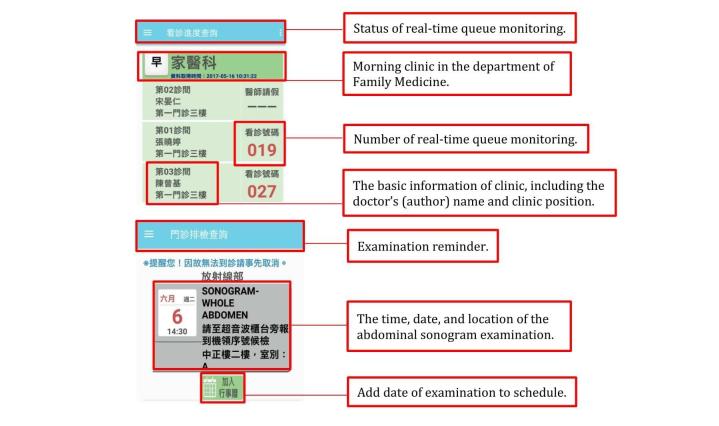
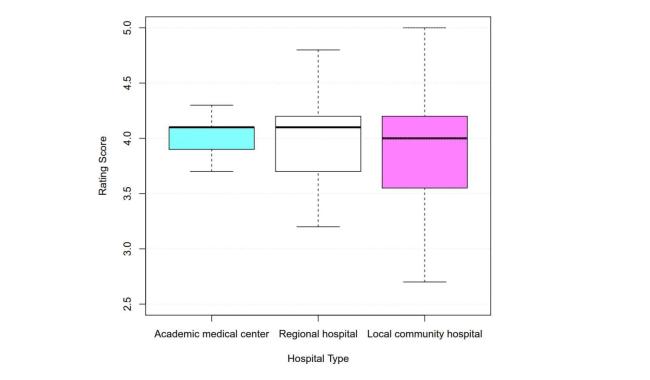
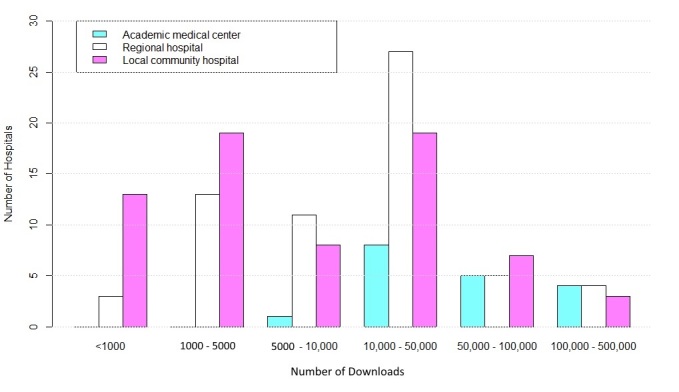
Among all the 414 hospitals in Taiwan, 150 (36.2%) owned Android apps that had been made available for public use, including 95% (18/19) of the academic medical centers, 77% (63/82) of the regional hospitals, and 22.0% (69/313) of the local community hospitals. Among the 13 different functionalities made available by the various hospital-owned apps, the most common were the doctor search (100%, 150/150), real-time queue monitoring (100%, 150/150), and online appointment scheduling (94.7%, 142/150) functionalities. The majority of apps (57.3%, 86/150) had a rating greater than 4 out of 5, 49.3% (74/150) had been updated at some point in 2017, and 36.0% (54/150) had been downloaded 10,000 to 50,000 times.
More than one-third of the hospitals owned apps intended to increase patient access to health care. The most common app features might reflect the health care situation in Taiwan, where the overcrowded outpatient departments of hospitals operate in an open-access mode without any strict referral system. Further research should focus on the effectiveness and safety of these apps.
在过去十年中,手机应用程序在医疗行业的使用迅速增长。由于台湾互联网使用率高,医院渴望提供自己的应用程序,以提高患者获得医疗服务的便利性。
本研究旨在概述台湾目前可用的医院自有应用程序,并对应用程序功能进行跨医院比较。
2017年5月,从医院主页和谷歌应用商店调查了台湾414家医院应用程序的可用性。然后详细检查下载应用程序的功能,并从谷歌应用商店获取每个应用程序的最后更新发布日期、下载频率和评分。
在台湾所有414家医院中,150家(36.2%)拥有可供公众使用的安卓应用程序,其中包括95%(18/19)的医学中心、77%(63/82)的区域医院和22.0%(69/313)的当地社区医院。在各种医院自有应用程序提供的13种不同功能中,最常见的是医生搜索(100%,150/150)、实时排队监测(100%,150/150)和在线预约挂号(94.7%,142/150)功能。大多数应用程序(57.3%,86/150)的评分高于4分(满分5分),49.3%(74/150)在2017年的某个时间点进行了更新,36.0%(54/150)的下载量为10000至50000次。
超过三分之一的医院拥有旨在增加患者获得医疗服务机会的应用程序。最常见的应用程序功能可能反映了台湾的医疗状况,即医院门诊部门人满为患,以开放式就诊模式运作,没有任何严格的转诊系统。进一步的研究应关注这些应用程序的有效性和安全性。