Department of Physics and Astronomy, University of Missouri, Columbia, Missouri, 65211, United States of America.
Department of Applied Mathematics and Theoretical Physics, University of Cambridge, Cambridge, CB3 OWA, United Kingdom.
Sci Rep. 2018 Jan 17;8(1):978. doi: 10.1038/s41598-018-19379-x.
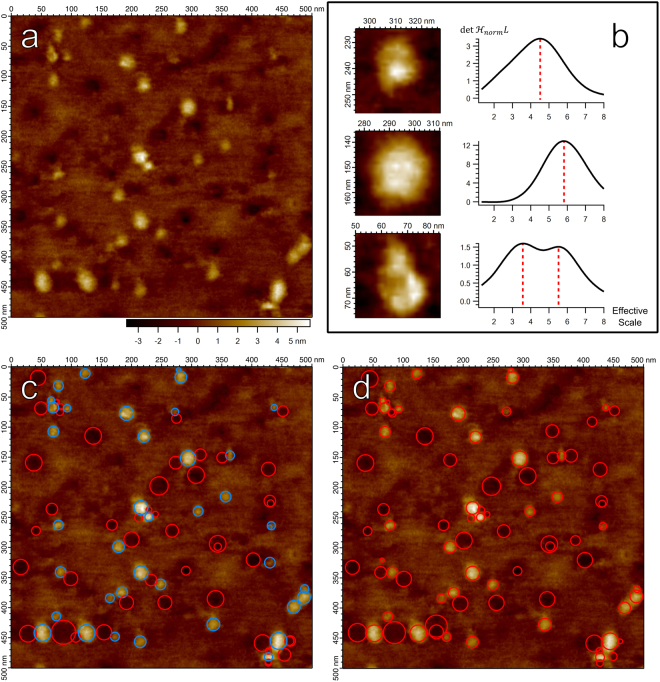
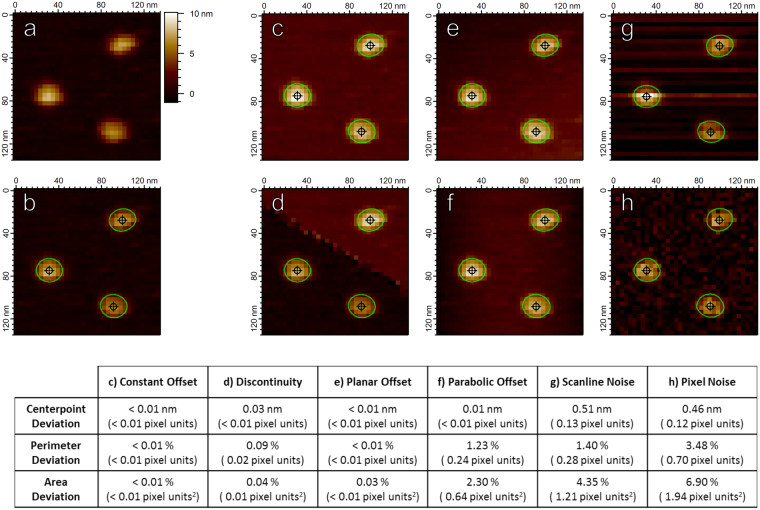
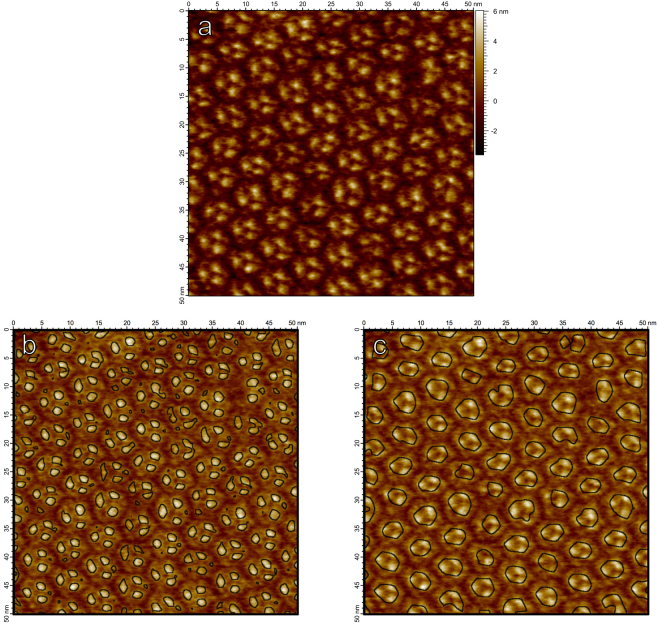
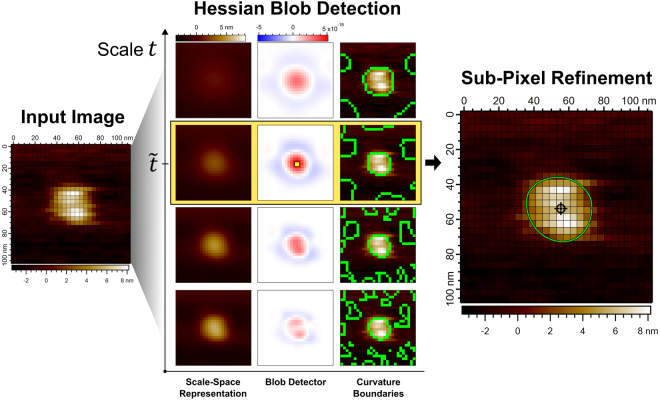
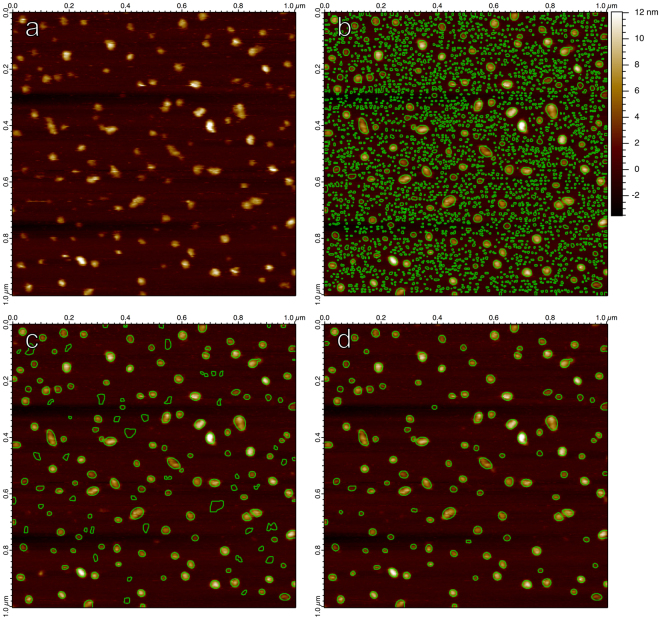
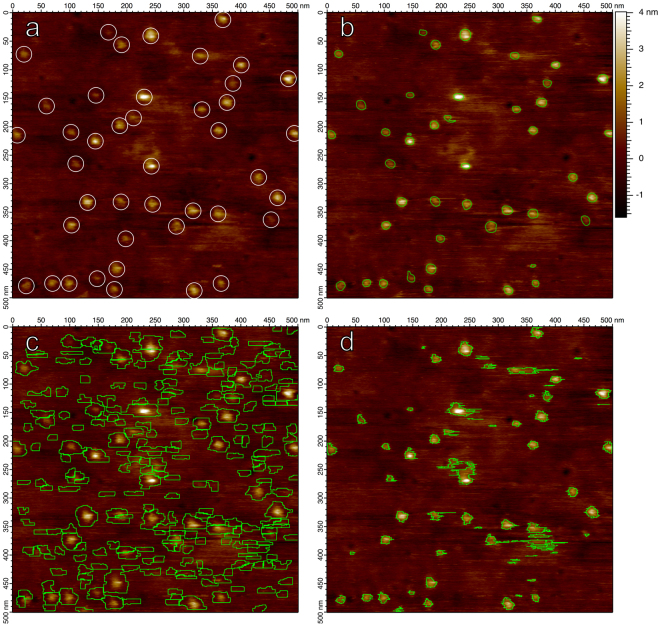
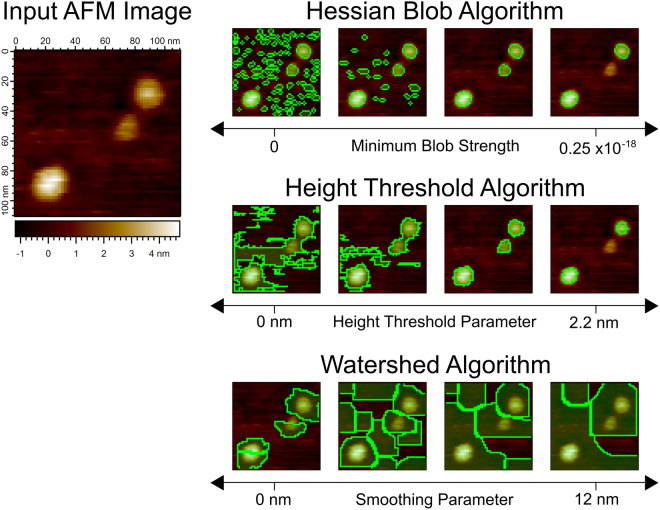
Imaging by atomic force microscopy (AFM) offers high-resolution descriptions of many biological systems; however, regardless of resolution, conclusions drawn from AFM images are only as robust as the analysis leading to those conclusions. Vital to the analysis of biomolecules in AFM imagery is the initial detection of individual particles from large-scale images. Threshold and watershed algorithms are conventional for automatic particle detection but demand manual image preprocessing and produce particle boundaries which deform as a function of user-defined parameters, producing imprecise results subject to bias. Here, we introduce the Hessian blob to address these shortcomings. Combining a scale-space framework with measures of local image curvature, the Hessian blob formally defines particle centers and their boundaries, both to subpixel precision. Resulting particle boundaries are independent of user defined parameters, with no image preprocessing required. We demonstrate through direct comparison that the Hessian blob algorithm more accurately detects biomolecules than conventional AFM particle detection techniques. Furthermore, the algorithm proves largely insensitive to common imaging artifacts and noise, delivering a stable framework for particle analysis in AFM.
原子力显微镜(AFM)成像提供了许多生物系统的高分辨率描述;然而,无论分辨率如何,从 AFM 图像中得出的结论只有在导致这些结论的分析稳健的情况下才可靠。在 AFM 图像中分析生物分子的关键是从大规模图像中初始检测到单个粒子。阈值和分水岭算法是自动粒子检测的常规方法,但需要手动图像预处理,并产生随用户定义参数而变形的粒子边界,从而产生受偏差影响的不精确结果。在这里,我们引入了Hessian blob 来解决这些缺点。通过将尺度空间框架与局部图像曲率度量相结合,Hessian blob 正式定义了粒子中心及其边界,都达到了亚像素精度。得到的粒子边界独立于用户定义的参数,不需要图像预处理。我们通过直接比较证明,Hessian blob 算法比传统的 AFM 粒子检测技术更准确地检测生物分子。此外,该算法对常见的成像伪影和噪声具有很大的抗干扰性,为 AFM 中的粒子分析提供了一个稳定的框架。