Farh Mohamed El-Agamy, Kim Yeon-Ju, Kim Yu-Jin, Yang Deok-Chun
Graduate School of Biotechnology and Ginseng Bank, College of Life Science, Kyung Hee University, Yongin, Republic of Korea.
Department of Oriental Medicinal Biotechnology, College of Life Sciences, Kyung Hee University, Yongin, Republic of Korea.
J Ginseng Res. 2018 Jan;42(1):9-15. doi: 10.1016/j.jgr.2017.01.004. Epub 2017 Jan 16.
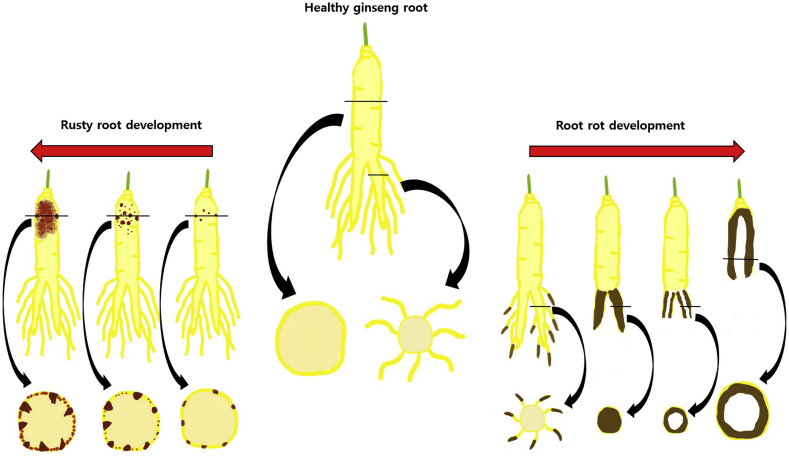
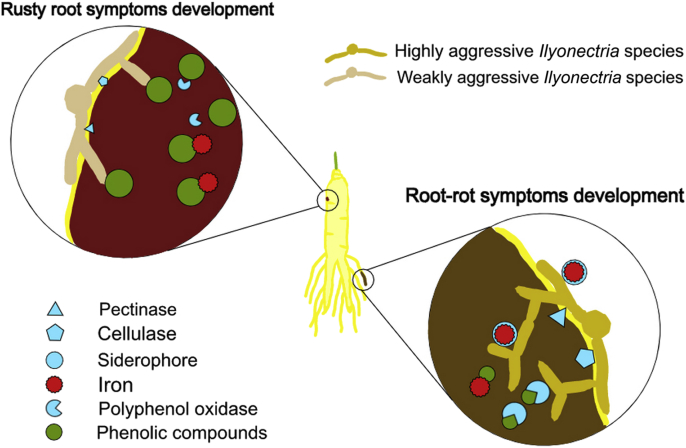
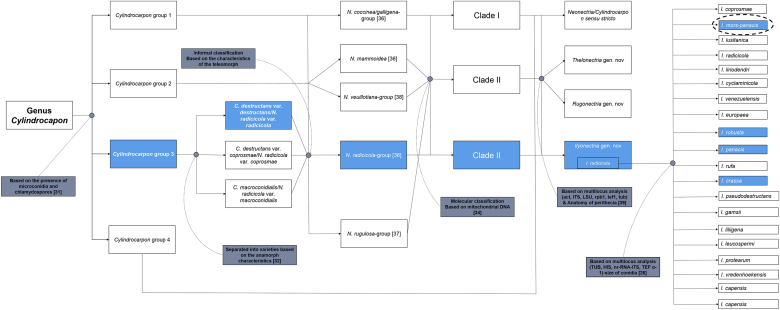
/ is thought to cause both rusty symptom and root-rot disease of American and Korean ginseng. Root-rot disease poses a more serious threat to ginseng roots than rusty symptoms, which we argue result from the plant defense response to pathogen attack. Therefore, strains causing rotten root are characterized as more aggressive than strains causing rusty symptoms. In this review, we state 1- the molecular evidence indicating that the root-rot causing strains are genetically distinct considering them as a separate species of , namely and 2- the physiological and biochemical differences between the weakly and highly aggressive species as well as those between rusty and rotten ginseng plants. Eventually, we postulated that rusty symptom occurs on ginseng roots due to incompatible interactions with the weakly aggressive species of , by the established iron-phenolic compound complexes while root-rot is developed by infection due to the production of high quantities of hydrolytic and oxidative fungal enzymes which destroy the plant defensive barriers, in parallel with the pathogen growth stimulation by utilizing the available iron. Furthermore, we highlight future areas for study that will help elucidate the complete mechanism of root-rot disease development.
据认为,/会导致西洋参和高丽参出现锈腐症状和根腐病。根腐病对人参根的威胁比锈腐症状更大,我们认为锈腐症状是植物对病原体攻击的防御反应所致。因此,引起根腐的菌株比引起锈腐症状的菌株更具侵袭性。在本综述中,我们阐述了:1-分子证据表明,导致根腐的菌株在基因上与/的其他菌株不同,可将它们视为/的一个单独物种,即;2-弱侵袭性物种和高侵袭性物种之间以及锈腐人参植株和根腐人参植株之间的生理生化差异。最终,我们推测,人参根上出现锈腐症状是由于与/的弱侵袭性物种发生不相容相互作用,通过形成铁-酚类化合物复合物所致,而根腐是由/感染引起的,因为该菌产生大量水解酶和氧化酶,这些酶会破坏植物防御屏障,同时利用可用铁刺激病原体生长。此外,我们强调了未来有助于阐明根腐病发病完整机制的研究领域。