Departament of Stomatology, Faculty of Medicine and Dentistry, University of Valencia, Valencia, Spain.
Sci Rep. 2018 Jan 19;8(1):1248. doi: 10.1038/s41598-018-19821-0.
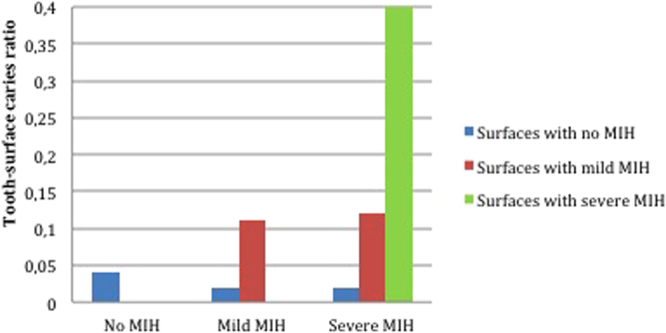
Molar incisor hypomineralization is a developmental defect of dental enamel associated with rapid caries progression. In order to discover whether molar incisor hypomineralization predisposes to dental caries, a cross-sectional cohort study was conducted in a sample of 414 children aged between eight and nine years. It was found that 24.2% of the children presented molar incisor hypomineralization. Of these, 72% had a mild form and 28% a severe form. Caries prevalence was greater among the children with severe form (60.7%) than in those with mild form (43.1%) or no molar incisor hypomineralization (45.5%). The caries indices were higher in out molar incisor hypomineralization (1.18) or with mild form (1.08). The tooth-surface caries ratio was significantly higher in surfaces with severe hypomineralization than in those with no hypomineralization or mild hypomineralization. A linear regression model showed that cariogenic food intake and the presence of severe molar incisor hypomineralization were significantly associated with DMFS. Consequently, an association was found to exist between dental caries and the presence of surfaces affected by severe molar incisor hypomineralization, which should be considered a risk factor within the multifactorial etiology of caries.
磨牙牙釉质发育不全是一种与快速龋齿进展相关的牙釉质发育缺陷。为了发现磨牙牙釉质发育不全是否容易发生龋齿,在一个 414 名 8-9 岁儿童的样本中进行了横断面队列研究。结果发现,24.2%的儿童存在磨牙牙釉质发育不全。其中,72%为轻度,28%为重度。重度患儿的龋齿患病率(60.7%)高于轻度患儿(43.1%)和无磨牙牙釉质发育不全患儿(45.5%)。重度患儿的龋齿指数(1.18)高于轻度患儿(1.08)。严重釉质发育不全的牙面龋比值明显高于无釉质发育不全或轻度釉质发育不全的牙面。线性回归模型显示,致龋性食物摄入和重度磨牙牙釉质发育不全的存在与 DMFS 显著相关。因此,在多因素龋病病因学中,发现龋齿与严重磨牙牙釉质发育不全受累表面之间存在关联,应将其视为一个危险因素。