Laboratoire Acté EA 4281, Chamalières, France.
BMC Public Health. 2018 Jan 22;18(1):163. doi: 10.1186/s12889-017-5011-3.
Implementing complex and multi-level public health programmes is challenging in school settings. Discrepancies between expected and actual programme outcomes are often reported. Such discrepancies are due to complex interactions between contextual factors. Contextual factors relate to the setting, the community, in which implementation occurs, the stakeholders involved, and the characteristics of the programme itself. This work uses realist evaluation to understand how contextual factors influence the implementation process, to result in variable programme outcomes. This study focuses on identifying contextual factors, pinpointing combinations of contextual factors, and understanding interactions and effects of such factors and combinations on programme outcomes on different levels of the implementation process.
Schools which had participated in a school-based health promotion programme between 2012 and 2015 were included. Two sets of qualitative data were collected: semi-structured interviews with school staff and programme coordinators; and written documents about the actions implemented in a selection of four schools. Quantitative data included 1553 questionnaires targeting pupils aged 8 to 11 in 14 schools to describe the different school contexts.
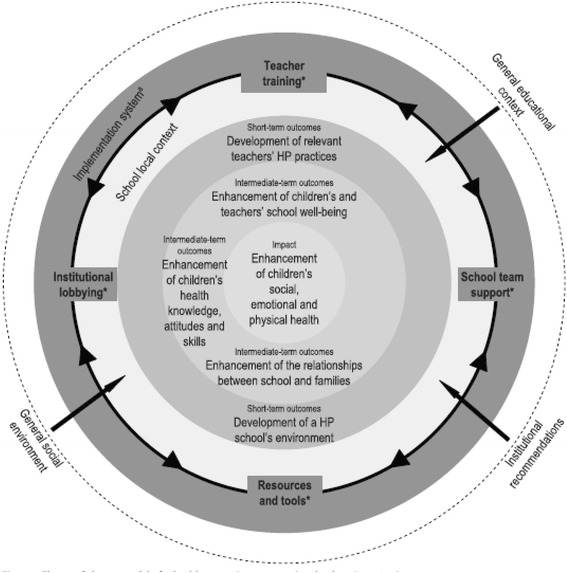
The comparison between what was expected from the programme (programme theory) and the outcomes identified in the field data, showed that some of the mechanisms expected to support the implementation of the programme, did not operate as anticipated (e.g. inclusion of training, initiation by decision-maker). Key factors which influenced the implementation process included, amongst other factors, the mode of introduction of the programme, home/school relationship, leadership of the management team, and the level of delegated power. Five types of interactions between contextual factors were put forward: enabling, hindering, neutral, counterbalancing and moderating effects. Recurrent combinations of factors were identified. Implementation was more challenging in vulnerable schools where school climate was poor.
A single programme cannot be suited or introduced in the same manner in every context. However, key recurrent combinations of contextual factors could contribute to the design of implementation patterns, which could provide guidelines and recommendation for grass-root programme implementation.
在学校环境中实施复杂且多层次的公共卫生项目具有挑战性。预期和实际项目结果之间经常存在差异。这些差异是由于背景因素之间的复杂相互作用造成的。背景因素与实施发生的环境、社区、相关利益者以及项目本身的特征有关。这项工作使用真实评估来了解背景因素如何影响实施过程,从而导致项目结果的差异。本研究重点是确定背景因素,指出背景因素的组合,并理解这些因素和组合在实施过程的不同层次上对项目结果的相互作用和影响。
参与了 2012 年至 2015 年期间基于学校的健康促进项目的学校被纳入研究。收集了两组定性数据:对学校工作人员和项目协调员进行半结构化访谈;以及关于在四所学校中实施的行动的书面文件。定量数据包括针对 14 所学校 8 至 11 岁学生的 1553 份问卷,以描述不同的学校环境。
将项目的预期(项目理论)与实地数据中确定的结果进行比较,表明一些预期支持项目实施的机制并没有按预期运作(例如,包括培训、决策者发起)。影响实施过程的关键因素包括,除其他因素外,项目引入的方式、家庭/学校关系、管理团队的领导能力以及授权的级别。提出了五种类型的背景因素之间的相互作用:促进、阻碍、中性、平衡和调节作用。反复出现的因素组合被识别出来。在学校氛围较差的弱势学校,实施工作更加困难。
不能在每种情况下以相同的方式适应或引入单一项目。然而,关键的背景因素反复出现的组合可以为实施模式的设计做出贡献,为基层项目的实施提供指导和建议。