Department of Ecology, Evolution and Behavior, University of Minnesota, St. Paul, MN, USA.
BioTechnology Institute, University of Minnesota, St. Paul, MN, USA.
ISME J. 2018 Mar;12(3):669-680. doi: 10.1038/s41396-017-0038-0. Epub 2018 Jan 24.
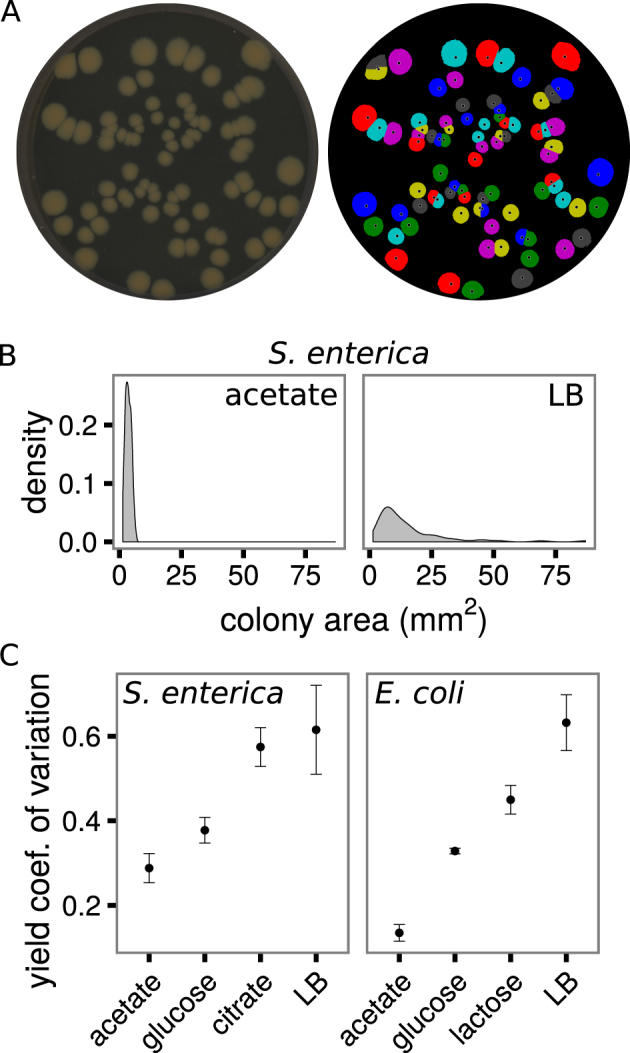
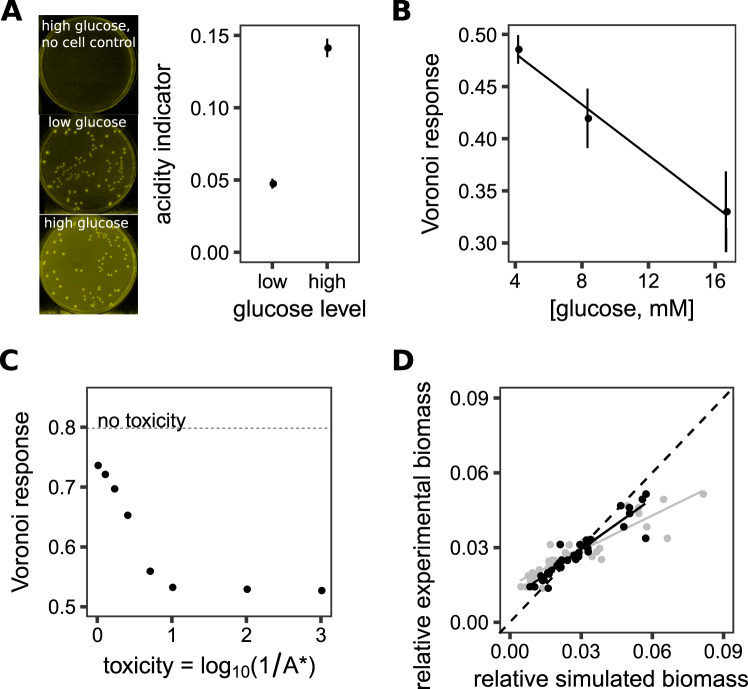
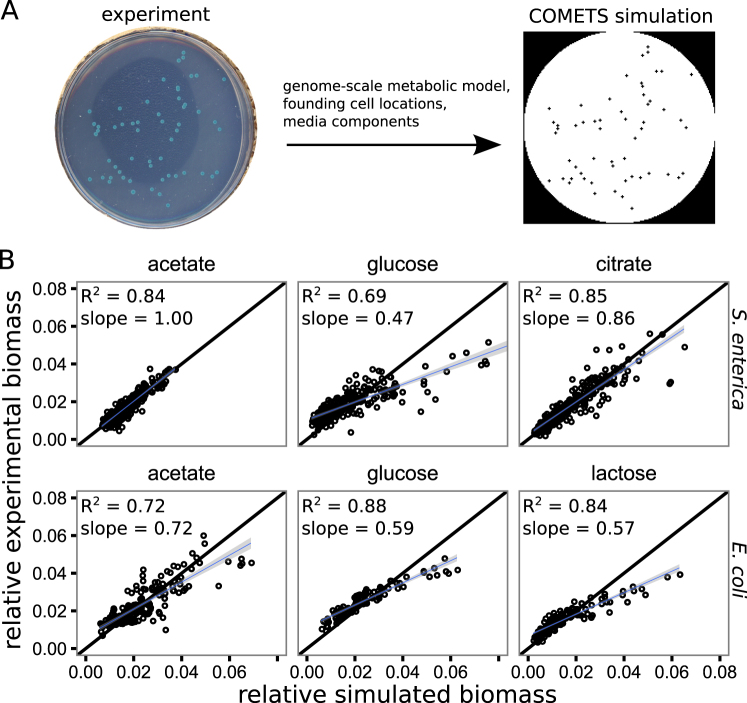
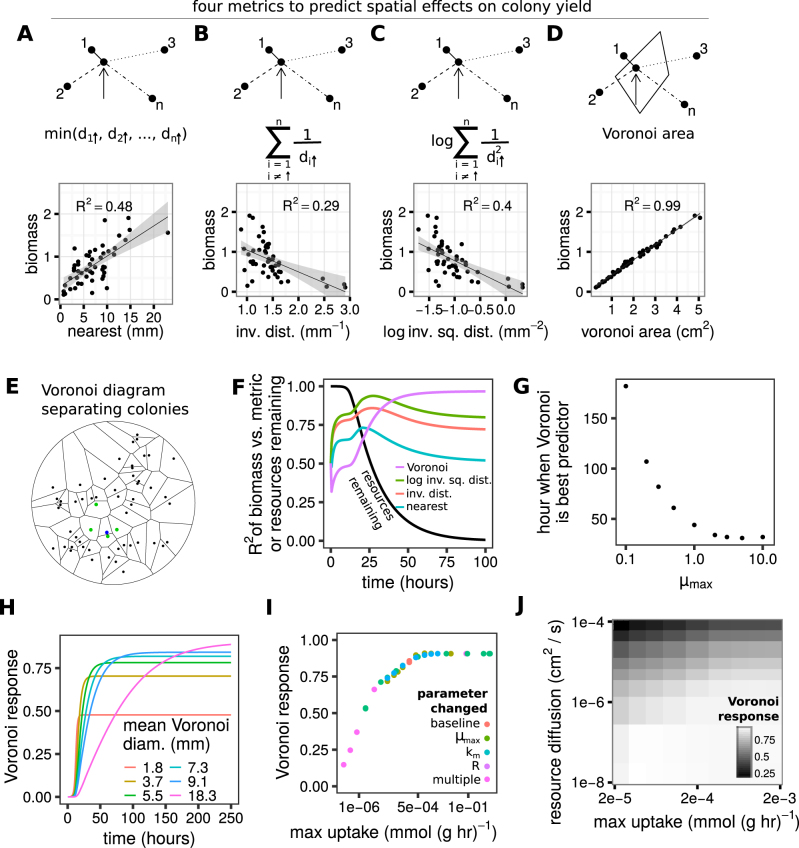
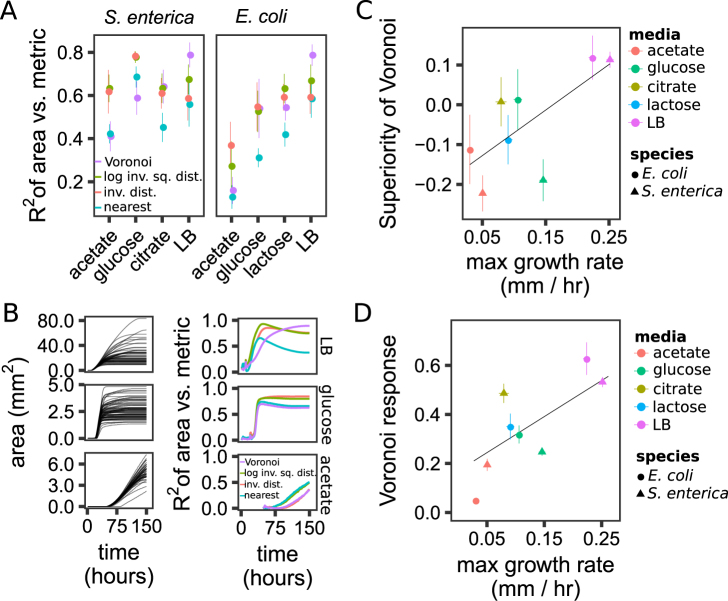
Spatial structure impacts microbial growth and interactions, with ecological and evolutionary consequences. It is therefore important to quantitatively understand how spatial proximity affects interactions in different environments. We tested how proximity influences colony size when either Escherichia coli or Salmonella enterica are grown on various carbon sources. The importance of colony location changed with species and carbon source. Spatially explicit, genome-scale metabolic modeling recapitulated observed colony size variation. Competitors that determine territory size, according to Voronoi diagrams, were the most important drivers of variation in colony size. However, the relative importance of different competitors changed through time. Further, the effect of location increased when colonies took up resources quickly relative to the diffusion of limiting resources. These analyses made it apparent that the importance of location was smaller than expected for experiments with S. enterica growing on glucose. The accumulation of toxic byproducts appeared to limit the growth of large colonies and reduced variation in colony size. Our work provides an experimentally and theoretically grounded understanding of how location interacts with metabolism and diffusion to influence microbial interactions.
空间结构会影响微生物的生长和相互作用,并产生生态和进化方面的后果。因此,定量了解空间接近度如何影响不同环境中的相互作用非常重要。我们测试了当大肠杆菌或沙门氏菌在不同碳源上生长时,接近度如何影响菌落大小。菌落位置的重要性因物种和碳源而异。基于 Voronoi 图的具有空间分辨率的基因组规模代谢模型再现了观察到的菌落大小变化。根据 Voronoi 图确定领地大小的竞争者是影响菌落大小变化的最重要驱动因素。然而,不同竞争者的相对重要性随时间而变化。此外,当菌落相对于限制资源的扩散更快地利用资源时,位置的影响会增加。这些分析表明,对于在葡萄糖上生长的沙门氏菌实验,位置的重要性比预期的要小。有毒副产物的积累似乎限制了大菌落的生长,并减少了菌落大小的变化。我们的工作提供了一种基于实验和理论的理解,即位置如何与代谢和扩散相互作用,从而影响微生物的相互作用。