Urizar Guido G, Henriques Laura, Chun Chi-Ah, Buonora Paul, Vu Kim-Phuong L, Galvez Gino, Kingsford Laura
1Department of Psychology, California State University, Long Beach, CA 90840 USA.
2Department of Science Education, California State University, Long Beach, CA 90840 USA.
BMC Proc. 2017 Dec 4;11(Suppl 12):26. doi: 10.1186/s12919-017-0088-3. eCollection 2017.
First-generation college graduates, racial and ethnic minorities, people with disabilities, and those from disadvantaged backgrounds are gravely underrepresented in the health research workforce representing behavioral health sciences and biomedical sciences and engineering (BHS/BSE). Furthermore, relative to their peers, very few students from these underrepresented groups (URGs) earn scientific bachelor's degrees with even fewer earning doctorate degrees. Therefore, programs that engage and retain URGs in health-related research careers early on in their career path are imperative to promote the diversity of well-trained research scientists who have the ability to address the nation's complex health challenges in an interdisciplinary way. The purpose of this paper is to describe the challenges, lessons learned, and sustainability of implementing a large-scale, multidisciplinary research infrastructure at California State University, Long Beach (CSULB) - a minority-serving institution - through federal funding received by the National Institutes of Health (NIH) Building Infrastructure Leading to Diversity (BUILD) Initiative.
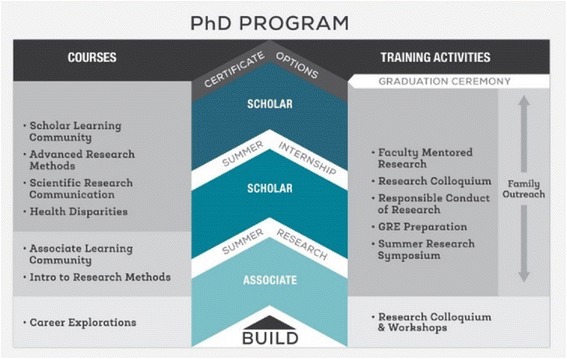
The CSULB BUILD initiative consists of developing a research infrastructure designed to engage and retain URGs on the research career path by providing them with the research training and skills needed to make them highly competitive for doctoral programs and entry into the research workforce. This initiative unites many research disciplines using basic, applied, and translational approaches to offer insights and develop technologies addressing prominent community and national health issues from a multidisciplinary perspective. Additionally, this initiative brings together local (e.g., high school, community college, doctoral research institutions) and national (e.g., National Research Mentoring Network) collaborative partners to alter how we identify, develop, and implement resources to enhance student and faculty research. Finally, this initiative establishes a student research training program that engages URGs earlier in their academic development, is larger and multidisciplinary in scope, and is responsive to the life contexts and promotes the cultural capital that URGs bring to their career path.
Although there have been many challenges to planning for and developing CSULB BUILD's large-scale, multidisciplinary research infrastructure, there have been many lessons learned in the process that could aid other campuses in the development and sustainability of similar research programs.
在代表行为健康科学以及生物医学科学与工程(BHS/BSE)的健康研究工作队伍中,第一代大学毕业生、少数族裔、残疾人士以及来自弱势背景的人群所占比例严重偏低。此外,相对于同龄人,这些代表性不足群体(URGs)中获得科学学士学位的学生极少,获得博士学位的更是寥寥无几。因此,在健康相关研究职业发展的早期阶段,吸引并留住URGs参与此类研究项目,对于培养具备跨学科能力、能够应对国家复杂健康挑战的训练有素的研究科学家的多样性而言至关重要。本文旨在描述通过美国国立卫生研究院(NIH)的建设促进多样性基础设施(BUILD)倡议获得联邦资金,在加州州立大学长滩分校(CSULB)——一所服务少数族裔的机构——实施大规模多学科研究基础设施所面临的挑战、经验教训以及可持续性。
CSULB的BUILD倡议包括开发一个研究基础设施,旨在通过为URGs提供使其在博士项目竞争中极具竞争力并进入研究工作队伍所需的研究培训和技能,吸引并留住他们在研究职业道路上发展。该倡议运用基础、应用和转化方法将众多研究学科联合起来,从多学科角度提供见解并开发解决突出社区和国家健康问题的技术。此外,该倡议汇聚了地方(如高中、社区学院、博士研究机构)和国家(如国家研究指导网络)的合作伙伴,以改变我们识别、开发和实施资源以加强学生和教师研究的方式。最后,该倡议建立了一个学生研究培训项目,该项目在URGs学术发展的早期阶段就吸引他们参与,规模更大且具有多学科性质,能够适应他们的生活环境并提升URGs带入其职业道路的文化资本。
尽管规划和发展CSULB的大规模多学科研究基础设施面临诸多挑战,但在此过程中也吸取了许多经验教训,这些经验教训有助于其他校园开展和维持类似的研究项目。