• 文献检索
  • 文档翻译
  • 深度研究
  • 学术资讯
  • Suppr Zotero 插件Zotero 插件
  • 邀请有礼
  • 套餐&价格
  • 历史记录
应用&插件
Suppr Zotero 插件Zotero 插件浏览器插件Mac 客户端Windows 客户端微信小程序
定价
高级版会员购买积分包购买API积分包
服务
文献检索文档翻译深度研究API 文档MCP 服务
关于我们
关于 Suppr公司介绍联系我们用户协议隐私条款
关注我们

Suppr 超能文献

核心技术专利:CN118964589B侵权必究
粤ICP备2023148730 号-1Suppr @ 2026

文献检索

告别复杂PubMed语法,用中文像聊天一样搜索,搜遍4000万医学文献。AI智能推荐,让科研检索更轻松。

立即免费搜索

文件翻译

保留排版,准确专业,支持PDF/Word/PPT等文件格式,支持 12+语言互译。

免费翻译文档

深度研究

AI帮你快速写综述,25分钟生成高质量综述,智能提取关键信息,辅助科研写作。

立即免费体验

一项关于使用活动追踪器评估姑息性放疗反应的试点研究。

A Pilot Study in the Use of Activity Trackers for Assessing Response to Palliative Radiotherapy.

作者信息

Dorion Valérie, Lambert Louise, Frazzi Alexandra, Cayer Jean-François, Wong Philip

机构信息

Department of Radiation Oncology, Centre hospitalier de l'Université de Montréal (CHUM).

Unité De Recherche Clinique En Oncologie Et Hématologie, Centre hospitalier de l'Université de Montréal (CHUM).

出版信息

Cureus. 2017 Nov 22;9(11):e1871. doi: 10.7759/cureus.1871.

DOI:10.7759/cureus.1871
PMID:29383293
原文链接:https://pmc.ncbi.nlm.nih.gov/articles/PMC5777628/
Abstract

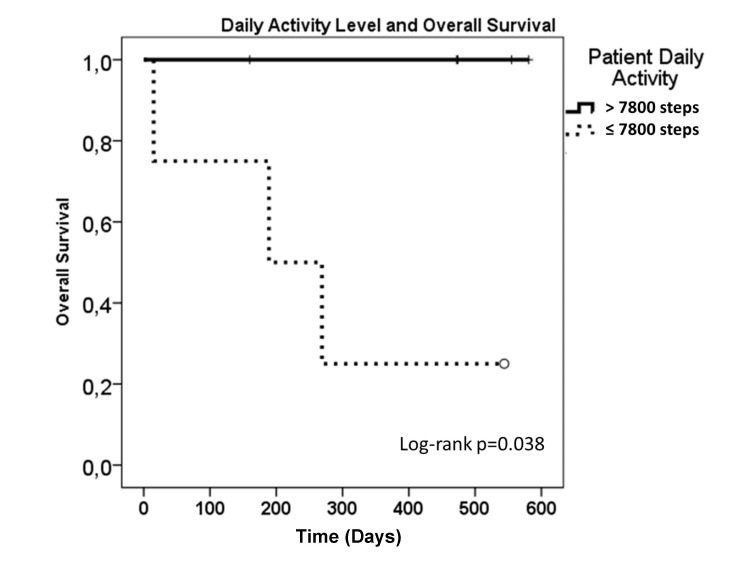
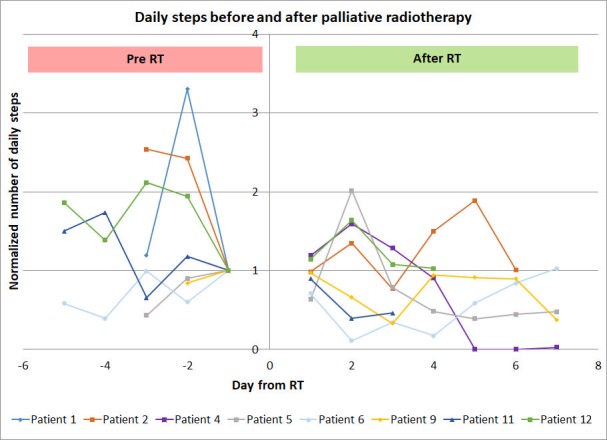
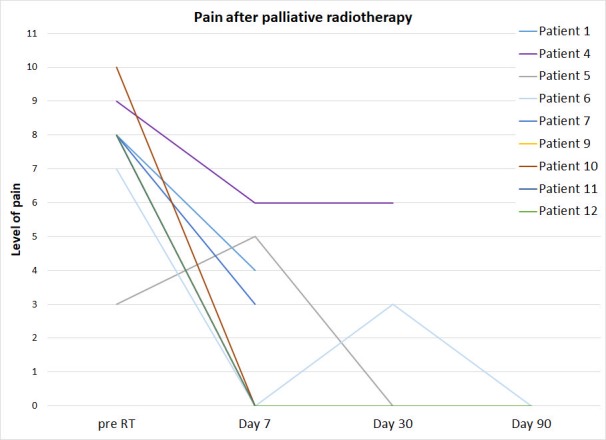
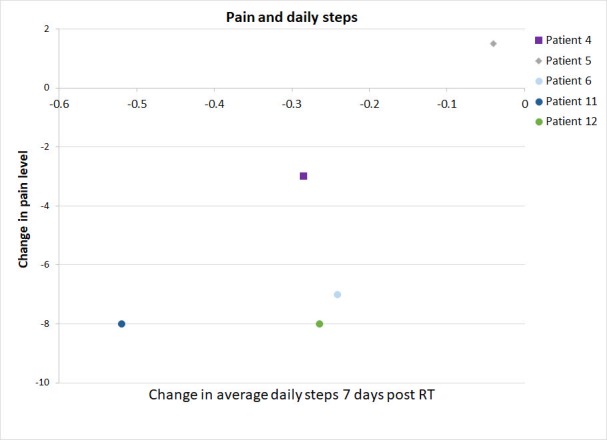
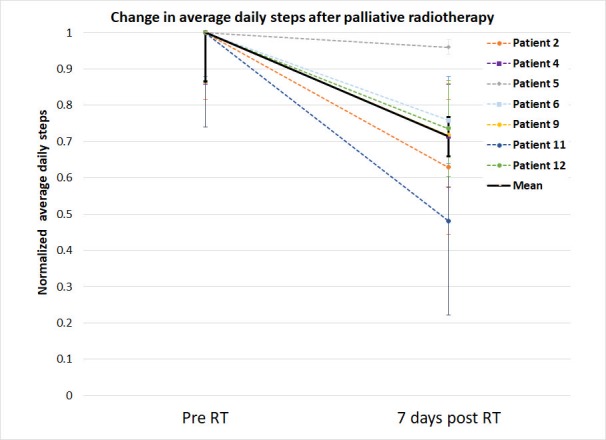
Purpose Radiation therapy (RT) has been a frequently used treatment for painful bone metastasis. The aim of this study was to determine the feasibility of using activity trackers (AT) to assess the patient prognosis and the effects of palliative RT. Methods and materials Twelve patients planned to receive palliative RT for axial metastases and were prospectively recruited to participate in this pilot clinical trial. The patients were eligible if there was no intent to change the analgesic medications prior to or within seven days of palliative RT. All the patients were lent a Misfit Flash activity tracker (Misfit, Burlingame, California, United States of America) and were asked to wear it from the time of baseline assessment prior to RT until seven days after RT. The patients completed the European Organisation for Research and Treatment of Cancer quality of life (QOL) questionnaire (EORTC-QLQ C30) and the Short Form Brief Pain Inventory (SF-BPI) before the treatment and at days seven, 30 and 90 after completion of the RT. The patients' Karnofsky Performance Status (KPS) was assessed at each visit. The patients' overall survival at the end of the RT was recorded. Average daily steps before and after RT were compared using paired Wilcoxon signed-rank test. The patients' overall survival was estimated using the Kaplan-Meier curve and analyzed using the Log-Rank test. Results The median age of the patients was 62 years (range: 40-79 years). Of the 12 patients, there were five prostate, three breasts, three lungs, and one colon cancer-related patients. Six patients received 20 Gray (Gy) in five fractions and six received 8 Gy in one fraction. By day seven, post-RT, there was a 30% (p <0.02) reduction in the patients' daily activity level. There was no correlation between improvements in the QOL or with the level of pain and with the number of daily steps. While baseline KPS was not prognostic of the patient survival, the patients who on average took more than 7800 steps per day prior to RT lived significantly (p=0.034) longer than those who were less active. Conclusions The baseline activity level is associated with the patient prognosis. A significant decline in the physical activity was observed at one week after palliative RT. The use of activity trackers was to prognosticate and to monitor the patients' response to the palliative RT and should be evaluated further.

摘要

目的 放射治疗(RT)一直是治疗疼痛性骨转移的常用方法。本研究的目的是确定使用活动追踪器(AT)评估患者预后及姑息性放疗效果的可行性。方法与材料 前瞻性招募12例计划接受姑息性放疗以治疗轴向转移瘤的患者参与这项初步临床试验。如果患者在姑息性放疗前或放疗7天内无意更换止痛药物,则符合入选标准。所有患者均获借一个Misfit Flash活动追踪器(Misfit,美国加利福尼亚州伯林盖姆),并被要求从放疗前的基线评估时开始佩戴,直至放疗后7天。患者在治疗前以及放疗完成后的第7天、30天和90天完成欧洲癌症研究与治疗组织生活质量(QOL)问卷(EORTC-QLQ C30)和简明疼痛问卷简表(SF-BPI)。每次就诊时评估患者的卡氏功能状态(KPS)。记录患者放疗结束时的总生存期。使用配对Wilcoxon符号秩检验比较放疗前后的平均每日步数。使用Kaplan-Meier曲线估计患者的总生存期,并使用对数秩检验进行分析。结果 患者的中位年龄为62岁(范围:40 - 79岁)。12例患者中,有5例前列腺癌、3例乳腺癌、3例肺癌和1例结肠癌相关患者。6例患者接受5次分割共20格雷(Gy)的放疗,6例患者接受单次8 Gy的放疗。放疗后第7天,患者的日常活动水平下降了30%(p <0.02)。生活质量的改善、疼痛程度与每日步数之间无相关性。虽然基线KPS不能预测患者的生存期,但放疗前平均每日步数超过7800步的患者的生存期显著(p = 0.034)长于活动量较少的患者。结论 基线活动水平与患者预后相关。姑息性放疗后1周观察到身体活动显著下降。使用活动追踪器对患者进行预后评估和监测其对姑息性放疗的反应,应进一步评估。
https://cdn.ncbi.nlm.nih.gov/pmc/blobs/43cf/5777628/c7d6411a5004/cureus-0009-00000001871-i05.jpg
https://cdn.ncbi.nlm.nih.gov/pmc/blobs/43cf/5777628/5397f5e9dcf2/cureus-0009-00000001871-i01.jpg
https://cdn.ncbi.nlm.nih.gov/pmc/blobs/43cf/5777628/7267f5462a6f/cureus-0009-00000001871-i02.jpg
https://cdn.ncbi.nlm.nih.gov/pmc/blobs/43cf/5777628/0db9035a7758/cureus-0009-00000001871-i03.jpg
https://cdn.ncbi.nlm.nih.gov/pmc/blobs/43cf/5777628/14c53be0cac5/cureus-0009-00000001871-i04.jpg
https://cdn.ncbi.nlm.nih.gov/pmc/blobs/43cf/5777628/c7d6411a5004/cureus-0009-00000001871-i05.jpg
https://cdn.ncbi.nlm.nih.gov/pmc/blobs/43cf/5777628/5397f5e9dcf2/cureus-0009-00000001871-i01.jpg
https://cdn.ncbi.nlm.nih.gov/pmc/blobs/43cf/5777628/7267f5462a6f/cureus-0009-00000001871-i02.jpg
https://cdn.ncbi.nlm.nih.gov/pmc/blobs/43cf/5777628/0db9035a7758/cureus-0009-00000001871-i03.jpg
https://cdn.ncbi.nlm.nih.gov/pmc/blobs/43cf/5777628/14c53be0cac5/cureus-0009-00000001871-i04.jpg
https://cdn.ncbi.nlm.nih.gov/pmc/blobs/43cf/5777628/c7d6411a5004/cureus-0009-00000001871-i05.jpg

相似文献

1
A Pilot Study in the Use of Activity Trackers for Assessing Response to Palliative Radiotherapy.一项关于使用活动追踪器评估姑息性放疗反应的试点研究。
Cureus. 2017 Nov 22;9(11):e1871. doi: 10.7759/cureus.1871.
2
Quality of life after palliative radiation therapy for patients with painful bone metastases: results of an international study validating the EORTC QLQ-BM22.姑息性放射治疗骨转移疼痛患者的生活质量:验证 EORTC QLQ-BM22 的国际研究结果。
Int J Radiat Oncol Biol Phys. 2012 Nov 1;84(3):e337-42. doi: 10.1016/j.ijrobp.2012.05.028. Epub 2012 Jul 3.
3
Quality of Life: A Prospective Randomized Trial of Palliative Volumetric Arc Therapy Versus 3-Dimensional Conventional Radiation Therapy.生活质量:一项关于姑息性容积弧形治疗与 3 维常规放射治疗的前瞻性随机试验。
Int J Radiat Oncol Biol Phys. 2021 Apr 1;109(5):1431-1439. doi: 10.1016/j.ijrobp.2020.11.061. Epub 2020 Nov 28.
4
Quality of life in responders after palliative radiation therapy for painful bone metastases using EORTC QLQ-C30 and EORTC QLQ-BM22: results of a Brazilian cohort.使用欧洲癌症研究与治疗组织核心问卷(EORTC QLQ-C30)和欧洲癌症研究与治疗组织骨转移问卷(EORTC QLQ-BM22)评估姑息性放射治疗疼痛性骨转移患者后的生活质量:巴西队列研究结果
Ann Palliat Med. 2017 Aug;6(Suppl 1):S65-S70. doi: 10.21037/apm.2017.04.06. Epub 2017 May 17.
5
Genetic biomarkers associated with changes in quality of life and pain following palliative radiotherapy in patients with bone metastases.与骨转移患者姑息性放疗后生活质量和疼痛变化相关的基因生物标志物。
Ann Palliat Med. 2017 Dec;6(Suppl 2):S248-S256. doi: 10.21037/apm.2017.09.01. Epub 2017 Sep 28.
6
To What Extent Does Radiotherapy Improve the Quality of Life of Patients With Bone Metastasis?: A Prospective, Single-Institutional Study.放射治疗在多大程度上改善骨转移患者的生活质量?一项前瞻性单机构研究。
Am J Clin Oncol. 2018 Feb;41(2):163-166. doi: 10.1097/COC.0000000000000249.
7
Effect of Hypofractionated, Palliative Radiotherapy on Quality of Life in Late-Stage Oral Cavity Cancer: A Prospective Clinical Trial.大分割姑息性放疗对晚期口腔癌患者生活质量的影响:一项前瞻性临床试验
Indian J Palliat Care. 2019 Jul-Sep;25(3):383-390. doi: 10.4103/IJPC.IJPC_115_18.
8
EORTC QLQ-C15-PAL quality of life scores in patients with advanced cancer referred for palliative radiotherapy.EORTC QLQ-C15-PAL 生活质量评分在接受姑息性放疗的晚期癌症患者中的应用。
Support Care Cancer. 2012 Apr;20(4):841-8. doi: 10.1007/s00520-011-1160-6. Epub 2011 May 3.
9
Ultra-hypofractionated versus conventionally fractionated radiotherapy for prostate cancer (HYPO-RT-PC): patient-reported quality-of-life outcomes of a randomised, controlled, non-inferiority, phase 3 trial.超分割与常规分割放疗治疗前列腺癌(HYPO-RT-PC)的比较:一项随机、对照、非劣效、3 期临床试验的患者报告的生活质量结局。
Lancet Oncol. 2021 Feb;22(2):235-245. doi: 10.1016/S1470-2045(20)30581-7. Epub 2021 Jan 11.
10
Incidence of pain flare following palliative radiotherapy for symptomatic bone metastases: multicenter prospective observational study.姑息性放疗治疗有症状骨转移后疼痛加剧的发生率:多中心前瞻性观察研究
BMC Palliat Care. 2015 Oct 1;14:48. doi: 10.1186/s12904-015-0045-8.

引用本文的文献

1
Using digital technology to support wellbeing and independence among people living with incurable cancers: a systematic review.利用数字技术支持晚期癌症患者的健康和独立性:一项系统综述。
Support Care Cancer. 2025 Jul 18;33(8):699. doi: 10.1007/s00520-025-09759-1.
2
Twenty-five years of experience with patient-reported outcome measures in soft-tissue sarcoma patients: a systematic review.软组织肉瘤患者报告结局测量 25 年的经验:系统评价。
Qual Life Res. 2024 Dec;33(12):3189-3211. doi: 10.1007/s11136-024-03755-4. Epub 2024 Sep 11.
3
Application of wearables for remote monitoring of oncology patients: A scoping review.

本文引用的文献

1
Effect of Radiotherapy on Painful Bone Metastases: A Secondary Analysis of the NCIC Clinical Trials Group Symptom Control Trial SC.23.放疗对骨转移疼痛的影响:NCIC 临床试验组症状控制试验 SC.23 的二次分析。
JAMA Oncol. 2017 Jul 1;3(7):953-959. doi: 10.1001/jamaoncol.2016.6770.
2
A prospective study validating the EORTC QLQ-BM22 bone metastases module in patients with painful bone metastases undergoing palliative radiotherapy.一项前瞻性研究,验证欧洲癌症研究与治疗组织(EORTC)QLQ-BM22骨转移模块在接受姑息性放疗的疼痛性骨转移患者中的有效性。
Radiother Oncol. 2016 May;119(2):208-12. doi: 10.1016/j.radonc.2016.04.035. Epub 2016 May 3.
3
可穿戴设备在肿瘤患者远程监测中的应用:一项范围综述。
Digit Health. 2024 Mar 5;10:20552076241233998. doi: 10.1177/20552076241233998. eCollection 2024 Jan-Dec.
4
The Use of Wearable Devices in Oncology Patients: A Systematic Review.可穿戴设备在肿瘤患者中的应用:系统评价。
Oncologist. 2024 Apr 4;29(4):e419-e430. doi: 10.1093/oncolo/oyad305.
5
Exercise Intervention for Bone Metastasis: Safety, Efficacy and Method of Delivery.骨转移的运动干预:安全性、有效性及实施方法
Cancers (Basel). 2023 Mar 15;15(6):1786. doi: 10.3390/cancers15061786.
6
Feasibility of Using Wearables for Home Monitoring during Radiotherapy for Head and Neck Cancer-Results from the OncoWatch 1.0 Study.头颈癌放疗期间使用可穿戴设备进行家庭监测的可行性——OncoWatch 1.0研究结果
Cancers (Basel). 2023 Jan 9;15(2):422. doi: 10.3390/cancers15020422.
7
Pilot Study of a Wearable Activity Monitor During Head and Neck Radiotherapy to Predict Clinical Outcomes.佩戴式活动监测仪对头颈放疗期间临床结果预测的初步研究。
JCO Clin Cancer Inform. 2022 Mar;6:e2100179. doi: 10.1200/CCI.21.00179.
8
The association between wearable activity monitor metrics and performance status in oncology: a systematic review.可穿戴活动监测指标与肿瘤患者体能状况的关联:系统评价。
Support Care Cancer. 2021 Nov;29(11):7085-7099. doi: 10.1007/s00520-021-06234-5. Epub 2021 Jun 12.
9
Treating Hematologic Malignancies During a Pandemic: Utilizing Telehealth and Digital Technology to Optimize Care.在大流行期间治疗血液系统恶性肿瘤:利用远程医疗和数字技术优化护理。
Front Oncol. 2020 Jun 26;10:1183. doi: 10.3389/fonc.2020.01183. eCollection 2020.
The Rise of Consumer Health Wearables: Promises and Barriers.
消费级健康可穿戴设备的崛起:前景与障碍
PLoS Med. 2016 Feb 2;13(2):e1001953. doi: 10.1371/journal.pmed.1001953. eCollection 2016 Feb.
4
Quality of life after palliative radiotherapy in bone metastases: A literature review.骨转移患者姑息性放疗后的生活质量:文献综述。
J Bone Oncol. 2014 Nov 18;4(1):24-31. doi: 10.1016/j.jbo.2014.11.001. eCollection 2015 Mar.
5
Simple prognostic model for patients with advanced cancer based on performance status.基于体能状态的晚期癌症患者简易预后模型
J Oncol Pract. 2014 Sep;10(5):e335-41. doi: 10.1200/JOP.2014.001457. Epub 2014 Aug 12.
6
How radiation oncologists evaluate and incorporate life expectancy estimates into the treatment of palliative cancer patients: a survey-based study.放射肿瘤学家如何评估和结合预期寿命估计值来治疗姑息治疗癌症患者:一项基于调查的研究。
Int J Radiat Oncol Biol Phys. 2013 Nov 1;87(3):471-8. doi: 10.1016/j.ijrobp.2013.06.2046.
7
Update of the international consensus on palliative radiotherapy endpoints for future clinical trials in bone metastases.骨转移姑息性放疗终点的国际共识更新:未来临床试验的应用。
Int J Radiat Oncol Biol Phys. 2012 Apr 1;82(5):1730-7. doi: 10.1016/j.ijrobp.2011.02.008. Epub 2011 Apr 12.
8
Palliative radiotherapy for bone metastases: an ASTRO evidence-based guideline.姑息性放疗治疗骨转移瘤:ASTRO 循证指南。
Int J Radiat Oncol Biol Phys. 2011 Mar 15;79(4):965-76. doi: 10.1016/j.ijrobp.2010.11.026. Epub 2011 Jan 27.
9
Reliability of ambulatory walking activity in patients with hematologic malignancies.血液系统恶性肿瘤患者门诊步行活动的可靠性
Arch Phys Med Rehabil. 2009 Jan;90(1):58-65. doi: 10.1016/j.apmr.2008.06.020.
10
Extent and determinants of error in physicians' prognoses in terminally ill patients: prospective cohort study.晚期患者中医生预后判断的误差程度及决定因素:前瞻性队列研究
West J Med. 2000 May;172(5):310-3. doi: 10.1136/ewjm.172.5.310.