McGrath Daniel S, Meitner Amadeus, Sears Christopher R
Department of Psychology, University of Calgary, Calgary, Alberta, Canada.
PLoS One. 2018 Jan 31;13(1):e0190614. doi: 10.1371/journal.pone.0190614. eCollection 2018.
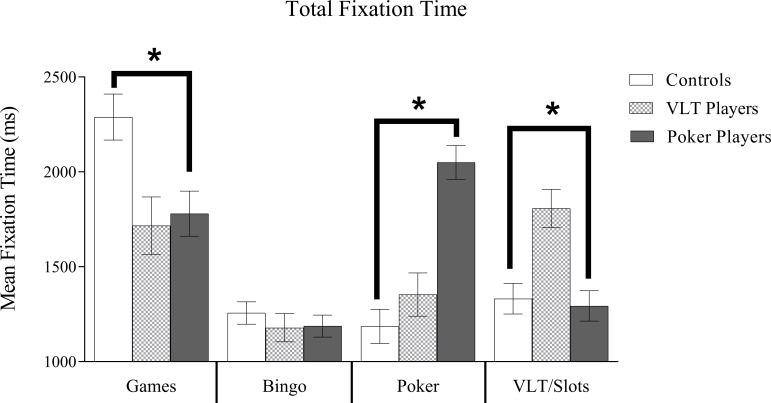
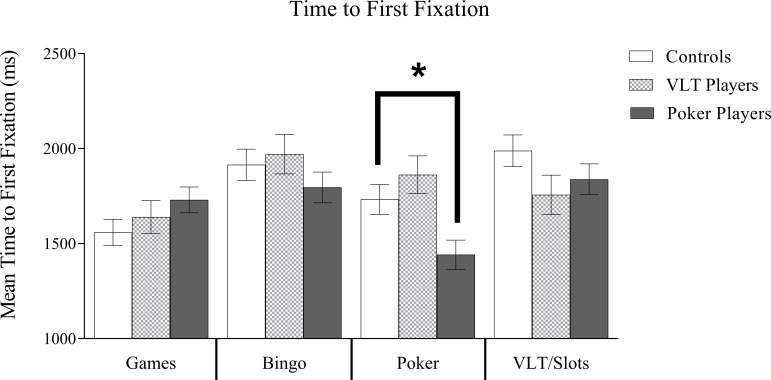
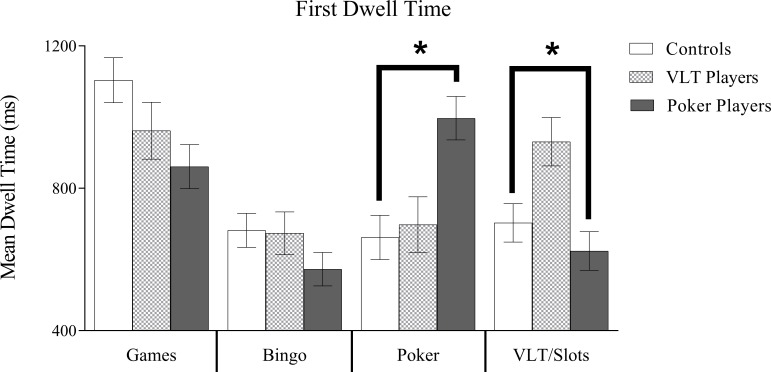
A growing body of research indicates that gamblers develop an attentional bias for gambling-related stimuli. Compared to research on substance use, however, few studies have examined attentional biases in gamblers using eye-gaze tracking, which has many advantages over other measures of attention. In addition, previous studies of attentional biases in gamblers have not directly matched type of gambler with personally-relevant gambling cues. The present study investigated the specificity of attentional biases for individual types of gambling using an eye-gaze tracking paradigm. Three groups of participants (poker players, video lottery terminal/slot machine players, and non-gambling controls) took part in one test session in which they viewed 25 sets of four images (poker, VLTs/slot machines, bingo, and board games). Participants' eye fixations were recorded throughout each 8-second presentation of the four images. The results indicated that, as predicted, the two gambling groups preferentially attended to their primary form of gambling, whereas control participants attended to board games more than gambling images. The findings have clinical implications for the treatment of individuals with gambling disorder. Understanding the importance of personally-salient gambling cues will inform the development of effective attentional bias modification treatments for problem gamblers.
越来越多的研究表明,赌徒会对与赌博相关的刺激产生注意力偏差。然而,与物质使用方面的研究相比,很少有研究使用眼动追踪技术来考察赌徒的注意力偏差,眼动追踪技术相较于其他注意力测量方法具有诸多优势。此外,以往关于赌徒注意力偏差的研究并未将赌徒类型与个人相关的赌博线索直接匹配起来。本研究采用眼动追踪范式,考察了个体对不同类型赌博的注意力偏差的特异性。三组参与者(扑克玩家、视频彩票终端/老虎机玩家和非赌博对照组)参加了一次测试,在测试中他们观看了25组四张图片(扑克、视频彩票终端/老虎机、宾果游戏和棋盘游戏)。在每次展示这四张图片的8秒过程中,都会记录参与者的眼动注视情况。结果表明,正如预期的那样,两个赌博组优先关注他们主要的赌博形式,而非赌博对照组参与者对棋盘游戏的关注多于赌博图片。这些发现对赌博障碍个体的治疗具有临床意义。了解个人突出的赌博线索的重要性,将为开发针对问题赌徒的有效注意力偏差矫正治疗方法提供依据。