Templeman Iain, Thompson Dylan, Gonzalez Javier, Walhin Jean-Philippe, Reeves Sue, Rogers Peter J, Brunstrom Jeffrey M, Karagounis Leonidas G, Tsintzas Kostas, Betts James A
Department for Health, University of Bath, Bath, BA2 7AY, UK.
Department of Life Sciences, University of Roehampton, London, SW15 4JD, UK.
Trials. 2018 Feb 2;19(1):86. doi: 10.1186/s13063-018-2451-8.
Prior studies have shown that intermittent fasting is capable of producing improvements in body weight and fasted health markers. However, the extent to which intermittent fasting incurs compensatory changes in the components of energy balance and its impact on postprandial metabolism are yet to be ascertained.
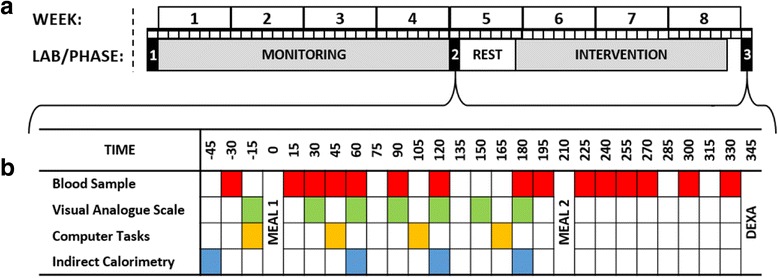
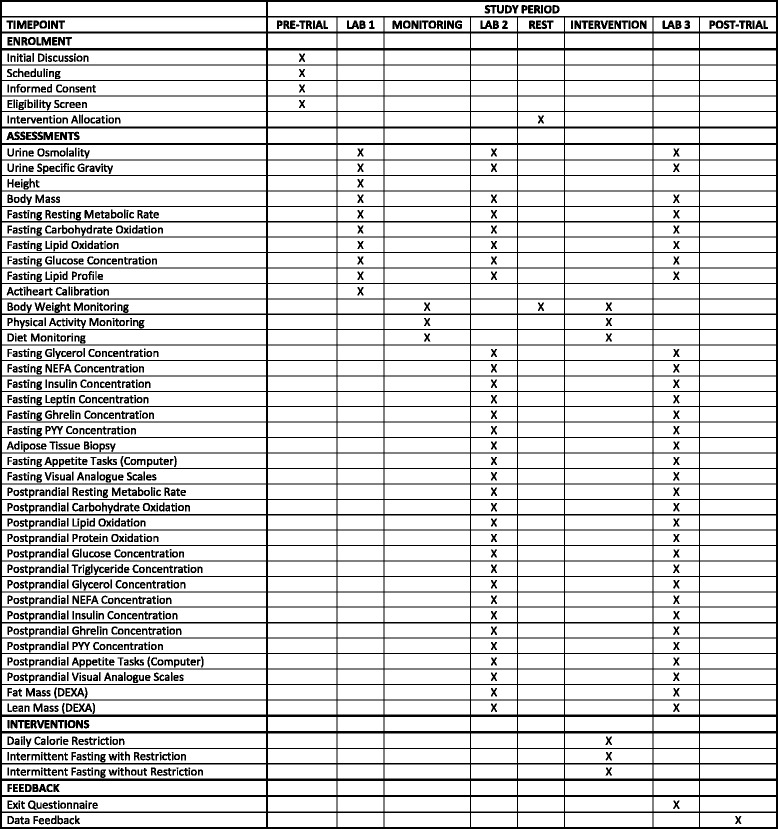
A total of 30-36 lean participants and 30-36 overweight/obese participants will be recruited to provide two separate study groups who will undergo the same protocol. Following an initial assessment of basic anthropometry and key health markers, measurements of habitual energy intake (weighed food and fluid intake) and physical activity energy expenditure (combined heart rate and accelerometry) will be obtained over 4 weeks under conditions of energy balance. Participants will then be randomly allocated to one of three experimental conditions for 20 days, namely (1) daily calorie restriction (reduce habitual daily energy intake by 25%), (2) intermittent fasting with calorie restriction (alternate between 24-hour periods of fasting and feeding to 150% of habitual daily energy intake), (3) intermittent fasting without calorie restriction (alternate between 24-hour periods of fasting and feeding to 200% of habitual daily energy intake). In addition to continued monitoring of energy intake and physical activity during the intervention, participants will report for laboratory-based assessments of various metabolic parameters both before and after the intervention. Specifically, fasting and postprandial measurements of resting metabolic rate, substrate oxidation, appetite, food preference, and plasma concentrations of key metabolites and hormones will be made, in addition to subcutaneous abdominal adipose tissue biopsies in the fasted state and an assessment of body composition via dual-energy x-ray absorptiometry.
Comparing observed changes in these measures across the three intervention arms in each group will establish the impact of intermittent fasting on postprandial metabolism and the components of energy balance in both lean and overweight/obese populations. Furthermore, this will be benchmarked against current nutritional interventions for weight management and the relative contributions of negative energy balance and fasting-dependent mechanisms in inducing any observed effects will be elucidated.
Trial retrospectively registered at clinicaltrials.gov under reference number NCT02498002 (version: IMF-02, date: July 6, 2015).
先前的研究表明,间歇性禁食能够改善体重和空腹健康指标。然而,间歇性禁食在能量平衡各组成部分引发代偿性变化的程度及其对餐后代谢的影响尚待确定。
总共将招募30 - 36名瘦素水平正常的参与者和30 - 36名超重/肥胖参与者,组成两个独立的研究组,两组将接受相同的实验方案。在初步评估基本人体测量学指标和关键健康指标之后,在能量平衡条件下,通过4周时间获取习惯性能量摄入量(称量食物和液体摄入量)以及身体活动能量消耗(结合心率和加速度计测量)的数据。然后,参与者将被随机分配到三种实验条件之一,持续20天,即(1)每日热量限制(将习惯性每日能量摄入量减少25%),(2)间歇性禁食并限制热量摄入(在24小时禁食期和按习惯性每日能量摄入量的150%进食之间交替),(3)间歇性禁食但不限制热量摄入(在24小时禁食期和按习惯性每日能量摄入量的200%进食之间交替)。除了在干预期间持续监测能量摄入和身体活动外,参与者将在干预前后接受基于实验室的各种代谢参数评估。具体而言,将进行静息代谢率、底物氧化、食欲、食物偏好以及关键代谢物和激素血浆浓度的空腹和餐后测量,此外还将在禁食状态下进行腹部皮下脂肪组织活检,并通过双能X射线吸收法评估身体成分。
比较每组中三个干预组在这些测量指标上观察到的变化,将确定间歇性禁食对餐后代谢以及瘦素水平正常和超重/肥胖人群能量平衡各组成部分的影响。此外,这将与当前用于体重管理的营养干预措施进行对比,并阐明负能量平衡和禁食相关机制在引发任何观察到的效果中的相对作用。
该试验于2015年7月6日在clinicaltrials.gov上进行回顾性注册,注册号为NCT02498002(版本:IMF - 02)。