Correia Joana M, Santos Inês, Pezarat-Correia Pedro, Silva Analiza M, Mendonca Goncalo V
Neuromuscular Research Lab, Faculty of Human Kinetics, University of Lisbon, Lisbon, Portugal.
Centro Interdisciplinar para o Estudo da Performance Humana (CIPER), Faculty of Human Kinetics, University of Lisbon, Lisbon, Portugal.
Front Nutr. 2021 Jan 26;7:625240. doi: 10.3389/fnut.2020.625240. eCollection 2020.
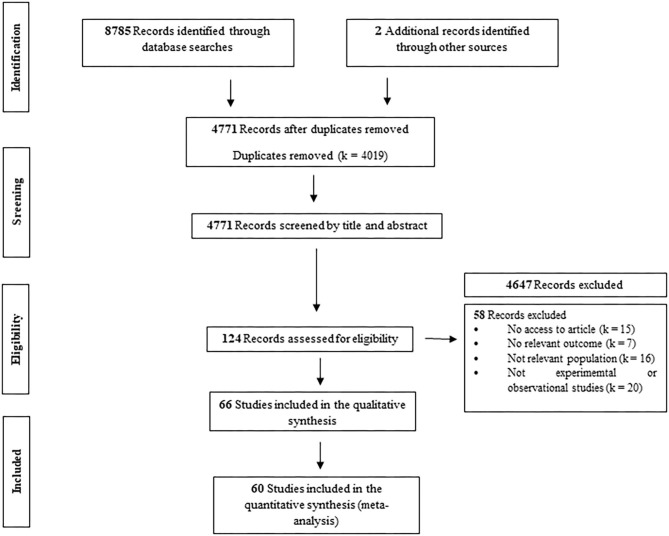
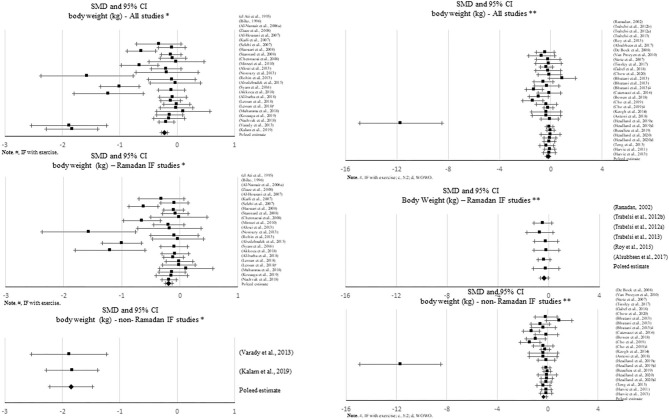
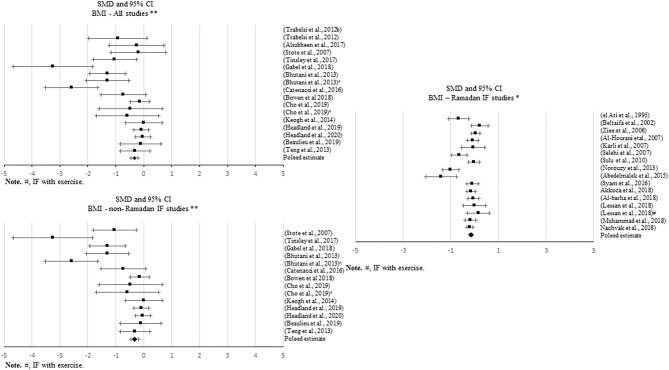
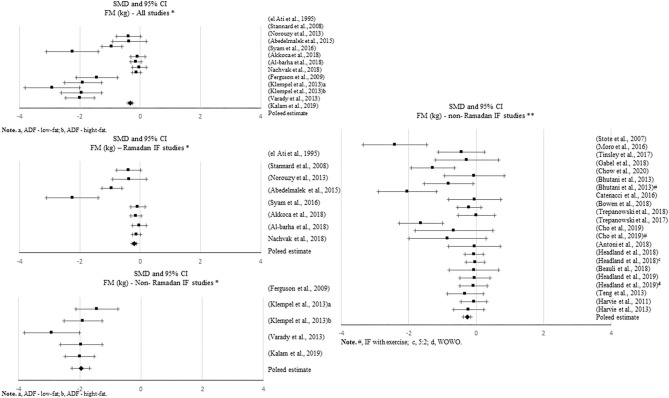
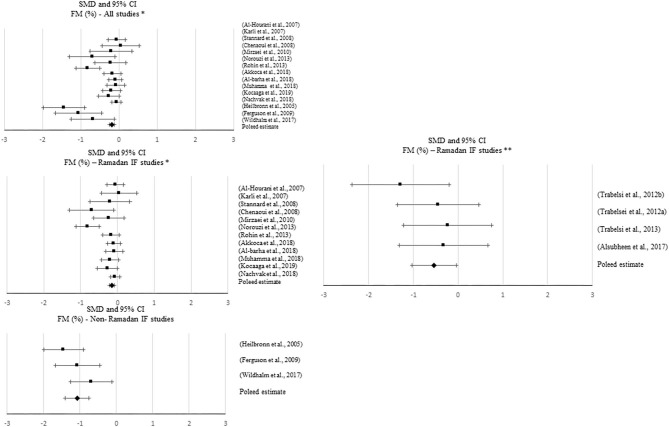
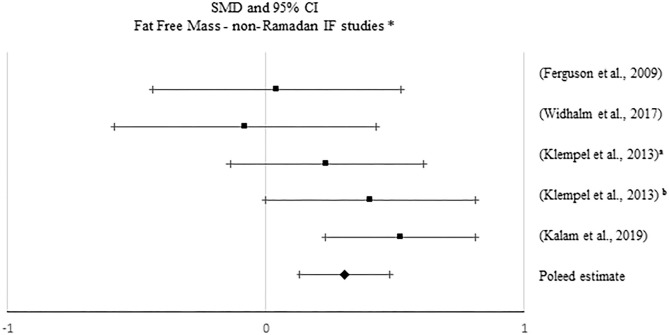
Intermittent fasting (IF) has gained popularity for body-composition improvement purposes. The aim of this systematic review and meta-analysis was to summarize the effects of Ramadan vs. non-Ramadan IF on parameters of body composition. We conducted a comprehensive search of peer-reviewed articles in three electronic databases: PubMed, Scopus, and Web of Science (published until May 2020). Studies were selected if they included samples of adults (≥18 years), had an experimental or observational design, investigated any type of IF and included body composition outcomes. Meta-analytical procedures were conducted when feasible. Sixty-six articles met the eligibility criteria. We found that non-Ramadan IF is effective for decreasing body weight (-0.341 (95% CI [-0.584, -0.098], = 0.006), body mass index (-0.699, 95% CI [-1.05, -0.347], < 0.001), and absolute fat mass (-0.447, 95% CI [-0.673, -0.221], < 0.001). When contrasting pre- post-intervention data on fat-free mass between treatments and controls, group-differences were non-significant ( > 0.05). Conversely, we observed a significant increase in fat-free mass when comparing pre- to post-intervention in a within design fashion (0.306, 95% CI [0.133, 0.48], = 0.001). Finally, despite being accompanied by dehydration, Ramadan IF is effective in decreasing body weight (-0.353; 95% CI [-0.651, -0.054], = 0.02) and relative fat mass (-0.533; 95% CI [-1.025, -0.04], = 0.034). Ramadan IF seems to implicate some beneficial adaptations in weight management, although non-Ramadan IF appears to be more effective in improving overall body composition.
间歇性禁食(IF)因有助于改善身体成分而受到欢迎。本系统评价和荟萃分析的目的是总结斋月期间与非斋月期间间歇性禁食对身体成分参数的影响。我们在三个电子数据库(PubMed、Scopus和Web of Science,检索截至2020年5月发表的文章)中全面检索了同行评审的文章。纳入的研究需符合以下条件:样本为成年人(≥18岁),采用实验性或观察性设计,研究任何类型的间歇性禁食,并包含身体成分相关结果。在可行的情况下进行荟萃分析。66篇文章符合纳入标准。我们发现,非斋月期间的间歇性禁食在减轻体重(-0.341(95%CI[-0.584,-0.098],P = 0.006)、降低体重指数(-0.699,95%CI[-1.05,-0.347],P < 0.001)和减少绝对脂肪量(-0.447,95%CI[-0.673,-0.221],P < 0.001)方面有效。在对比治疗组和对照组干预前后去脂体重的数据时,组间差异无统计学意义(P > 0.05)。相反,当以组内设计方式比较干预前后时,我们观察到去脂体重显著增加(0.306,95%CI[0.133, , 0.48],P = 0.001)。最后,尽管斋月期间的间歇性禁食会伴有脱水,但在减轻体重(-0.353;95%CI[-0.651,-0.054],P = 0.02)和降低相对脂肪量(-0.533;95%CI[-1.025,-0.04],P = 0.034)方面是有效的。斋月期间的间歇性禁食似乎在体重管理方面有一些有益的适应性变化,尽管非斋月期间的间歇性禁食在改善整体身体成分方面似乎更有效。