Monell Chemical Senses Center, Philadelphia, Pennsylvania, United States of America.
School of Food Science and Biotechnology, Zhejiang Gonshang University, Hangzhou, Zhejiang, China.
PLoS Genet. 2018 Feb 7;14(2):e1007058. doi: 10.1371/journal.pgen.1007058. eCollection 2018 Feb.
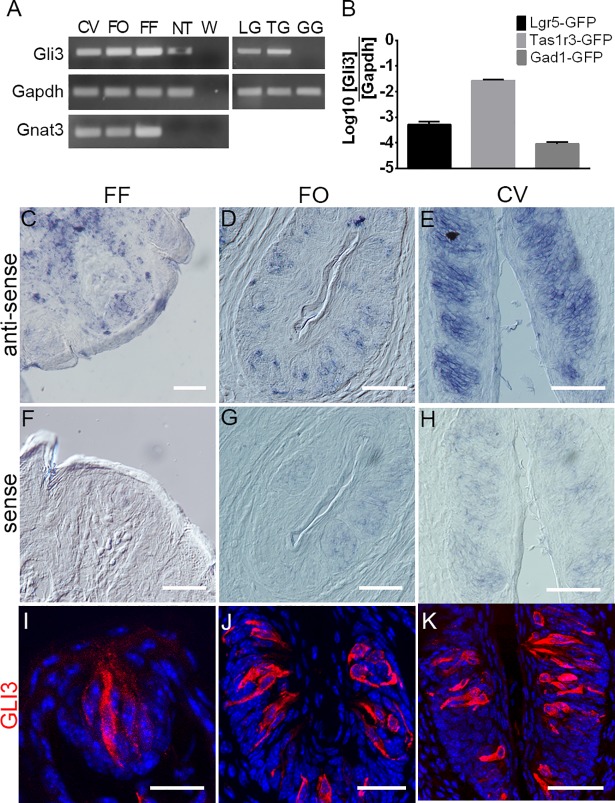
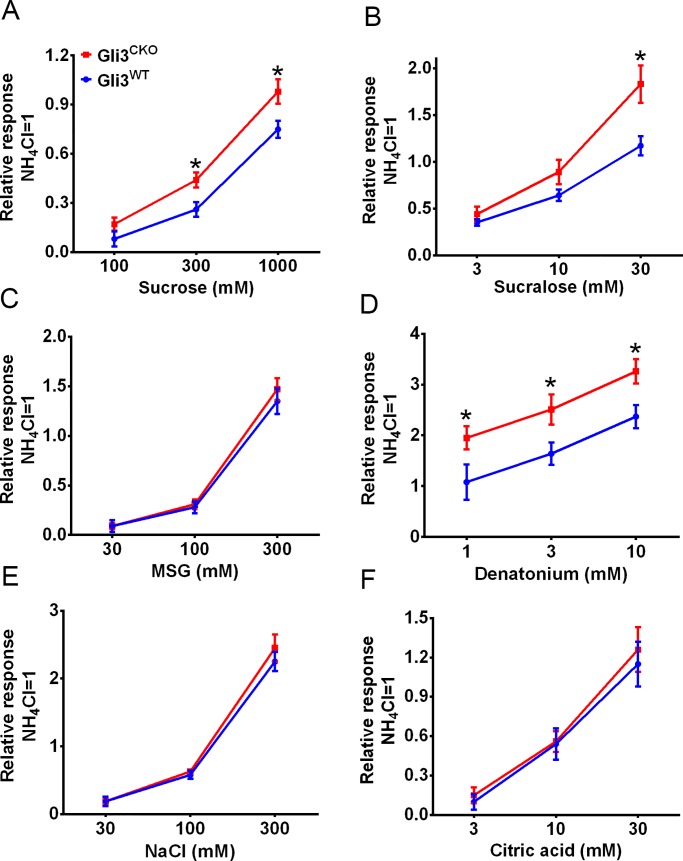
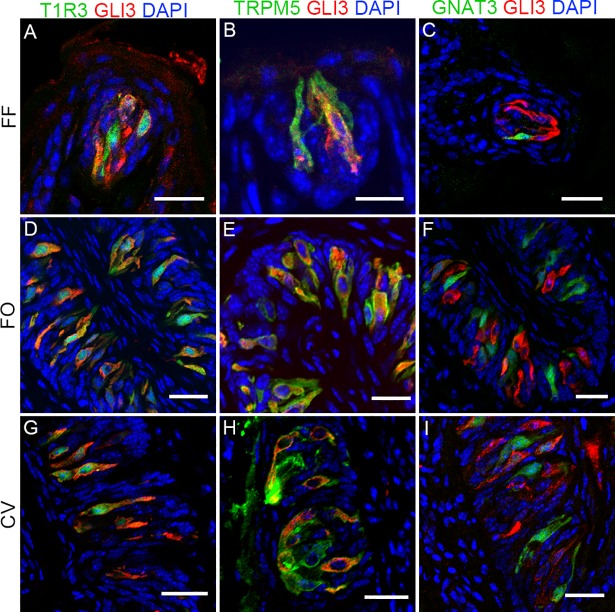
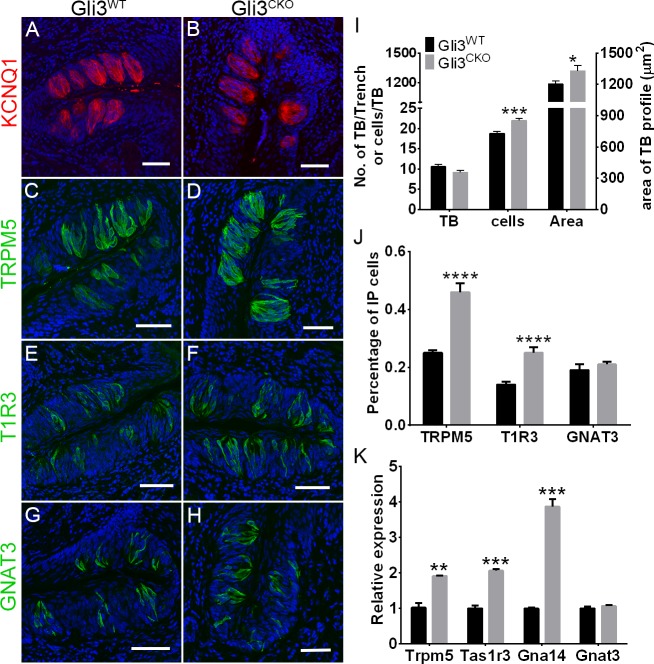
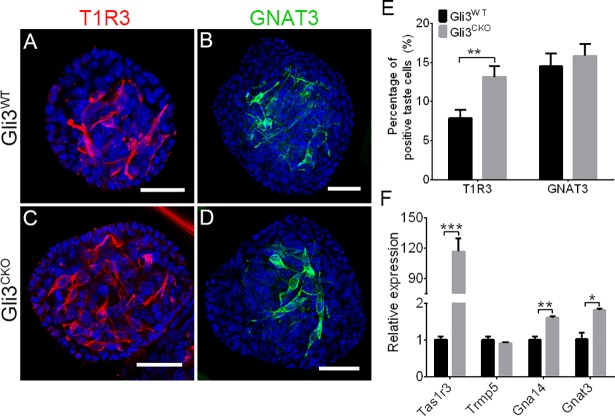
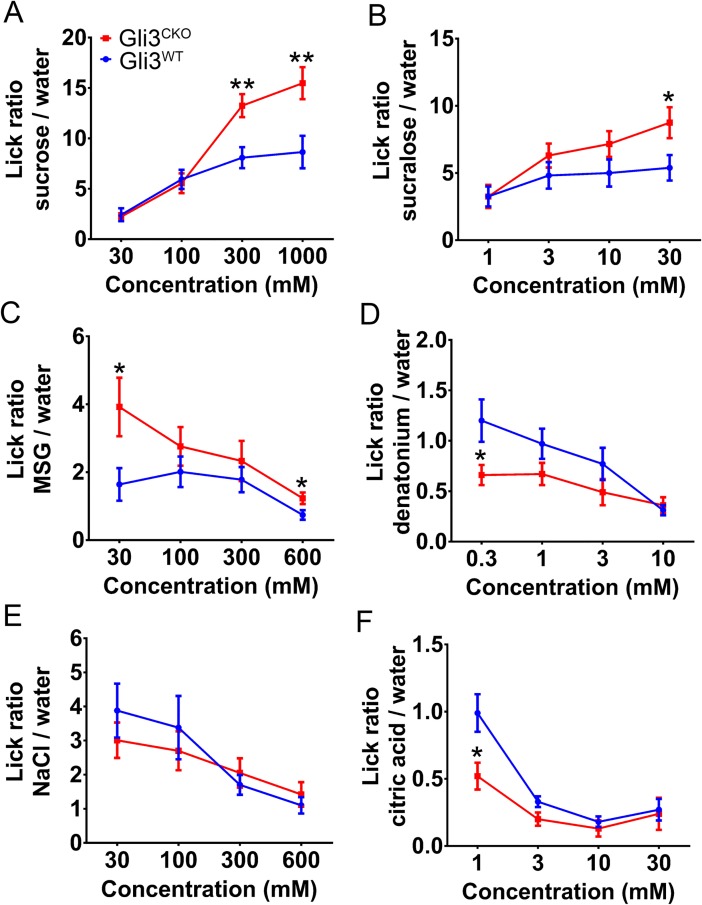
Mouse taste receptor cells survive from 3-24 days, necessitating their regeneration throughout adulthood. In anterior tongue, sonic hedgehog (SHH), released by a subpopulation of basal taste cells, regulates transcription factors Gli2 and Gli3 in stem cells to control taste cell regeneration. Using single-cell RNA-Seq we found that Gli3 is highly expressed in Tas1r3-expressing taste receptor cells and Lgr5+ taste stem cells in posterior tongue. By PCR and immunohistochemistry we found that Gli3 was expressed in taste buds in all taste fields. Conditional knockout mice lacking Gli3 in the posterior tongue (Gli3CKO) had larger taste buds containing more taste cells than did control wild-type (Gli3WT) mice. In comparison to wild-type mice, Gli3CKO mice had more Lgr5+ and Tas1r3+ cells, but fewer type III cells. Similar changes were observed ex vivo in Gli3CKO taste organoids cultured from Lgr5+ taste stem cells. Further, the expression of several taste marker and Gli3 target genes was altered in Gli3CKO mice and/or organoids. Mirroring these changes, Gli3CKO mice had increased lick responses to sweet and umami stimuli, decreased lick responses to bitter and sour taste stimuli, and increased glossopharyngeal taste nerve responses to sweet and bitter compounds. Our results indicate that Gli3 is a suppressor of stem cell proliferation that affects the number and function of mature taste cells, especially Tas1r3+ cells, in adult posterior tongue. Our findings shed light on the role of the Shh pathway in adult taste cell regeneration and may help devise strategies for treating taste distortions from chemotherapy and aging.
小鼠味觉受体细胞的存活时间为 3-24 天,因此需要在成年期不断再生。在前舌部,由一群基底味觉细胞分泌的 Sonic Hedgehog(SHH)调节干细胞中的转录因子 Gli2 和 Gli3,以控制味觉细胞的再生。通过单细胞 RNA-Seq,我们发现 Gli3 在 Tas1r3 表达的味觉受体细胞和后舌部的 Lgr5+味觉干细胞中高度表达。通过 PCR 和免疫组织化学,我们发现 Gli3 在所有味觉区域的味蕾中均有表达。在后舌部缺乏 Gli3 的条件性敲除小鼠(Gli3CKO)的味蕾比对照野生型(Gli3WT)小鼠更大,含有更多的味觉细胞。与野生型小鼠相比,Gli3CKO 小鼠的 Lgr5+和 Tas1r3+细胞更多,但 III 型细胞更少。在Gli3CKO 味觉类器官中也观察到了类似的变化,这些类器官是从小鼠的 Lgr5+味觉干细胞培养而来。此外,几种味觉标记物和 Gli3 靶基因的表达在 Gli3CKO 小鼠和/或类器官中发生了改变。这些变化反映在 Gli3CKO 小鼠对甜味和鲜味刺激的舔舐反应增加、对苦味和酸味刺激的舔舐反应减少以及对甜味和苦味化合物的舌咽味觉神经反应增加。我们的研究结果表明,Gli3 是一种抑制干细胞增殖的因子,它影响成年后舌部的成熟味觉细胞,特别是 Tas1r3+细胞的数量和功能。我们的研究结果揭示了 Shh 通路在成年味觉细胞再生中的作用,并可能有助于制定治疗化疗和衰老引起的味觉扭曲的策略。