• 文献检索
  • 文档翻译
  • 深度研究
  • 学术资讯
  • Suppr Zotero 插件Zotero 插件
  • 邀请有礼
  • 套餐&价格
  • 历史记录
应用&插件
Suppr Zotero 插件Zotero 插件浏览器插件Mac 客户端Windows 客户端微信小程序
定价
高级版会员购买积分包购买API积分包
服务
文献检索文档翻译深度研究API 文档MCP 服务
关于我们
关于 Suppr公司介绍联系我们用户协议隐私条款
关注我们

Suppr 超能文献

核心技术专利:CN118964589B侵权必究
粤ICP备2023148730 号-1Suppr @ 2026

文献检索

告别复杂PubMed语法,用中文像聊天一样搜索,搜遍4000万医学文献。AI智能推荐,让科研检索更轻松。

立即免费搜索

文件翻译

保留排版,准确专业,支持PDF/Word/PPT等文件格式,支持 12+语言互译。

免费翻译文档

深度研究

AI帮你快速写综述,25分钟生成高质量综述,智能提取关键信息,辅助科研写作。

立即免费体验

利用非侵入性测量方法对人体核心体温进行个体化估计。

Individualized estimation of human core body temperature using noninvasive measurements.

机构信息

Department of Defense Biotechnology High Performance Computing Software Applications Institute, Telemedicine and Advanced Technology Research Center, United States Army Medical Research and Materiel Command, Fort Detrick, Maryland.

Department of Military and Emergency Medicine, Uniformed Services University of the Health Sciences , Bethesda, Maryland.

出版信息

J Appl Physiol (1985). 2018 Jun 1;124(6):1387-1402. doi: 10.1152/japplphysiol.00837.2017. Epub 2018 Feb 8.

DOI:10.1152/japplphysiol.00837.2017
PMID:29420153
原文链接:https://pmc.ncbi.nlm.nih.gov/articles/PMC6032092/
Abstract

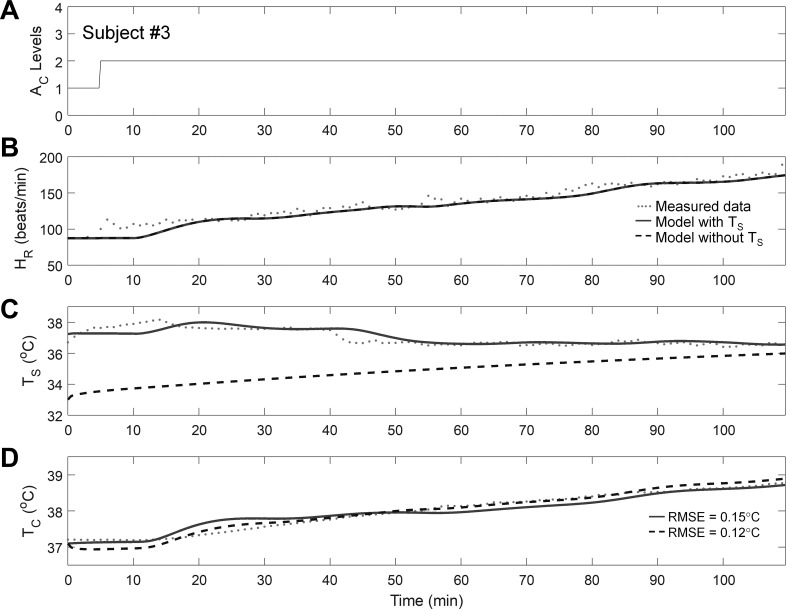
A rising core body temperature (T) during strenuous physical activity is a leading indicator of heat-injury risk. Hence, a system that can estimate T in real time and provide early warning of an impending temperature rise may enable proactive interventions to reduce the risk of heat injuries. However, real-time field assessment of T requires impractical invasive technologies. To address this problem, we developed a mathematical model that describes the relationships between T and noninvasive measurements of an individual's physical activity, heart rate, and skin temperature, and two environmental variables (ambient temperature and relative humidity). A Kalman filter adapts the model parameters to each individual and provides real-time personalized T estimates. Using data from three distinct studies, comprising 166 subjects who performed treadmill and cycle ergometer tasks under different experimental conditions, we assessed model performance via the root mean squared error (RMSE). The individualized model yielded an overall average RMSE of 0.33 (SD = 0.18)°C, allowing us to reach the same conclusions in each study as those obtained using the T measurements. Furthermore, for 22 unique subjects whose T exceeded 38.5°C, a potential lower T limit of clinical relevance, the average RMSE decreased to 0.25 (SD = 0.20)°C. Importantly, these results remained robust in the presence of simulated real-world operational conditions, yielding no more than 16% worse RMSEs when measurements were missing (40%) or laden with added noise. Hence, the individualized model provides a practical means to develop an early warning system for reducing heat-injury risk. NEW & NOTEWORTHY A model that uses an individual's noninvasive measurements and environmental variables can continually "learn" the individual's heat-stress response by automatically adapting the model parameters on the fly to provide real-time individualized core body temperature estimates. This individualized model can replace impractical invasive sensors, serving as a practical and effective surrogate for core temperature monitoring.

摘要

在剧烈的体力活动中,核心体温(T)的升高是热损伤风险的主要指标。因此,能够实时估计 T 并提供即将升温的预警的系统,可能使能够采取主动干预措施降低热损伤风险。然而,实时现场评估 T 需要不切实际的侵入性技术。为了解决这个问题,我们开发了一个数学模型,该模型描述了 T 与个体的非侵入性活动测量、心率和皮肤温度以及两个环境变量(环境温度和相对湿度)之间的关系。卡尔曼滤波器使模型参数适应每个个体,并提供实时个性化的 T 估计。使用来自三个不同研究的数据,这些研究包含 166 名在不同实验条件下进行跑步机和自行车测力计任务的受试者,我们通过均方根误差(RMSE)评估了模型性能。个体化模型的总体平均 RMSE 为 0.33(SD=0.18)°C,使我们能够在每项研究中得出与使用 T 测量相同的结论。此外,对于 22 名 T 超过 38.5°C 的独特受试者,即潜在的具有临床意义的较低 T 限值,平均 RMSE 降至 0.25(SD=0.20)°C。重要的是,即使在存在模拟现实操作条件的情况下,这些结果仍然稳健,当测量缺失(40%)或充满附加噪声时,RMSE 增加不超过 16%。因此,个体化模型为开发降低热损伤风险的预警系统提供了一种实用方法。

新的和值得注意的是,一种使用个体的非侵入性测量和环境变量的模型可以通过自动适应模型参数来“持续学习”个体的热应激反应,从而实时提供个性化的核心体温估计。这种个体化模型可以替代不切实际的侵入性传感器,作为核心体温监测的实用且有效的替代方法。

https://cdn.ncbi.nlm.nih.gov/pmc/blobs/cbe0/6032092/33bf186e6212/zdg0041825730010.jpg
https://cdn.ncbi.nlm.nih.gov/pmc/blobs/cbe0/6032092/45c1030c2b7e/zdg0041825730001.jpg
https://cdn.ncbi.nlm.nih.gov/pmc/blobs/cbe0/6032092/a354a664c9f6/zdg0041825730002.jpg
https://cdn.ncbi.nlm.nih.gov/pmc/blobs/cbe0/6032092/2bc23efbca49/zdg0041825730003.jpg
https://cdn.ncbi.nlm.nih.gov/pmc/blobs/cbe0/6032092/1c024624c4a0/zdg0041825730004.jpg
https://cdn.ncbi.nlm.nih.gov/pmc/blobs/cbe0/6032092/4ec009d759ac/zdg0041825730005.jpg
https://cdn.ncbi.nlm.nih.gov/pmc/blobs/cbe0/6032092/0008bace9a8b/zdg0041825730006.jpg
https://cdn.ncbi.nlm.nih.gov/pmc/blobs/cbe0/6032092/acdd5e58a6b5/zdg0041825730007.jpg
https://cdn.ncbi.nlm.nih.gov/pmc/blobs/cbe0/6032092/f96557ec1ab4/zdg0041825730008.jpg
https://cdn.ncbi.nlm.nih.gov/pmc/blobs/cbe0/6032092/27f9b16a912a/zdg0041825730009.jpg
https://cdn.ncbi.nlm.nih.gov/pmc/blobs/cbe0/6032092/33bf186e6212/zdg0041825730010.jpg
https://cdn.ncbi.nlm.nih.gov/pmc/blobs/cbe0/6032092/45c1030c2b7e/zdg0041825730001.jpg
https://cdn.ncbi.nlm.nih.gov/pmc/blobs/cbe0/6032092/a354a664c9f6/zdg0041825730002.jpg
https://cdn.ncbi.nlm.nih.gov/pmc/blobs/cbe0/6032092/2bc23efbca49/zdg0041825730003.jpg
https://cdn.ncbi.nlm.nih.gov/pmc/blobs/cbe0/6032092/1c024624c4a0/zdg0041825730004.jpg
https://cdn.ncbi.nlm.nih.gov/pmc/blobs/cbe0/6032092/4ec009d759ac/zdg0041825730005.jpg
https://cdn.ncbi.nlm.nih.gov/pmc/blobs/cbe0/6032092/0008bace9a8b/zdg0041825730006.jpg
https://cdn.ncbi.nlm.nih.gov/pmc/blobs/cbe0/6032092/acdd5e58a6b5/zdg0041825730007.jpg
https://cdn.ncbi.nlm.nih.gov/pmc/blobs/cbe0/6032092/f96557ec1ab4/zdg0041825730008.jpg
https://cdn.ncbi.nlm.nih.gov/pmc/blobs/cbe0/6032092/27f9b16a912a/zdg0041825730009.jpg
https://cdn.ncbi.nlm.nih.gov/pmc/blobs/cbe0/6032092/33bf186e6212/zdg0041825730010.jpg

相似文献

1
Individualized estimation of human core body temperature using noninvasive measurements.利用非侵入性测量方法对人体核心体温进行个体化估计。
J Appl Physiol (1985). 2018 Jun 1;124(6):1387-1402. doi: 10.1152/japplphysiol.00837.2017. Epub 2018 Feb 8.
2
Prospective Validation of 2B-Cool : Integrating Wearables and Individualized Predictive Analytics to Reduce Heat Injuries.2B-Cool的前瞻性验证:整合可穿戴设备与个性化预测分析以减少热损伤
Med Sci Sports Exerc. 2023 Apr 1;55(4):751-764. doi: 10.1249/MSS.0000000000003093. Epub 2022 Dec 1.
3
Estimation of core body temperature from skin temperature, heat flux, and heart rate using a Kalman filter.利用卡尔曼滤波器从皮肤温度、热通量和心率估算核心体温。
Comput Biol Med. 2018 Aug 1;99:1-6. doi: 10.1016/j.compbiomed.2018.05.021. Epub 2018 May 18.
4
Comparison of two mathematical models for predicted human thermal responses to hot and humid environments.两种预测人体在热湿环境中热反应的数学模型比较。
J Therm Biol. 2021 Apr;97:102902. doi: 10.1016/j.jtherbio.2021.102902. Epub 2021 Mar 11.
5
Accuracy of Algorithm to Non-Invasively Predict Core Body Temperature Using the Kenzen Wearable Device.使用 Kenzen 可穿戴设备无创预测核心体温的算法准确性。
Int J Environ Res Public Health. 2021 Dec 13;18(24):13126. doi: 10.3390/ijerph182413126.
6
Firefighter feedback during active cooling: a useful tool for heat stress management?主动降温过程中消防员的反馈:热应激管理的有用工具?
J Therm Biol. 2014 Dec;46:65-71. doi: 10.1016/j.jtherbio.2014.10.003. Epub 2014 Oct 22.
7
Real-time core body temperature estimation from heart rate for first responders wearing different levels of personal protective equipment.通过心率对穿戴不同等级个人防护装备的急救人员进行实时核心体温估计。
Ergonomics. 2015;58(11):1830-41. doi: 10.1080/00140139.2015.1036792. Epub 2015 May 13.
8
A modified Kalman filter-based model for core temperature estimation during exercise and recovery with/without personal cooling interventions.一种改良的卡尔曼滤波模型,用于在运动和恢复期间(有无个人冷却干预)估计核心温度。
J Therm Biol. 2022 Oct;109:103307. doi: 10.1016/j.jtherbio.2022.103307. Epub 2022 Aug 27.
9
A real-time algorithm for predicting core temperature in humans.一种用于预测人体核心温度的实时算法。
IEEE Trans Inf Technol Biomed. 2010 Jul;14(4):1039-45. doi: 10.1109/TITB.2010.2043956. Epub 2010 Apr 5.
10
Predicting recovery from exertional heat strain in military working dogs.预测军犬运动性热应激后的恢复情况。
J Therm Biol. 2018 Aug;76:45-51. doi: 10.1016/j.jtherbio.2018.07.001. Epub 2018 Jul 5.

引用本文的文献

1
Predicting the body core temperature of recreational athletes at the end of a 10 km self-paced run under environmental heat stress.预测在环境热应激下进行 10 公里自我计时跑结束时的业余运动员的体核温度。
Exp Physiol. 2023 Jun;108(6):852-864. doi: 10.1113/EP091017. Epub 2023 Apr 5.
2
Wearable Sensor Technology to Predict Core Body Temperature: A Systematic Review.可穿戴传感器技术预测核心体温:系统评价。
Sensors (Basel). 2022 Oct 9;22(19):7639. doi: 10.3390/s22197639.
3
A 3-D virtual human thermoregulatory model to predict whole-body and organ-specific heat-stress responses.

本文引用的文献

1
Re-visiting the tympanic membrane vicinity as core body temperature measurement site.重新审视将鼓膜附近作为核心体温测量部位。
PLoS One. 2017 Apr 17;12(4):e0174120. doi: 10.1371/journal.pone.0174120. eCollection 2017.
2
Non-invasive Measures of Core Temperature versus Ingestible Thermistor during Exercise in the Heat.热环境中运动时核心温度的非侵入性测量与可摄入式热敏电阻的比较
Int J Exerc Sci. 2017 Mar 1;10(2):225-233. doi: 10.70252/MGQG4687. eCollection 2017.
3
How accurate are the wrist-based heart rate monitors during walking and running activities? Are they accurate enough?
用于预测全身和器官特异性热应激反应的三维虚拟人体热调节模型。
Eur J Appl Physiol. 2021 Sep;121(9):2543-2562. doi: 10.1007/s00421-021-04698-1. Epub 2021 Jun 5.
4
Heat risk exacerbation potential for neurology patients during the COVID-19 pandemic and related isolation.新冠疫情大流行期间及相关隔离措施对神经科患者的热风险恶化的潜在影响。
Int J Biometeorol. 2021 Apr;65(4):627-630. doi: 10.1007/s00484-020-02044-2. Epub 2020 Nov 8.
5
Validity of a noninvasive estimation of deep body temperature when wearing personal protective equipment during exercise and recovery.穿着个人防护装备进行运动和恢复时,非侵入性估计深部体温的有效性。
Mil Med Res. 2019 Jun 14;6(1):20. doi: 10.1186/s40779-019-0208-7.
6
Prediction of Core Body Temperature Based on Skin Temperature, Heat Flux, and Heart Rate Under Different Exercise and Clothing Conditions in the Heat in Young Adult Males.基于年轻成年男性在炎热环境中不同运动和着装条件下的皮肤温度、热通量和心率预测核心体温
Front Physiol. 2018 Dec 10;9:1780. doi: 10.3389/fphys.2018.01780. eCollection 2018.
7
Development of Body-Tissue Temperature-Control Transducer.体组织温度控制传感器的研制。
Sensors (Basel). 2018 Dec 20;19(1):14. doi: 10.3390/s19010014.
在步行和跑步活动中,腕式心率监测器的准确性如何?它们的准确性足够吗?
BMJ Open Sport Exerc Med. 2016 Apr 25;2(1):e000106. doi: 10.1136/bmjsem-2015-000106. eCollection 2016.
4
The thermal-circulatory ratio (TCR): An index to evaluate the tolerance to heat.热循环比率(TCR):一种评估耐热性的指标。
Temperature (Austin). 2014 Jul 2;1(2):101-6. doi: 10.4161/temp.29752. eCollection 2014 Jul-Sep.
5
Explained variance in the thermoregulatory responses to exercise: the independent roles of biophysical and fitness/fatness-related factors.运动热调节反应中的解释方差:生物物理因素与健康/肥胖相关因素的独立作用。
J Appl Physiol (1985). 2015 Nov 1;119(9):982-9. doi: 10.1152/japplphysiol.00281.2015. Epub 2015 Aug 27.
6
Prediction of Core Body Temperature from Multiple Variables.基于多个变量预测核心体温。
Ann Occup Hyg. 2015 Nov;59(9):1168-78. doi: 10.1093/annhyg/mev054. Epub 2015 Aug 12.
7
Medicines can affect thermoregulation and accentuate the risk of dehydration and heat-related illness during hot weather.药物会影响体温调节,并加剧炎热天气期间脱水和与热相关疾病的风险。
J Clin Pharm Ther. 2015 Aug;40(4):363-7. doi: 10.1111/jcpt.12294. Epub 2015 Jun 13.
8
Characterizing occupational heat-related mortality in the United States, 2000-2010: an analysis using the Census of Fatal Occupational Injuries database.2000 - 2010年美国职业性热相关死亡率特征分析:基于致命职业伤害普查数据库的分析
Am J Ind Med. 2015 Feb;58(2):203-11. doi: 10.1002/ajim.22381.
9
Heat tolerance testing: association between heat intolerance and anthropometric and fitness measurements.耐热性测试:不耐热与人体测量及体能测量之间的关联。
Mil Med. 2014 Nov;179(11):1339-46. doi: 10.7205/MILMED-D-14-00169.
10
Importance of airflow for physiologic and ergogenic effects of precooling.气流对预冷生理和运动能力增强效应的重要性。
J Athl Train. 2014 Sep-Oct;49(5):632-9. doi: 10.4085/1062-6050-49.3.27. Epub 2014 Aug 21.