Jhang Yuna, Franklin Beau, Ramsdell-Hudock Heather L, Oller D Kimbrough
Department of Speech Language Pathology and Audiology, Chung Shan University, Taichung, Taiwan.
The Institute for Research and Rehabilitation, Memorial Hermann Healthcare, Houston, TX, United States.
Front Commun (Lausanne). 2017;2. doi: 10.3389/fcomm.2017.00010. Epub 2017 Sep 15.
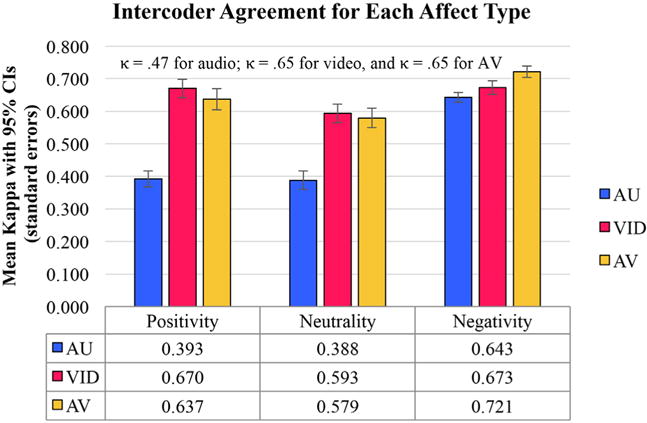
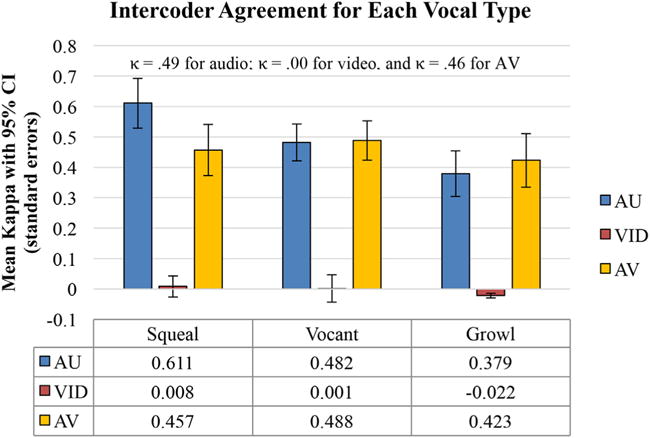
Seeking roots of language, we probed infant facial expressions and vocalizations. Both have roles in language, but the voice plays an especially flexible role, expressing a variety of functions and affect conditions with the same vocal categories-a word can be produced with many different affective flavors. This requirement of language is seen in very early infant vocalizations. We examined the extent to which affect is transmitted by early vocal categories termed "protophones" (squeals, vowel-like sounds, and growls) and by their co-occurring facial expressions, and similarly the extent to which vocal type is transmitted by the voice and co-occurring facial expressions. Our coder agreement data suggest infant affect during protophones was most reliably transmitted by the face (judged in video-only), while vocal type was transmitted most reliably by the voice (judged in audio-only). Voice alone transmitted negative affect more reliably than neutral or positive affect, suggesting infant protophones may be used especially to call for attention when the infant is in distress. By contrast, the face alone provided no significant information about protophone categories. Indeed coders in VID could scarcely recognize the difference between silence and voice when coding protophones in VID. The results suggest that partial decoupling of communicative roles for face and voice occurs even in the first months of life. Affect in infancy appears to be transmitted in a way that audio and video aspects are flexibly interwoven, as in mature language.
为探寻语言的根源,我们研究了婴儿的面部表情和发声。二者在语言中均发挥作用,但声音起着尤为灵活的作用,能用相同的语音类别表达多种功能和情感状态——一个词可以用许多不同的情感色彩来发出。语言的这一要求在婴儿早期发声中即可见。我们研究了情感在被称为“原始语音”(尖叫声、类元音声音和咆哮声)的早期语音类别及其同时出现的面部表情中传递的程度,同样也研究了语音类型在声音及同时出现的面部表情中传递的程度。我们的编码者一致性数据表明,原始语音期间婴儿的情感最可靠地通过面部传递(仅根据视频判断),而语音类型最可靠地通过声音传递(仅根据音频判断)。单独的声音传递负面情感比传递中性或正面情感更可靠,这表明婴儿的原始语音可能尤其在婴儿处于痛苦时用于引起注意。相比之下,单独的面部对于原始语音类别没有提供显著信息。实际上,在对视频中的原始语音进行编码时,视频编码者几乎无法识别沉默和声音之间的差异。结果表明,即使在生命的最初几个月,面部和声音的交际角色也会出现部分解耦。婴儿期的情感似乎以一种音频和视频方面灵活交织的方式传递,就像在成熟语言中一样。