Clay Zanna, Archbold Jahmaira, Zuberbühler Klaus
School of Psychology, University of Birmingham , Birmingham , UK ; Department of Comparative Cognition, Institute of Biology, University of Neuchatel , Neuchatel , Switzerland.
Department of Comparative Cognition, Institute of Biology, University of Neuchatel , Neuchatel , Switzerland.
PeerJ. 2015 Aug 4;3:e1124. doi: 10.7717/peerj.1124. eCollection 2015.
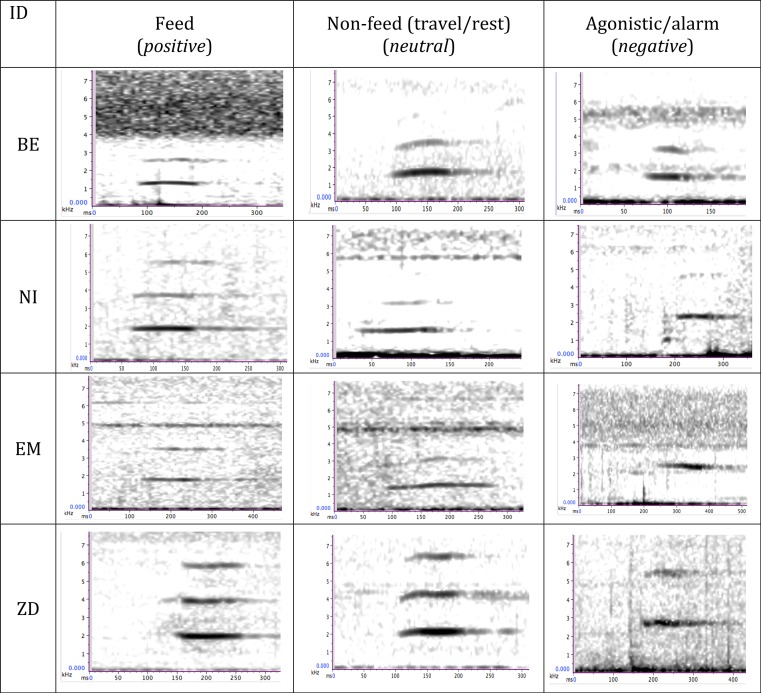
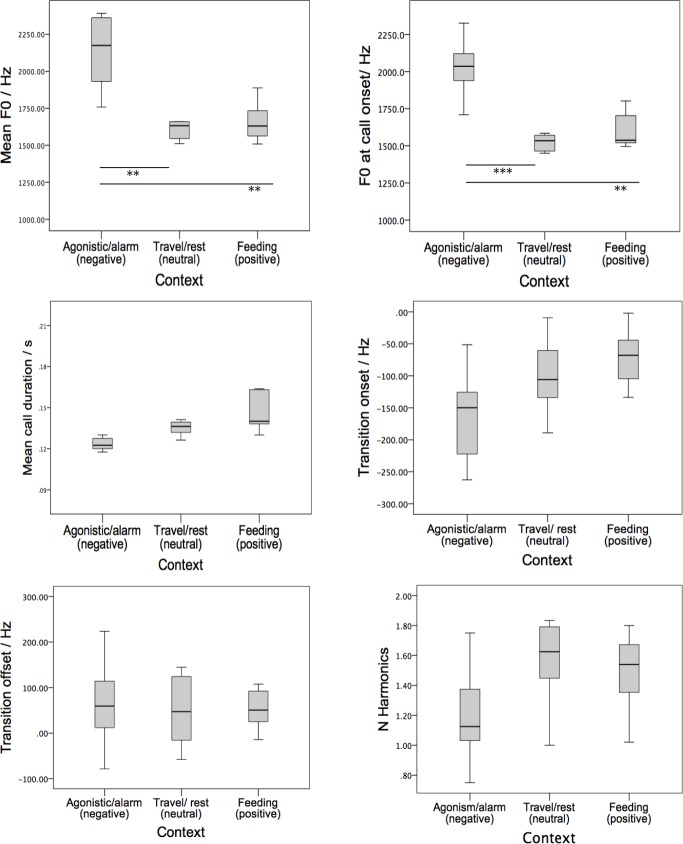
A shared principle in the evolution of language and the development of speech is the emergence of functional flexibility, the capacity of vocal signals to express a range of emotional states independently of context and biological function. Functional flexibility has recently been demonstrated in the vocalisations of pre-linguistic human infants, which has been contrasted to the functionally fixed vocal behaviour of non-human primates. Here, we revisited the presumed chasm in functional flexibility between human and non-human primate vocal behaviour, with a study on our closest living primate relatives, the bonobo (Pan paniscus). We found that wild bonobos use a specific call type (the "peep") across a range of contexts that cover the full valence range (positive-neutral-negative) in much of their daily activities, including feeding, travel, rest, aggression, alarm, nesting and grooming. Peeps were produced in functionally flexible ways in some contexts, but not others. Crucially, calls did not vary acoustically between neutral and positive contexts, suggesting that recipients take pragmatic information into account to make inferences about call meaning. In comparison, peeps during negative contexts were acoustically distinct. Our data suggest that the capacity for functional flexibility has evolutionary roots that predate the evolution of human speech. We interpret this evidence as an example of an evolutionary early transition away from fixed vocal signalling towards functional flexibility.
语言进化和言语发展中的一个共同原则是功能灵活性的出现,即声音信号能够独立于语境和生物学功能表达一系列情绪状态的能力。最近在处于语言前阶段的人类婴儿的发声中证实了功能灵活性,这与非人类灵长类动物功能固定的发声行为形成了对比。在这里,我们通过对现存与人类亲缘关系最近的灵长类动物倭黑猩猩(Pan paniscus)进行研究,重新审视了人类与非人类灵长类动物发声行为在功能灵活性方面假定的巨大差异。我们发现,野生倭黑猩猩在一系列情境中使用一种特定的叫声类型(“吱吱叫”),这些情境涵盖了它们日常活动中大部分的全效价范围(积极 - 中性 - 消极),包括进食、旅行、休息、攻击、警报、筑巢和梳理毛发。“吱吱叫”在某些情境中以功能灵活的方式发出,但在其他情境中并非如此。至关重要的是,在中性和积极情境之间叫声在声学上没有变化,这表明接收者会考虑语用信息来推断叫声的含义。相比之下,在消极情境中的“吱吱叫”在声学上是不同的。我们的数据表明,功能灵活性的能力具有早于人类言语进化的进化根源。我们将这一证据解释为从固定声音信号向功能灵活性进化早期转变的一个例子。