Kayser Lars, Karnoe Astrid, Furstrand Dorthe, Batterham Roy, Christensen Karl Bang, Elsworth Gerald, Osborne Richard H
Department of Public Health, University of Copenhagen, Copenhagen, Denmark.
The Danish Multiple Sclerosis Society, Valby, Denmark.
J Med Internet Res. 2018 Feb 12;20(2):e36. doi: 10.2196/jmir.8371.
For people to be able to access, understand, and benefit from the increasing digitalization of health services, it is critical that services are provided in a way that meets the user's needs, resources, and competence.
The objective of the study was to develop a questionnaire that captures the 7-dimensional eHealth Literacy Framework (eHLF).
Draft items were created in parallel in English and Danish. The items were generated from 450 statements collected during the conceptual development of eHLF. In all, 57 items (7 to 9 items per scale) were generated and adjusted after cognitive testing. Items were tested in 475 people recruited from settings in which the scale was intended to be used (community and health care settings) and including people with a range of chronic conditions. Measurement properties were assessed using approaches from item response theory (IRT) and classical test theory (CTT) such as confirmatory factor analysis (CFA) and reliability using composite scale reliability (CSR); potential bias due to age and sex was evaluated using differential item functioning (DIF).
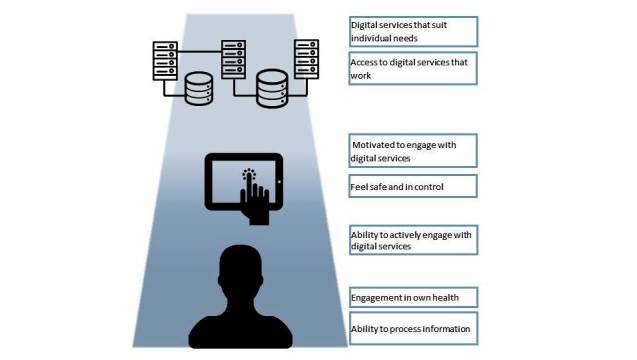
CFA confirmed the presence of the 7 a priori dimensions of eHLF. Following item analysis, a 35-item 7-scale questionnaire was constructed, covering (1) using technology to process health information (5 items, CSR=.84), (2) understanding of health concepts and language (5 items, CSR=.75), (3) ability to actively engage with digital services (5 items, CSR=.86), (4) feel safe and in control (5 items, CSR=.87), (5) motivated to engage with digital services (5 items, CSR=.84), (6) access to digital services that work (6 items, CSR=.77), and (7) digital services that suit individual needs (4 items, CSR=.85). A 7-factor CFA model, using small-variance priors for cross-loadings and residual correlations, had a satisfactory fit (posterior productive P value: .27, 95% CI for the difference between the observed and replicated chi-square values: -63.7 to 133.8). The CFA showed that all items loaded strongly on their respective factors. The IRT analysis showed that no items were found to have disordered thresholds. For most scales, discriminant validity was acceptable; however, 2 pairs of dimensions were highly correlated; dimensions 1 and 5 (r=.95), and dimensions 6 and 7 (r=.96). All dimensions were retained because of strong content differentiation and potential causal relationships between these dimensions. There is no evidence of DIF.
The eHealth Literacy Questionnaire (eHLQ) is a multidimensional tool based on a well-defined a priori eHLF framework with robust properties. It has satisfactory evidence of construct validity and reliable measurement across a broad range of concepts (using both CTT and IRT traditions) in various groups. It is designed to be used to understand and evaluate people's interaction with digital health services.
为了使人们能够获取、理解并受益于日益数字化的健康服务,以满足用户需求、资源和能力的方式提供服务至关重要。
本研究的目的是开发一份能够体现7维电子健康素养框架(eHLF)的问卷。
用英语和丹麦语并行创建问卷初稿。这些条目源自eHLF概念开发过程中收集的450条陈述。总共生成了57个条目(每个维度7至9个条目),并在认知测试后进行了调整。对从预期使用该量表的场所(社区和医疗保健场所)招募的475人进行了测试,这些人包括患有一系列慢性病的患者。使用项目反应理论(IRT)和经典测试理论(CTT)的方法评估测量属性,如验证性因素分析(CFA)以及使用复合量表信度(CSR)评估信度;使用差异项目功能(DIF)评估年龄和性别导致的潜在偏差。
CFA证实了eHLF的7个先验维度的存在。经过项目分析,构建了一份包含35个条目的7分量表问卷,涵盖(1)使用技术处理健康信息(5个条目,CSR = 0.84),(2)对健康概念和语言的理解(5个条目,CSR = 0.75),(3)积极参与数字服务的能力(5个条目,CSR = 0.86),(4)感到安全并能掌控(5个条目,CSR = 0.87),(5)参与数字服务的动机(5个条目,CSR = 0.84),(6)能够使用有效的数字服务(六个条目,CSR = 0.77),以及(7)适合个人需求的数字服务(4个条目,CSR = 0.85)。一个7因素CFA模型,使用交叉载荷和残差相关性的小方差先验,拟合效果令人满意(后验有效P值:0.27,观察到的与复制的卡方值之差的95%置信区间:-63.7至133.8)。CFA表明所有条目在各自的因素上有很强的载荷。IRT分析表明没有发现条目有紊乱的阈值。对于大多数量表,区分效度是可以接受的;然而,有两对维度高度相关;维度1和5(r = 0.95),以及维度6和7(r = 0.96)。由于这些维度之间有很强的内容差异和潜在的因果关系,所有维度都被保留。没有DIF的证据。
电子健康素养问卷(eHLQ)是一种基于定义明确的先验eHLF框架的多维工具,具有稳健的属性。它在各种群体中,在广泛的概念范围内(使用CTT和IRT传统),具有令人满意的结构效度和可靠测量的证据。它旨在用于理解和评估人们与数字健康服务的互动。
