Wan Jianji, Yang Jie, Huang Yueshen, Deng Liehua
Department of Dermatology, The First Affiliated Hospital of Jinan University, Guangzhou, Guangdong 510632, P.R. China.
Department of Dermatology, Guangdong General Hospital, Guangdong Academy of Medical Science, Guangzhou, Guangdong 510080, P.R. China.
Oncol Lett. 2018 Feb;15(2):1475-1482. doi: 10.3892/ol.2017.7445. Epub 2017 Nov 20.
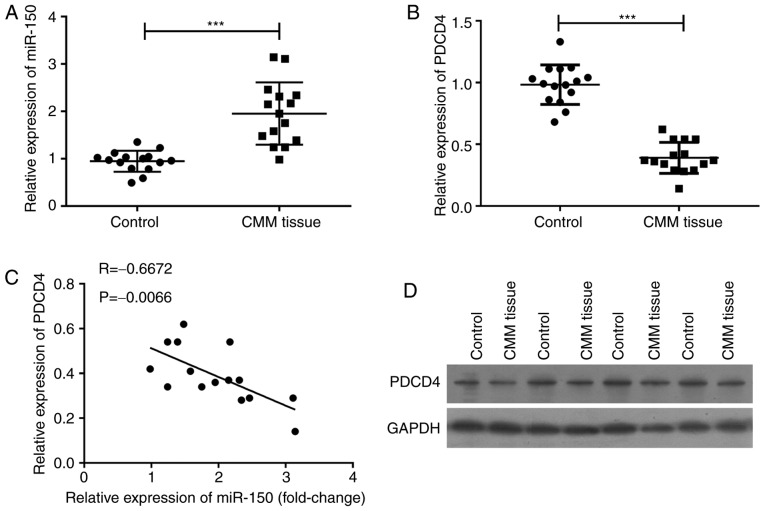
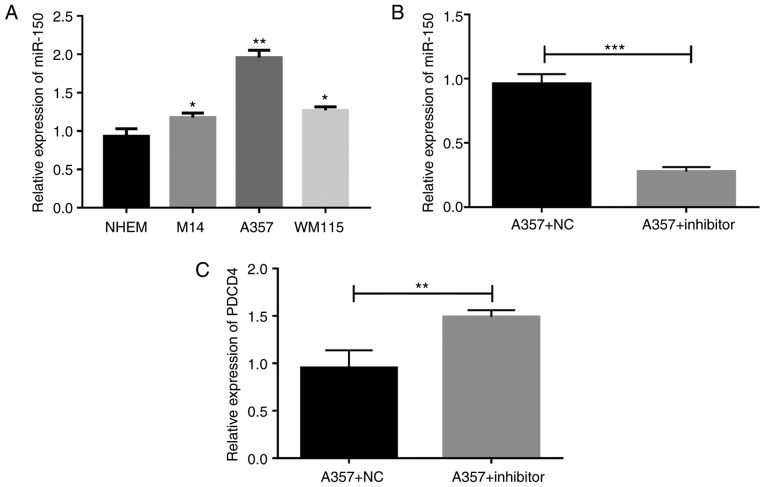
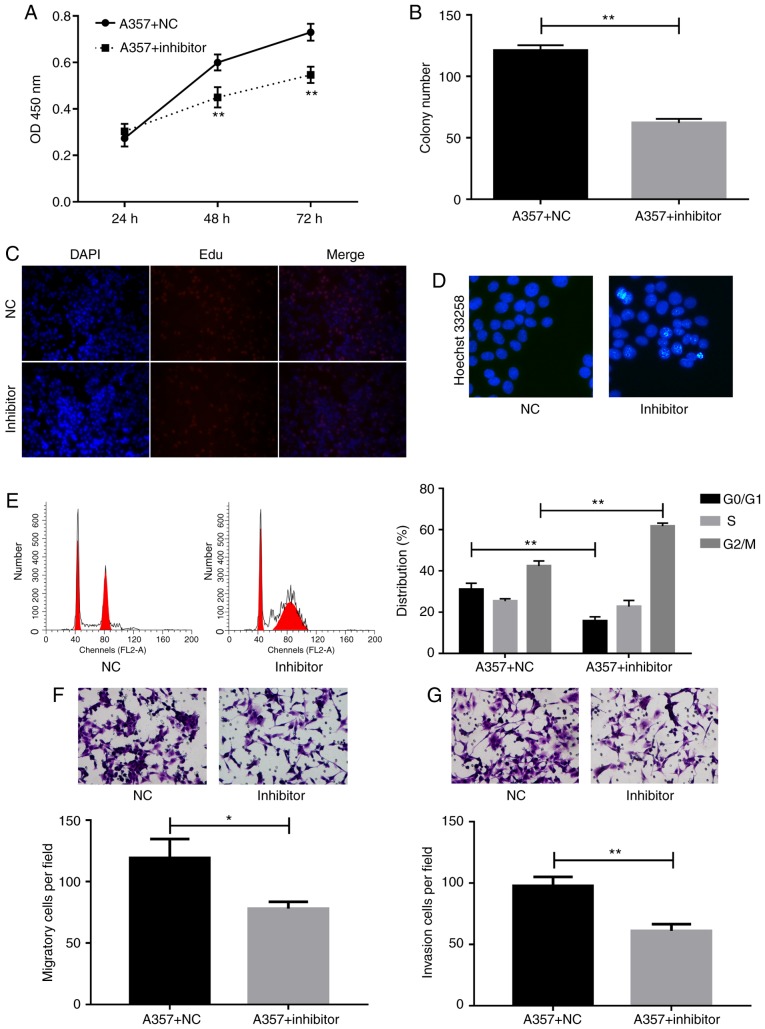
Malignant melanoma is a tumor with a high mortality rate. Previous studies have demonstrated that the oncogenesis of melanoma is associated with microRNA (miR)-150. However, the role of miR-150 in melanoma and its regulatory mechanisms are still unclear. In the present study, melanoma cancer tissues and adjacent normal tissues were obtained from 20 melanoma patients. The expression level of miR-150 in melanoma tissue and cell lines was detected by reverse transcription-quantitative polymerase chain reaction. miR-150 inhibitors/negative control were transfected into melanoma A375 cells in order to investigate the effects of miR-150 on cell proliferation, apoptosis, cell cycle migration and invasion using a Cell Counting Kit-8, colony formation, Hoechst 33528, flow cytometry, and Transwell assays. The association between miR-150 and programmed cell death protein-4 (PDCD4) was detected by a dual luciferase reporter assay. The functional role of PDCD4 in miR-150-affected melanoma cells was confirmed by small interfering (si)RNA knockdown. Results demonstrated that miR-150 was significantly upregulated and mRNA and protein expressions of PDCD4 were decreased in melanoma cancer tissues as compared with adjacent normal tissues. The level of PDCD4 was inversely associated with the level of miR-150. Transfection of miR-150 inhibitors suppressed cell proliferation, migration, and invasion, while the apoptosis of cells was promoted and G2/M cell arrest was induced. MiR-150 inhibitors enhanced the expression of caspase-8 and p21. The PDCD4 was identified as a direct target gene of miR-150. The effects of miR-150 inhibitors on apoptosis and apoptosis-associated proteins, including caspase-8 and p21, of A375 cells, were reversed following transfection of siRNA-PDCD4. Therefore, miR-150 inhibitors enhance cell apoptosis via upregulation of PDCD4-mediated activation of caspase-8 and p21. These findings demonstrate the potential for a promising therapeutic strategy in the management of melanoma.
恶性黑色素瘤是一种死亡率很高的肿瘤。先前的研究表明,黑色素瘤的肿瘤发生与微小RNA(miR)-150有关。然而,miR-150在黑色素瘤中的作用及其调控机制仍不清楚。在本研究中,从20例黑色素瘤患者中获取黑色素瘤癌组织和相邻正常组织。通过逆转录-定量聚合酶链反应检测miR-150在黑色素瘤组织和细胞系中的表达水平。将miR-150抑制剂/阴性对照转染到黑色素瘤A375细胞中,以便使用细胞计数试剂盒-8、集落形成、Hoechst 33528、流式细胞术和Transwell实验研究miR-150对细胞增殖、凋亡、细胞周期迁移和侵袭的影响。通过双荧光素酶报告基因实验检测miR-150与程序性细胞死亡蛋白4(PDCD4)之间的关联。通过小干扰(si)RNA敲低证实了PDCD4在受miR-150影响的黑色素瘤细胞中的功能作用。结果表明,与相邻正常组织相比,黑色素瘤癌组织中miR-150显著上调,PDCD4的mRNA和蛋白表达降低。PDCD4的水平与miR-150的水平呈负相关。转染miR-150抑制剂可抑制细胞增殖、迁移和侵袭,同时促进细胞凋亡并诱导G2/M期细胞阻滞。miR-150抑制剂增强了半胱天冬酶-8和p21的表达。PDCD4被鉴定为miR-150的直接靶基因。转染siRNA-PDCD4后,miR-150抑制剂对A375细胞凋亡及凋亡相关蛋白(包括半胱天冬酶-8和p21)的影响被逆转。因此,miR-150抑制剂通过上调PDCD4介导的半胱天冬酶-8和p21的激活来增强细胞凋亡。这些发现证明了在黑色素瘤治疗中一种有前景的治疗策略的潜力。