Department of Food Analysis, Prof. Waclaw Dabrowski Institute of Agricultural and Food Biotechnology, Rakowiecka 36, 02-532 Warsaw, Poland.
Department of Chemistry, Poznan University of Life Sciences, Wojska Polskiego 75, 60-625 Poznan, Poland.
Toxins (Basel). 2018 Feb 13;10(2):81. doi: 10.3390/toxins10020081.
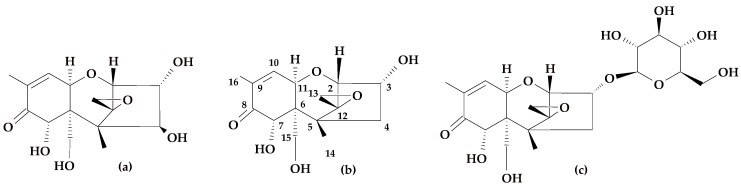
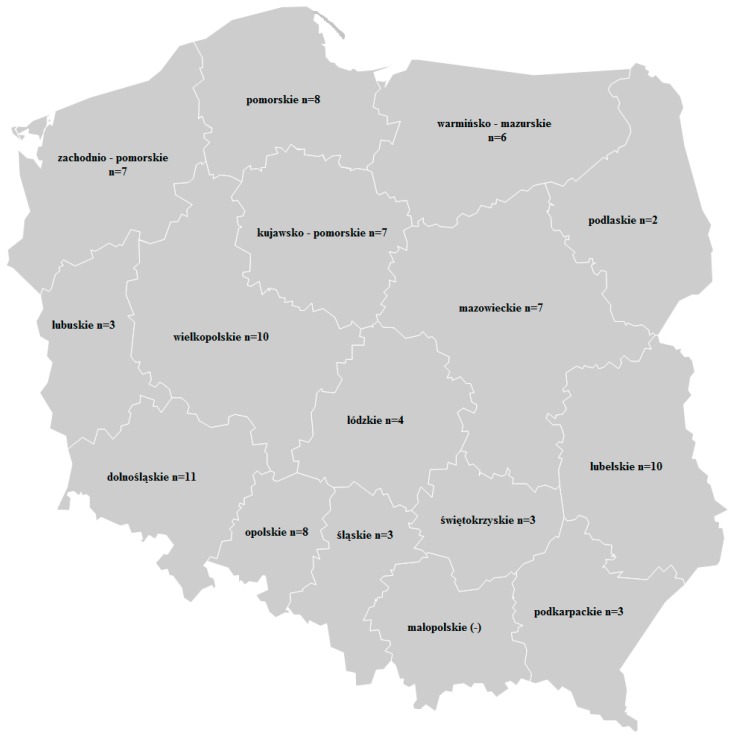
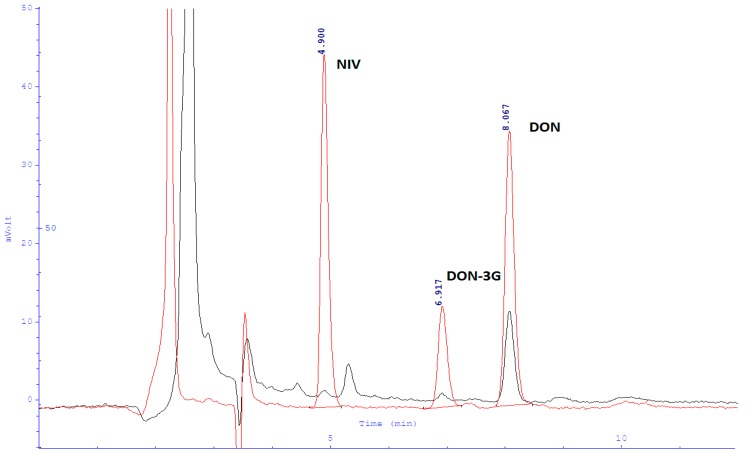
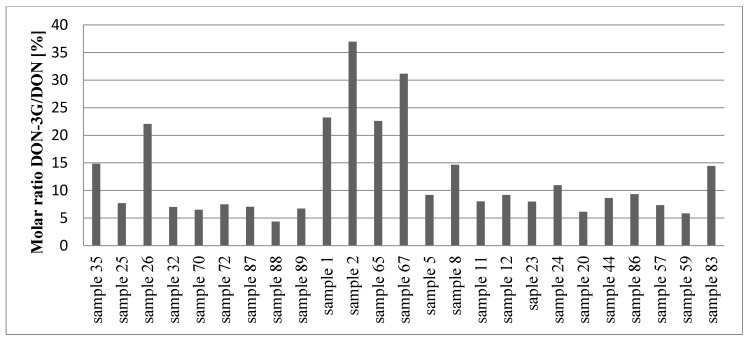
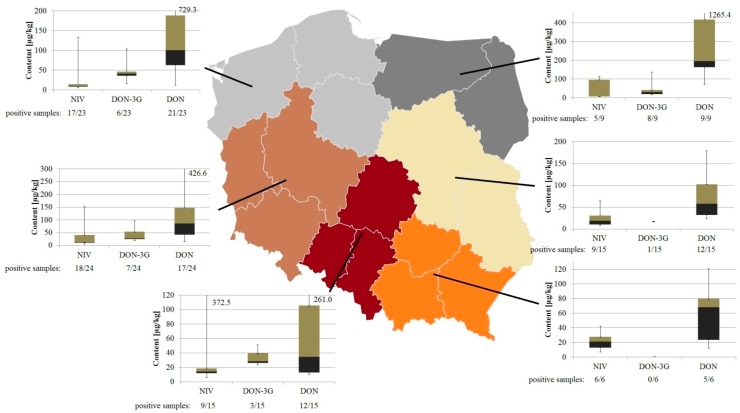
The presence of mycotoxins in cereal grain is a very important food safety factor. The occurrence of "masked" mycotoxins has been intensively investigated in recent years. In this study, the occurrence of nivalenol, deoxynivalenol-3-glucoside, and deoxynivalenol in 92 samples of winter wheat from Polish cultivars was determined. The frequency of the occurrence of deoxynivalenol and nivalenol in the samples was 83% and 70%, respectively. The average content of the analytes was: for deoxynivalenol 140.2 µg/kg (10.5-1265.4 µg/kg), for nivalenol 35.0 µg/kg (5.1-372.5 µg/kg). Deoxynivalenol-3-glucoside, the formation of which is connected with the biotransformation pathway in plants, was present in 27% of tested wheat samples; its average content was 41.9 µg/kg (15.8-137.5 µg/kg). The relative content of deoxynivalenol-3-glucoside (DON-3G) compared to deoxynivalenol (DON) in positive samples was 4-37%. Despite the high frequency of occurrence of these mycotoxins, the quality of wheat from the 2016 season was good. The maximum content of DON, as defined in EU regulations (1250 µg/kg), was exceeded in only one sample. Nevertheless, the presence of a glycosidic derivative of deoxynivalenol can increase the risk to food safety, as it can be hydrolyzed by intestinal microflora.
真菌毒素在谷物中的存在是一个非常重要的食品安全因素。近年来,人们对“掩蔽”真菌毒素的发生进行了深入研究。在这项研究中,测定了波兰品种 92 份冬小麦样本中雪腐镰刀菌烯醇、脱氧雪腐镰刀菌烯醇-3-葡萄糖苷和脱氧雪腐镰刀菌烯醇的含量。样品中脱氧雪腐镰刀菌烯醇和雪腐镰刀菌烯醇的出现频率分别为 83%和 70%。分析物的平均含量为:脱氧雪腐镰刀菌烯醇 140.2 µg/kg(10.5-1265.4 µg/kg),雪腐镰刀菌烯醇 35.0 µg/kg(5.1-372.5 µg/kg)。脱氧雪腐镰刀菌烯醇-3-葡萄糖苷的形成与植物中的生物转化途径有关,在 27%的测试小麦样品中存在;其平均含量为 41.9 µg/kg(15.8-137.5 µg/kg)。阳性样品中脱氧雪腐镰刀菌烯醇-3-葡萄糖苷(DON-3G)与脱氧雪腐镰刀菌烯醇(DON)的相对含量为 4-37%。尽管这些真菌毒素的出现频率很高,但 2016 年小麦的质量良好。只有一个样品的 DON 含量超过了欧盟法规(1250 µg/kg)规定的最大值。然而,脱氧雪腐镰刀菌烯醇糖苷衍生物的存在可能会增加食品安全风险,因为它可以被肠道微生物群水解。