Wu Ming-Li, Li Qing, Xu Jiang, Li Xi-Wen
1Institute of Chinese Materia Medica, China Academy of Chinese Medical Sciences, Dongcheng District, Dongzhimen Nanxiaojie within 16, Beijing, 100700 China.
2Pharmacy Faculty, Hubei University of Chinese Medicine, No. 1, Huangjiahu West Road, Hongshan District, Wuhan, 430065 Hubei China.
Chin Med. 2018 Feb 13;13:10. doi: 10.1186/s13020-018-0164-2. eCollection 2018.
is one of the basic species of the traditional herbal medicine amomi fructus rotundus, with great pharmacology effect. The system position of is not clear yet, and the introduction of this plant has been hindered by many plant diseases. However, the correlational molecular studies are relatively scarce.
The total chloroplast (cp) DNA was extracted according to previous studies, and then sequenced by 454 GS FLX Titanium platform. Sequence assembly was complished by Newbler. Genome annotation was preformed by CPGAVAS and tRNA-SCAN. Then, general characteristics of the cp genome and genome comparsion with three Zingiberaceae species was analyzed by corresponding softwares. Additionally, phylogenetical trees were reconstructed, based on the shared protein-coding gene sequences among 15 plant taxa by maximum parsimony (MP) and maximum likelihood (ML) methods.
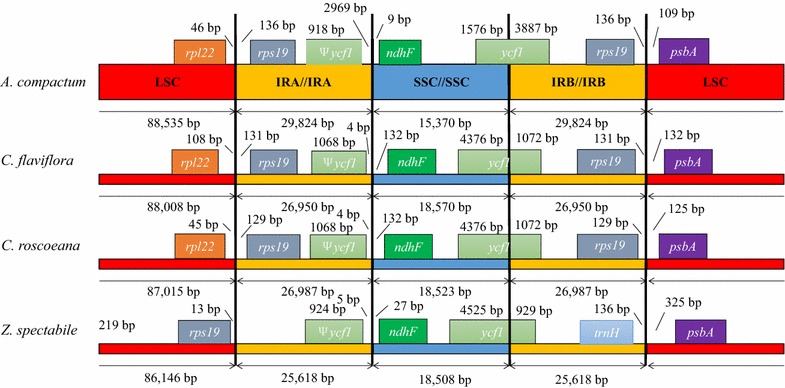
The cp genome with a classic quadripartite structure, consisting of a pair of reverse complement repeat regions (IRa/IRb) of 29,824 bp, a large single copy (LSC, 88,535 bp) region as well as a small single copy (SSC, 15,370 bp) region, is 163,553 bp in total size. The total GC content of this cp genome is 36.0%. The cp genome owns 135 functional genes, that 113 genes are unique, containing eighty protein-coding genes, twenty-nine tRNA (transfer RNA) genes and four rRNA (ribosomal RNA) genes. Codon usage of the cp genome is biased toward codons ending with A/T. Total 58 SSR loci and 24 large repeats are detected in the cp genome. Relative to three other Zingiberaceae cp genomes, the cp genome exhibits an obvious expansion in the IR regions. In cp genome, the pseudogene is 2969 bp away from the IRa/SSC border, whereas in other Zingiberaceae species, it is only 4-5 bp away from the IRa/SSC border. Comparative cp genome sequences analysis of with other Zingiberaceae reveals that the gene order and gene content differ slightly among Zingiberaceae species. The phylogenetic analysis based on 67 protein-coding gene sequences supports the phylogenetic position of .
The study has identified unique features of the cp genome which would be helpful for us to understand the cp genome evolution and offer useful information for phylogenetics and further studies of this traditional medicinal plant.
是传统草药砂仁的基本物种之一,具有重要的药理作用。其系统位置尚不清楚,且该植物的引种受到多种植物病害的阻碍。然而,相关的分子研究相对较少。
根据先前的研究提取总叶绿体(cp)DNA,然后通过454 GS FLX Titanium平台进行测序。序列组装由Newbler完成。基因组注释由CPGAVAS和tRNA-SCAN进行。然后,通过相应软件分析该cp基因组的一般特征以及与三种姜科植物的基因组比较。此外,基于15个植物类群之间共享的蛋白质编码基因序列,通过最大简约法(MP)和最大似然法(ML)重建系统发育树。
该cp基因组具有经典的四分体结构,由一对29,824 bp的反向互补重复区域(IRa/IRb)、一个大单拷贝(LSC,88,535 bp)区域以及一个小单拷贝(SSC,15,370 bp)区域组成,总大小为163,553 bp。该cp基因组的总GC含量为36.0%。该cp基因组拥有135个功能基因,其中113个基因是独特的,包括80个蛋白质编码基因、29个tRNA(转移RNA)基因和4个rRNA(核糖体RNA)基因。该cp基因组的密码子使用偏向于以A/T结尾的密码子。在该cp基因组中总共检测到58个SSR位点和24个大重复序列。相对于其他三种姜科植物的cp基因组,该cp基因组在IR区域表现出明显的扩张。在该cp基因组中,假基因距离IRa/SSC边界2969 bp,而在其他姜科植物物种中,它距离IRa/SSC边界仅4 - 5 bp。与其他姜科植物的cp基因组序列比较分析表明,姜科植物物种之间的基因顺序和基因含量略有不同。基于67个蛋白质编码基因序列的系统发育分析支持了该植物的系统发育位置。
该研究确定了该cp基因组的独特特征,这将有助于我们理解cp基因组的进化,并为该传统药用植物的系统发育学和进一步研究提供有用信息。