Lee Se Yeong, Lee Yunki, Le Thi Phuong, Oh Dong Hwan, Park Ki Dong
Department of Molecular Science and Technology, Ajou University, San 5, Woncheon, Yeongtong, Suwon, 16499 Republic of Korea.
Biomater Res. 2018 Feb 12;22:3. doi: 10.1186/s40824-017-0113-7. eCollection 2018.
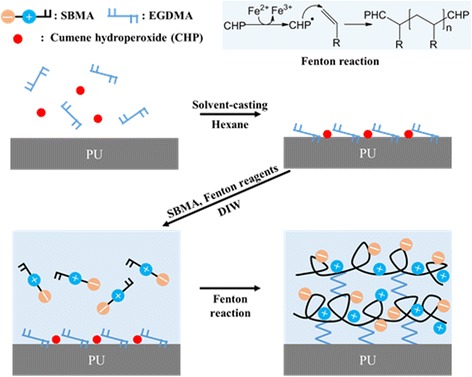
Zwitterionic molecules have been widely studied as coating materials for preparing anti-fouling surfaces because they possess strong hydration properties that can resist non-specific protein adsorption. Numerous studies on surface modification using zwitterionic molecules have been investigated, such as electrochemically mediated and photoinitiated radical polymerization. However, these methods have some limitations, including multi-step process, difficulties in producing thick and dense layers as well as the requirement of extra facilities. In this study, we report a novel zwitterionic hydrogel-coating method via Fenton reaction for the preparation of anti-fouling surfaces.
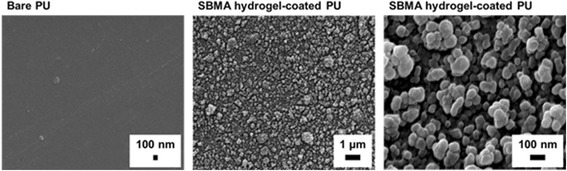
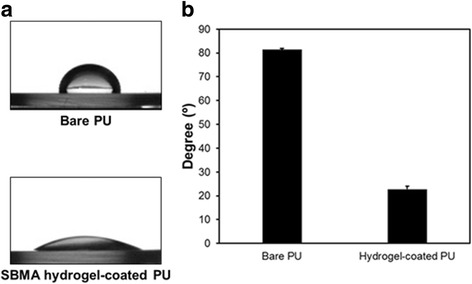
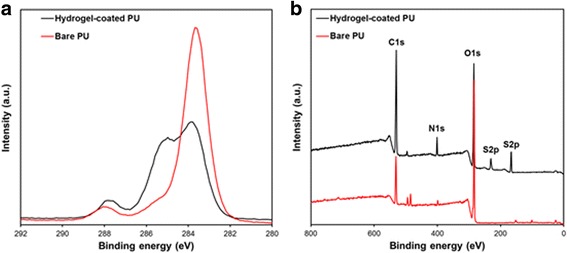
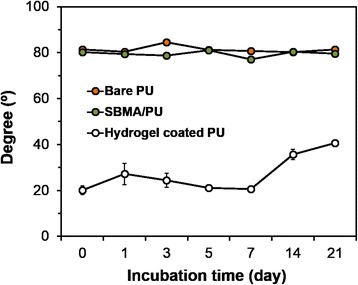
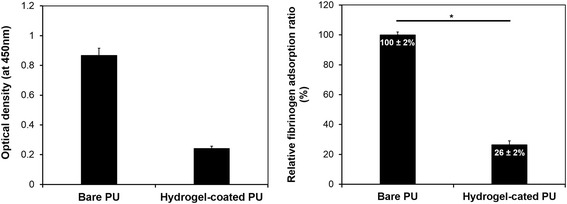
Sulfobetaine methacrylate (SBMA) hydrogel was coated on polyurethane (PU) by polymerization of SBMA molecules via the Fenton reaction. The coated surfaces were characterized by the measurements of water contact angle, SEM and XPS. The anti-fouling properties of the modified surfaces were evaluated by reductions of fibrinogen absorption and cell (human dermal fibroblasts, hDFBs) adhesion.
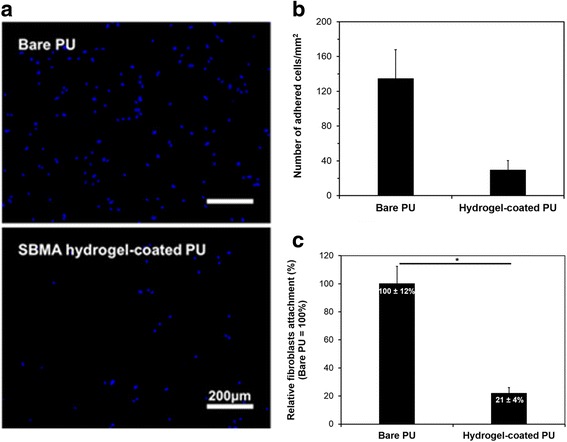
SBMA hydrogel layers were coated on the PU substrates and these layers have a high affinity for water. The hydrogel coatings were highly stable for 7 days, without a significant change in surface wettability. Importantly, the hydrogel-coated PU substrates decrease 80% of surface-adsorbed fibrinogen and surface-attached hDFBs (compared with uncoated PU substrates), indicating the excellent anti-fouling activities of modified surfaces.
The hydrogel-coated PU surfaces prepared by Fenton reaction with anti-fouling properties could have potential uses for implantable biomedical devices.
两性离子分子作为制备防污表面的涂层材料已被广泛研究,因为它们具有强大的水合特性,能够抵抗非特异性蛋白质吸附。关于使用两性离子分子进行表面改性的众多研究已被开展,例如电化学介导和光引发自由基聚合。然而,这些方法存在一些局限性,包括多步骤过程、难以制备厚且致密的层以及需要额外的设备。在本研究中,我们报道了一种通过芬顿反应制备防污表面的新型两性离子水凝胶涂层方法。
通过芬顿反应使甲基丙烯酸磺酸甜菜碱(SBMA)分子聚合,将SBMA水凝胶涂覆在聚氨酯(PU)上。通过测量水接触角、扫描电子显微镜(SEM)和X射线光电子能谱(XPS)对涂覆表面进行表征。通过纤维蛋白原吸附减少和细胞(人皮肤成纤维细胞,hDFBs)粘附来评估改性表面的防污性能。
SBMA水凝胶层涂覆在PU基材上,这些层对水具有高亲和力。水凝胶涂层在7天内高度稳定,表面润湿性没有显著变化。重要的是,水凝胶涂覆的PU基材使表面吸附的纤维蛋白原和表面附着的hDFBs减少了80%(与未涂覆的PU基材相比),表明改性表面具有优异的防污活性。
通过芬顿反应制备的具有防污性能的水凝胶涂覆PU表面可能在可植入生物医学装置中具有潜在用途。