Korevaar Daniël A, Cohen Jérémie F, Reitsma Johannes B, Bruns David E, Gatsonis Constantine A, Glasziou Paul P, Irwig Les, Moher David, de Vet Henrica C W, Altman Douglas G, Hooft Lotty, Bossuyt Patrick M M
1Department of Clinical Epidemiology, Biostatistics and Bioinformatics, Academic Medical Centre, University of Amsterdam, Amsterdam, The Netherlands.
2INSERM UMR 1153 and Department of Pediatrics, Necker Hospital, AP-HP, Paris Descartes University, Paris, France.
Res Integr Peer Rev. 2016 Jun 7;1:7. doi: 10.1186/s41073-016-0014-7. eCollection 2016.
Although the number of reporting guidelines has grown rapidly, few have gone through an updating process. The STARD statement (Standards for Reporting Diagnostic Accuracy), published in 2003 to help improve the transparency and completeness of reporting of diagnostic accuracy studies, was recently updated in a systematic way. Here, we describe the steps taken and a justification for the changes made.
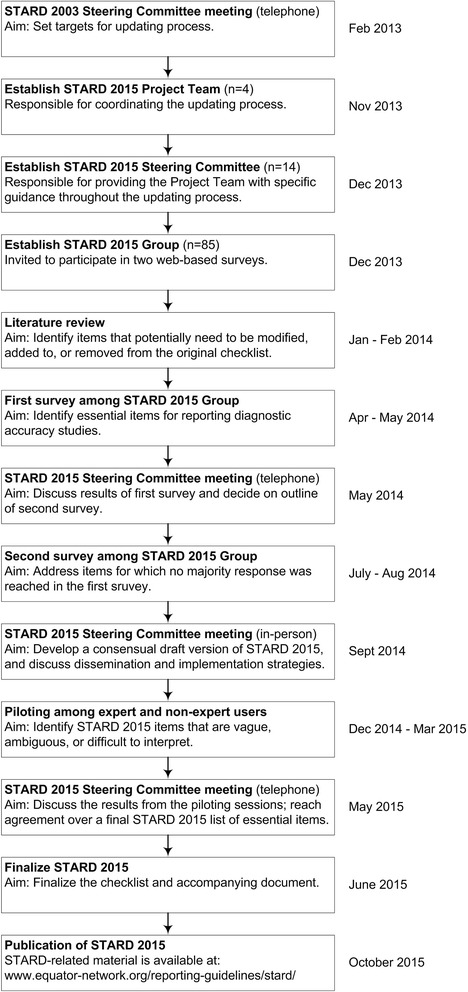
A 4-member Project Team coordinated the updating process; a 14-member Steering Committee was regularly solicited by the Project Team when making critical decisions. First, a review of the literature was performed to identify topics and items potentially relevant to the STARD updating process. After this, the 85 members of the STARD Group were invited to participate in two online surveys to identify items that needed to be modified, removed from, or added to the STARD checklist. Based on the results of the literature review process, 33 items were presented to the STARD Group in the online survey: 25 original items and 8 new items; 73 STARD Group members (86 %) completed the first survey, and 79 STARD Group members (93 %) completed the second survey.Then, an in-person consensus meeting was organized among the members of the Project Team and Steering Committee to develop a consensual draft version of STARD 2015. This version was piloted in three rounds among a total of 32 expert and non-expert users. Piloting mostly led to rewording of items. After this, the update was finalized. The updated STARD 2015 list now consists of 30 items. Compared to the previous version of STARD, three original items were each converted into two new items, four original items were incorporated into other items, and seven new items were added.
After a systematic updating process, STARD 2015 provides an updated list of 30 essential items for reporting diagnostic accuracy studies.
尽管报告指南的数量迅速增加,但很少有经过更新过程的。2003年发布的STARD声明(诊断准确性研究报告标准)旨在帮助提高诊断准确性研究报告的透明度和完整性,最近以系统的方式进行了更新。在此,我们描述了所采取的步骤以及所做更改的理由。
一个由4名成员组成的项目团队协调了更新过程;在做出关键决策时,项目团队定期征求一个由14名成员组成的指导委员会的意见。首先,进行了文献综述以确定可能与STARD更新过程相关的主题和项目。在此之后,邀请STARD小组的85名成员参与两项在线调查,以确定需要修改、从STARD清单中删除或添加的项目。根据文献综述过程的结果,在在线调查中向STARD小组提出了33个项目:25个原始项目和8个新项目;73名STARD小组成员(86%)完成了第一次调查,79名STARD小组成员(93%)完成了第二次调查。然后,在项目团队和指导委员会成员之间组织了一次面对面的共识会议,以制定STARD 2015的共识草案版本。该版本在总共32名专家和非专家用户中进行了三轮试点。试点主要导致了项目措辞的重新调整。在此之后,更新最终确定。更新后的STARD 2015清单现在由30个项目组成。与STARD的先前版本相比,三个原始项目各自被转换为两个新项目,四个原始项目被纳入其他项目,并且添加了七个新项目。
经过系统的更新过程,STARD 2015提供了一份更新的清单,其中包含30个报告诊断准确性研究的基本项目。