Hyde Lisa L, Boyes Allison W, Evans Tiffany-Jane, Mackenzie Lisa J, Sanson-Fisher Rob
Health Behaviour Research Collaborative, School of Medicine and Public Health, Faculty of Health and Medicine, University of Newcastle, Callaghan, Australia.
Priority Research Centre for Health Behaviour, University of Newcastle, Callaghan, Australia.
JMIR Hum Factors. 2018 Feb 19;5(1):e6. doi: 10.2196/humanfactors.9039.
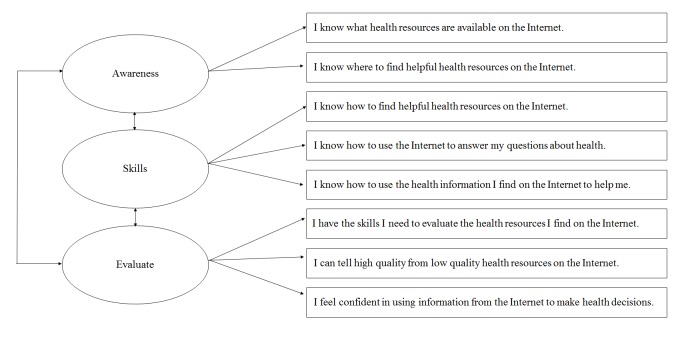
Electronic health (eHealth) literacy is needed to effectively engage with Web-based health resources. The 8-item eHealth literacy scale (eHEALS) is a commonly used self-report measure of eHealth literacy. Accumulated evidence has suggested that the eHEALS is unidimensional. However, a recent study by Sudbury-Riley and colleagues suggested that a theoretically-informed three-factor model fit better than a one-factor model. The 3 factors identified were awareness (2 items), skills (3 items), and evaluate (3 items). It is important to determine whether these findings can be replicated in other populations.
The aim of this cross-sectional study was to verify the three-factor eHEALS structure among magnetic resonance imaging (MRI) and computed tomography (CT) medical imaging outpatients.
MRI and CT outpatients were recruited consecutively in the waiting room of one major public hospital. Participants self-completed a touchscreen computer survey, assessing their sociodemographic, scan, and internet use characteristics. The eHEALS was administered to internet users, and the three-factor structure was tested using structural equation modeling.
Of 405 invited patients, 87.4% (354/405) were interested in participating in the study, and of these, 75.7% (268/354) were eligible. Of the eligible participants, 95.5% (256/268) completed all eHEALS items. Factor loadings were 0.80 to 0.94 and statistically significant (P<.001). All reliability measures were acceptable (indicator reliability: awareness=.71-.89, skills=.78-.80, evaluate=.64-.79; composite reliability: awareness=.89, skills=.92, evaluate=.89; variance extracted estimates: awareness=.80, skills=.79, evaluate=.72). Two out of three goodness-of-fit indices were adequate (standardized root mean square residual (SRMR)=.038; comparative fit index (CFI)=.944; root mean square error of approximation (RMSEA)=.156). Item 3 was removed because of its significant correlation with item 2 (Lagrange multiplier [LM] estimate 104.02; P<.001) and high loading on 2 factors (LM estimate 91.11; P<.001). All 3 indices of the resulting 7-item model indicated goodness of fit (χ=11.3; SRMR=.013; CFI=.999; RMSEA=.011).
The three-factor eHEALS structure was supported in this sample of MRI and CT medical imaging outpatients. Although further factorial validation studies are needed, these 3 scale factors may be used to identify individuals who could benefit from interventions to improve eHealth literacy awareness, skill, and evaluation competencies.
要有效利用基于网络的健康资源,需要具备电子健康(eHealth)素养。8项电子健康素养量表(eHEALS)是常用的电子健康素养自我报告测量工具。已有证据表明eHEALS是单维的。然而,萨德伯里 - 莱利及其同事最近的一项研究表明,一个理论上合理的三因素模型比单因素模型拟合得更好。确定的3个因素为意识(2项)、技能(3项)和评估(3项)。确定这些发现是否能在其他人群中得到重复验证很重要。
本横断面研究的目的是在磁共振成像(MRI)和计算机断层扫描(CT)医学影像门诊患者中验证三因素eHEALS结构。
在一家大型公立医院的候诊室连续招募MRI和CT门诊患者。参与者通过触摸屏电脑自行完成一项调查,评估其社会人口统计学、扫描及互联网使用特征。对互联网用户施测eHEALS,并使用结构方程模型测试三因素结构。
在405名受邀患者中,87.4%(354/405)有兴趣参与研究,其中75.7%(268/354)符合条件。在符合条件的参与者中,95.5%(256/268)完成了所有eHEALS项目。因子载荷为0.80至0.94,且具有统计学意义(P<0.001)。所有信度指标均可接受(指标信度:意识=0.71 - 0.89,技能=0.78 - 0.80,评估=0.64 - 0.79;组合信度:意识=0.89,技能=0.92,评估=0.89;提取方差估计值:意识=0.80,技能=0.79,评估=0.72)。三个拟合优度指标中有两个是合适的(标准化残差均方根(SRMR)=0.038;比较拟合指数(CFI)=0.944;近似误差均方根(RMSEA)=0.156)。由于第3项与第2项显著相关(拉格朗日乘数[LM]估计值104.02;P<0.001)且在两个因子上载荷较高(LM估计值91.11;P<0.001),故将其删除。所得7项模型的所有3个指标均显示拟合良好(χ=11.3;SRMR=0.013;CFI=0.999;RMSEA=0.011)。
在这个MRI和CT医学影像门诊患者样本中,三因素eHEALS结构得到了支持。尽管还需要进一步的因子验证研究,但这3个量表因子可用于识别那些可能从提高电子健康素养意识、技能和评估能力的干预措施中获益的个体。