Ienca Marcello, Vayena Effy, Blasimme Alessandro
Health Ethics and Policy Laboratory, Department of Health Sciences and Technology, ETH Zurich, Zurich, Switzerland.
Front Med (Lausanne). 2018 Feb 6;5:13. doi: 10.3389/fmed.2018.00013. eCollection 2018.
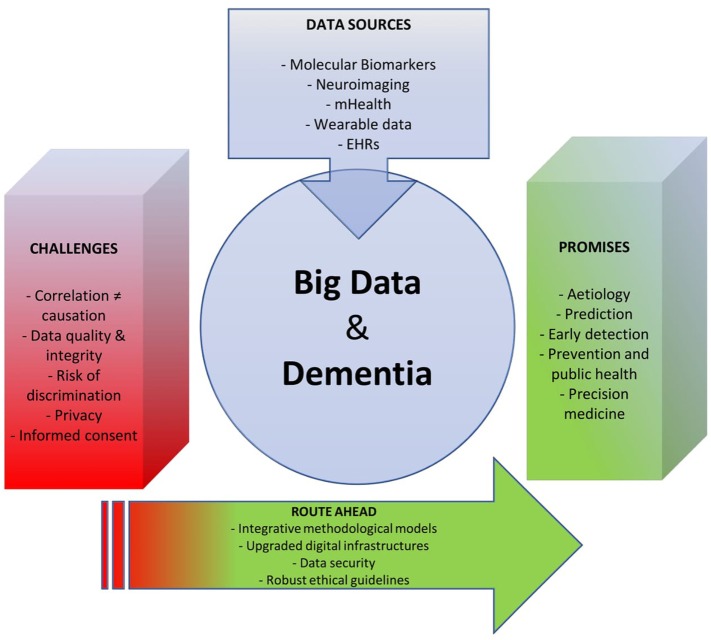
Emerging trends in pervasive computing and medical informatics are creating the possibility for large-scale collection, sharing, aggregation and analysis of unprecedented volumes of data, a phenomenon commonly known as big data. In this contribution, we review the existing scientific literature on big data approaches to dementia, as well as commercially available mobile-based applications in this domain. Our analysis suggests that big data approaches to dementia research and care hold promise for improving current preventive and predictive models, casting light on the etiology of the disease, enabling earlier diagnosis, optimizing resource allocation, and delivering more tailored treatments to patients with specific disease trajectories. Such promissory outlook, however, has not materialized yet, and raises a number of technical, scientific, ethical, and regulatory challenges. This paper provides an assessment of these challenges and charts the route ahead for research, ethics, and policy.
普适计算和医学信息学的新兴趋势为大规模收集、共享、聚合和分析前所未有的大量数据创造了可能性,这一现象通常被称为大数据。在本论文中,我们回顾了关于痴呆症大数据方法的现有科学文献,以及该领域现有的基于移动设备的商业应用。我们的分析表明,痴呆症研究和护理的大数据方法有望改进当前的预防和预测模型,阐明疾病的病因,实现早期诊断,优化资源分配,并为具有特定疾病轨迹的患者提供更具针对性的治疗。然而,这种充满希望的前景尚未实现,并引发了一些技术、科学、伦理和监管方面的挑战。本文对这些挑战进行了评估,并规划了研究、伦理和政策的未来发展方向。