Merritt David C, Jamnik Joseph, El-Sohemy Ahmed
Department of Nutritional Sciences, University of Toronto, 150 College Street, Room 350, Toronto, Ontario M5S 3E2 Canada.
Genes Nutr. 2018 Feb 20;13:4. doi: 10.1186/s12263-018-0593-7. eCollection 2018.
Variation in the fat mass and obesity-associated gene () has been associated with susceptibility to obesity, but the association appears to be modified by diet. We investigated whether dietary protein intake modifies the association between variant rs1558902 and body mass index (BMI) and waist circumference in young adults ( = 1491) from the cross-sectional Toronto Nutrigenomics and Health Study.
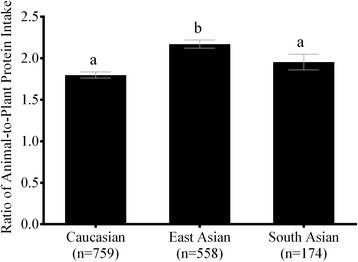
Lifestyle, genetic, anthropometric, and biochemical data were collected and diet was assessed using a Toronto-modified Willett Food Frequency Questionnaire. General linear models stratified by ethnicity and adjusted for age, sex, and total energy intake were used to examine the association between FTO genotypes and measures of body weight, and whether protein intake modified any of the associations. East Asians who were homozygous for the rs1558902 risk allele (A) had a greater BMI ( = 0.004) and waist circumference ( = 0.03) than T allele carriers. This association was not observed in individuals of Caucasian or South Asian ancestry. Among East Asians, a significant FTO-protein interaction was observed for BMI ( = 0.01) and waist circumference ( = 0.007). Those with low protein intake (≤ 18% total energy intake) who were homozygous for the rs1558902 risk allele (A) had significantly higher BMI ( < 0.0001) and waist circumference ( = 0.0006) compared to carriers of the T allele. These associations were absent in the high protein intake group (> 18% total energy intake). Compared to Caucasians and South Asians, East Asians consumed a significantly higher ratio of animal-to-plant protein ( < 0.05).
These findings suggest that high dietary protein intake may protect against the effects of risk variants in the gene on BMI and waist circumference.
脂肪量和肥胖相关基因(FTO)的变异与肥胖易感性有关,但这种关联似乎会受到饮食的影响。我们在多伦多营养基因组学与健康研究的横断面研究中,对1491名年轻人进行了调查,以探究膳食蛋白质摄入量是否会改变FTO基因变异rs1558902与体重指数(BMI)及腰围之间的关联。
收集了生活方式、基因、人体测量和生化数据,并使用多伦多改良的威尔特食物频率问卷评估饮食情况。采用按种族分层并对年龄、性别和总能量摄入进行调整的一般线性模型,来检验FTO基因型与体重指标之间的关联,以及蛋白质摄入量是否会改变这些关联。rs1558902风险等位基因(A)纯合的东亚人的BMI(P = 0.004)和腰围(P = 0.03)高于T等位基因携带者。在白种人或南亚血统个体中未观察到这种关联。在东亚人中,观察到BMI(P = 0.01)和腰围(P = 0.007)存在显著的FTO-蛋白质相互作用。rs1558902风险等位基因(A)纯合且蛋白质摄入量低(≤总能量摄入的18%)的个体,与T等位基因携带者相比,BMI显著更高(P < 0.0001),腰围也更大(P = 0.0006)。在高蛋白质摄入量组(>总能量摄入的18%)中,这些关联不存在。与白种人和南亚人相比,东亚人摄入的动植物蛋白比例显著更高(P < 0.05)。
这些发现表明,高膳食蛋白质摄入量可能会抵御FTO基因风险变异对BMI和腰围的影响。